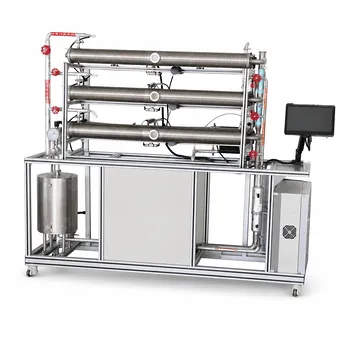
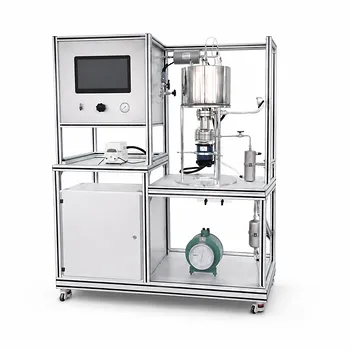
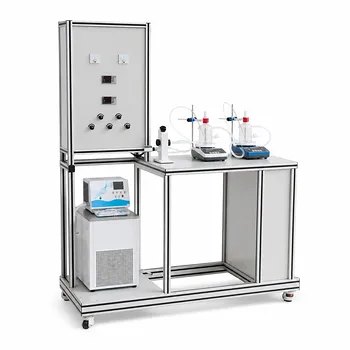
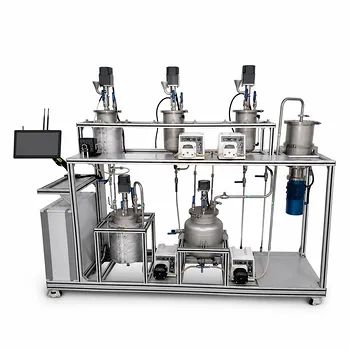
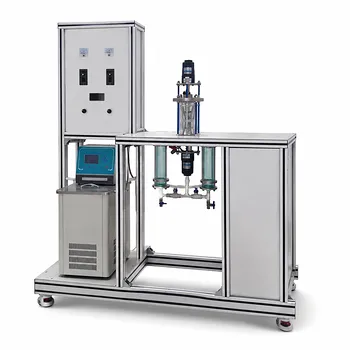
The key heat management advantage of a three-phase slurry reactor lies in its ability to replace complex heat exchange surfaces with the simple, bulk heat capacity of a liquid medium. In a pilot plant setting, this directly illustrates how an inert liquid absorbs the intense exothermic heat from reactions like methanol synthesis, maintaining a nearly uniform temperature across the entire catalyst bed without the need for intricate internal cooling. This is in stark contrast to gas-solid fixed-bed reactors, where poor heat transfer often forces compromises between conversion and safety. By measuring heat-transfer coefficients during solvent recycling, the pilot plant gives students and researchers a quantifiable, hands-on demonstration of how to achieve almost isothermal operation in a process that would otherwise be dangerously hot-spot prone.
The three-phase slurry reactor’s true advantage is the decoupling of heat management from reactor geometry. By letting the liquid’s thermal mass soak up the reaction enthalpy, it achieves isothermal conditions without the pressure drop and complexity of multi-tubular designs. For a highly exothermic equilibrium-limited reaction like methanol synthesis, this translates directly into higher single-pass conversions, reduced compression costs, and a safer, more controllable process envelope.
The Core Mechanism: Liquid-Phase Heat Sink
How the Inert Liquid Absorbs Reaction Heat
In a three-phase slurry reactor, solid catalyst particles are suspended in an inert hydrocarbon liquid while synthesis gas bubbles through. The reaction occurs on the catalyst surface, generating substantial heat.
That heat immediately transfers into the surrounding liquid. Because the liquid has a high heat capacity—much larger than that of a gas—it can absorb a large amount of energy with only a minimal temperature increase. The liquid essentially acts as a thermal buffer, flattening out temperature gradients that would otherwise form along the reactor.
The Result: An Almost Isothermal Temperature Profile
This bulk absorption eliminates local hot spots. The entire catalyst bed operates at a nearly uniform temperature, even as the reaction proceeds.
In a pilot plant, you can directly observe this by placing thermocouples along the reactor axis. Instead of seeing steep temperature peaks typical of fixed-bed reactors, the readings stay within a narrow band—demonstrating excellent axial temperature control without any internal heat transfer tubes. The liquid phase itself becomes the primary heat removal pathway.
Why Isothermal Conditions are a Game-Changer for Methanol Synthesis
Preventing Hot Spots and Catalyst Deactivation
Methanol synthesis from synthesis gas (CO/CO₂ + H₂) is highly exothermic. In a fixed-bed reactor, a temperature spike can sinter the copper-based catalyst, permanently reducing its activity.
A slurry reactor prevents this. By keeping the temperature uniform and moderate, it preserves catalyst structure and extends its operational life. The pilot plant allows you to correlate the flat temperature profile directly with sustained catalytic activity over multiple recycling runs, proving the concept in a measurable way.
Boosting Single-Pass Conversion and Reducing Compression Costs
Methanol synthesis is also equilibrium-limited: higher temperatures favor the reverse reaction, lowering the maximum achievable conversion per pass. A fixed-bed reactor often must operate with a large temperature rise, sacrificing conversion to stay below damaging limits.
Isothermal operation at a carefully chosen optimal temperature sidesteps this trade-off. You can push the reaction closer to equilibrium without crossing into unsafe territory. The result is a higher single-pass conversion. This means less unreacted gas needs to be recycled, which directly reduces compression energy—a major operating cost in any synthesis loop. The pilot plant quantifies this advantage when you compare the slurry reactor’s performance with that of a conventional two-phase fixed-bed unit under identical feed conditions.
Lessons from the Pilot Plant: Observing Heat Management in Action
Monitoring Heat-Transfer Coefficients During Solvent Recycling
The inert liquid is not a static sink; it is continuously circulated, often through an external heat exchanger. The pilot plant includes instrumentation to monitor heat-transfer coefficients during this solvent recycling loop.
By adjusting the liquid circulation rate and measuring the temperature difference across the exchanger, you build a direct, dynamic understanding of how much energy is being removed and how the overall thermal balance is maintained. This transforms the abstract concept of “liquid heat capacity” into a tangible engineering parameter you can control and optimize.
Direct Comparison with Two-Phase Fixed-Bed Reactors
The educational power of the pilot plant comes from the side-by-side comparison it enables. When you run the same exothermic reaction in a fixed-bed reactor, you immediately see the difference: a steep temperature peak near the inlet, followed by a decline. You can then calculate how much of that peak must be suppressed by diluting the feed with recycled product gas—adding compression cost and complexity.
The slurry reactor’s nearly flat temperature profile makes the heat management advantage unmistakable. The data tells a clear story: one system uses clever engineering to fight an inherently poor heat transfer environment; the other uses a fundamental physical property to avoid the fight altogether.
Understanding the Trade-offs of Slurry Reactor Technology
Isothermal operation isn’t free. The slurry phase introduces its own set of challenges, and these are equally important lessons from the pilot plant.
- Catalyst Attrition and Fines: The suspended particles collide and slowly wear down. You’ll see a gradual pressure drop change or require filtration to keep fines from building up. This wear must be weighed against the benefits of uniform temperature.
- Liquid Phase Stability: The inert hydrocarbon can slowly degrade under reaction conditions. Monitoring its properties over time teaches you to select solvents that are truly inert over long campaigns.
- Back-Mixing and Selectivity: The well-mixed liquid phase can reduce the overall reaction rate and potentially affect product selectivity if intermediate products can undergo further reactions. The pilot plant’s gas-liquid-solid hydrodynamic measurements (residence time distributions) reveal this intrinsic trade-off between isothermal perfection and reactor efficiency.
- Solvent Recovery Energy: While recycling the liquid helps manage heat, the recovery and purification of that solvent add an energy penalty. The pilot plant’s heat exchanger data helps you close the energy balance and see if the compression savings truly outweigh this new cost.
How to Apply This to Your Process or Curriculum
The pilot plant distill a complex thermodynamic challenge into a set of measurable, comparable experiments. Your focus determines what you take away from it.
- If your primary focus is process intensification for equilibrium-limited exothermic reactions: Use the slurry reactor’s isothermal profile to justify pushing for higher per-pass conversion. The data will show you where the economic break-even point lies relative to increased compression and solvent recovery costs.
- If your primary focus is catalyst longevity and operability: The elimination of hot spots is the headline. Document the temperature uniformity and correlate it with catalyst deactivation rates over multiple runs to build a strong case for slurry technology where catalyst cost is paramount.
- If your primary focus is teaching core heat transfer principles: The side-by-side comparison with a fixed-bed reactor is the most powerful tool. Have students calculate heat removal rates, draw temperature profiles, and quantify the compression savings from the higher conversion—turning abstract equations into a compelling, real-world economic argument.
Ultimately, the three-phase slurry reactor pilot plant does more than just manage heat; it makes the invisible physics of thermal management visible, turning a complex trade-off into a clear, data-driven design choice.
Summary Table:
| Feature | Three-Phase Slurry Reactor | Gas-Solid Fixed-Bed Reactor |
|---|---|---|
| Temperature Profile | Isothermal (nearly uniform) | Steep temperature peaks (hot-spots) |
| Heat Removal Mechanism | Bulk liquid phase heat capacity | Internal/external heat exchange surfaces |
| Catalyst Protection | High (prevents thermal sintering) | Low (susceptible to localized overheating) |
| Single-Pass Conversion | High (optimized equilibrium control) | Limited (sacrificed to maintain safety) |
| Operational Trade-off | Catalyst attrition & solvent recycling | High pressure drops & gas recycle costs |
Bring Advanced Chemical Engineering Principles to Life with LABPARK
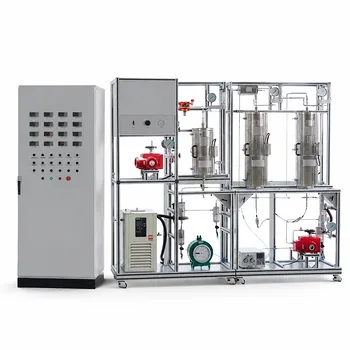
Are you looking to provide students, researchers, or process engineers with hands-on experience in advanced thermal management? LABPARK provides state-of-the-art Educational and Vocational Unit Operations Pilot Plants in chemical engineering, bioprocess & biotech, and environmental & water treatment for universities, research institutes, and enterprises.
Our slurry reactor pilot plants empower your institution to:
- Visualize Isothermal Control: Compare slurry and fixed-bed systems side-by-side to clearly demonstrate heat transfer physics.
- Optimize Exothermic Reactions: Let researchers and students safely experiment with high-enthalpy processes like methanol synthesis.
- Develop Practical Skills: Train users on solvent recycling, heat-transfer coefficient calculations, and process scaling.
Ready to elevate your engineering curriculum or research capabilities? Contact LABPARK today to discuss our custom pilot plant solutions!
Related Products
- Gas Phase Mixing and Residence Time Distribution Determination Educational Unit Operations Pilot Plant
- Fixed-Bed Chemical Reaction and Gas Dust Tar Removal Unit Operations Pilot Plant
- Crude Benzene Hydrogenation Educational Unit Operations Pilot Plant
- Multi-Stage Stirred Tanks in Series Residence Time Distribution and Mixing Performance Determination Educational Pilot Plant
- Residence Time Distribution and Reactor Flow Characteristics Determination Educational Pilot Plant
People Also Ask
- Why do gas-flow unit operations pilot plants require an expansion factor? Achieve Precise Flow Calculations
- Pulse vs. Step Injection for RTD: Practical Differences in Pilot Plants Explained
- How do pressure changes affect gas-phase reaction rates? Safely Optimize Your Kinetics
- Why use an experimental factor for terminal velocity in gas flow pilot plants? Streamline Frictional Flow Analysis
- How is the pressure-volume extrapolation method applied in educational pilot plants to calibrate gas sensors?