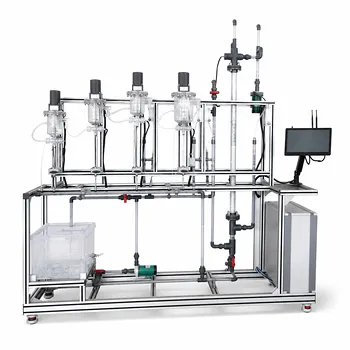
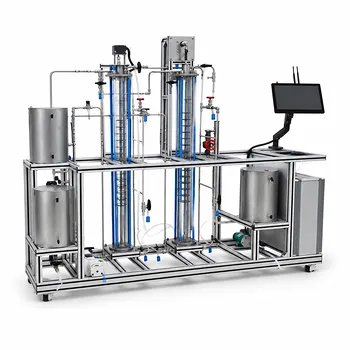
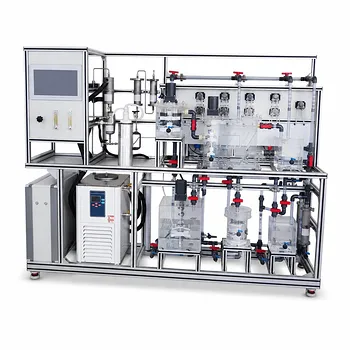
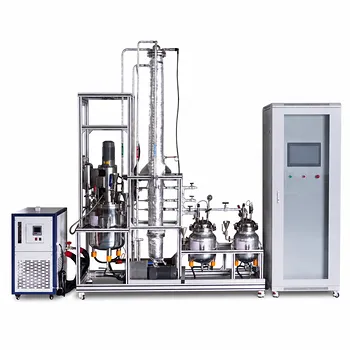
The simple truth is that a recycle loop doesn't change the reactor's inherent conversion limit—but it can dramatically boost the overall system's performance.
A recycle loop separates unreacted material from the product stream and sends it back to the reactor inlet. This means the single-pass conversion inside the reactor may remain low due to thermodynamic or selectivity constraints, but the overall conversion of fresh feed to product can approach 100%. In a pilot plant, students demonstrate this by physically measuring flow rates and compositions at key points around the loop, then calculating and comparing these two conversion metrics.
A recycle loop decouples what happens inside the reactor from what happens to the entire process. It transforms a low single-pass conversion into a near-total utilization of raw materials. Laboratory training with a physical pilot plant is the fastest way to grasp this mass-balance reality—and to learn the economic and operational trade-offs that come with it.
The Fundamental Relationship Between Recycle and Conversion
The heart of the matter is the distinction between two conversion measures. Grasping this difference is the first deep lesson any pilot-plant training must deliver.
Single-Pass Conversion vs. Overall System Conversion
Single-pass conversion is calculated based on the reactant entering the reactor. If only 40% of that reactant is gone when the stream leaves, that's your single-pass number.
Overall conversion is calculated based on the fresh feed entering the entire system, not just the reactor. Because unreacted material is continuously recycled, the fresh feed has many chances to react. This overall value can be 95% or higher, even with a middling single-pass figure.
The primary reference emphasizes that many real reactions—like ethylene oxidation or hydration—are thermodynamically limited to 5–60% per pass. The recycle loop is what makes those processes economically viable by squeezing maximum product from every fresh-feed molecule.
Why Reactors Are Intentionally Run at Low Conversion
A key insight buried in the supplementary references is that high conversion often kills selectivity. When reactant concentration drops and product concentration builds inside the reactor, side reactions accelerate, generating more waste.
Process designers therefore deliberately target a lower single-pass conversion to keep the desired product pure. The recycle loop then recovers the unreacted material, solving the yield problem without sacrificing selectivity. This is a critical concept to demonstrate in training—students see that a "bad" reactor conversion can be a smart engineering choice.
Demonstrating the Concept in a Pilot Plant
The primary reference gives a crystal-clear blueprint: a reactor-separator system with a physical recycle line. This is the empirical backbone of the training exercise.
Setting Up the Measurement Points
Instructors guide students to sample and measure flow rates and compositions at four critical nodes:
- Fresh Feed (the makeup stream entering the system)
- Mixed Feed (fresh feed combined with the recycle stream, entering the reactor)
- Reactor Product (the stream leaving the reactor)
- Recycle Stream (the unconverted material sent back from the separator)
With these data, students can perform simultaneous mass balances. They'll directly calculate the low single-pass conversion and then watch it "multiply" when they compute the overall conversion based on fresh feed alone.
Running a Steady-State Mass Balance by Hand
The auxiliary reference on calculation methods reinforces that this isn't just a display—it’s an active calculation exercise. Using iterative ("tearing") methods or matrix-based simultaneous equation solvers, students predict recycle-stream flow rates and compositions, then verify them against sensor readings.
This closes the gap between idealized textbook problems and the real, dynamic behavior of a closed-loop system. When the experiment reaches steady state and the numbers match, the concept of material recycling becomes visceral.
Observing Real-Time Dynamics with Inline Sensors
Continuous pilot plants with recycle loops and variable purge valves add another dimension, as noted in the supplementary references. Students can watch inert-gas accumulation over time on a concentration monitor, then adjust the purge-to-recycle ratio. They see the immediate impact on reactor composition and conversion, connecting control actions directly to mass-balance consequences.
Beyond Conversion: Selectivity, Purging, and Catalyst Deactivation
A well-designed pilot plant training goes beyond a single conversion number to teach dynamic process management.
The Necessity of a Purge Stream
Recycling everything sounds ideal until inert components build up. If the fresh feed contains a small amount of argon or nitrogen, recycling concentrates those inerts, diluting the reactants and slowing the reaction.
The supplementary references highlight that a purge valve on the pilot plant lets students actively manage this. By altering the purge-to-recycle ratio, they see the trade-off between losing some reactant via purge (economic loss) versus letting inerts accumulate (kinetic loss). This exercise teaches the economic optimization that drives real industrial design.
Compensating for Catalyst Deactivation
Catalysts don't stay fresh forever. As activity declines, the single-pass conversion drops. To maintain the same fresh-feed processing rate and product output, the recycle ratio must be increased.
This dynamic can be run as a timed experiment. Students log the rising recycle flow needed to hold product yield constant, then extrapolate to the point where the required recycle flow becomes infinite—the moment the catalyst is dead. This turns an abstract deactivation curve into a concrete, time-bound operational limit.
Understanding the Trade-offs
No engineering solution is free. A recycle loop introduces costs and complexities that must be weighed against its benefits.
Separation Costs and Energy Requirements
Every recycle loop requires a separation unit (distillation column, membrane, absorber) and a recycle pump or compressor. These units consume energy and capital. The supplementary material on pilot plant design underscores that return lines, buffer tanks, and compressors must be sized correctly to handle the recycle load. In training, students can calculate the energy cost of the recycle compressor and compare it to the savings from recovered feed, framing a classic economic optimization.
Recycle-Induced Dynamic Instability
A recycle loop creates feedback. A small disturbance at the reactor can travel through the separator and recycle line, returning to the reactor inlet amplified. Pilots with recycle loops are excellent platforms to demonstrate oscillations and teach strategies for steady-state control—adding surge tanks, tuning controllers, and setting proper purge rates.
The Batch-to-Continuous Gap
Supplementary references note that batch experiments cannot simulate the steady-state buildup of by-products or impurities that occurs in a continuous recycle system. A lab-scale pilot operating in continuous recycle mode reveals real yield numbers, including impurity accumulation effects, that batch experiments miss. This prevents dangerous overestimation of yields before commercial design.
Making the Right Choice for Your Training Goals
The demonstration you build depends on which operational lesson you want to cement.
- If your primary focus is mastering mass balances: Structure the experiment around the four measurement points, manual composition sampling, and side-by-side calculation of single-pass and overall conversion. Let students prove with their own data that the overall conversion can far exceed the single-pass figure.
- If your primary focus is understanding selectivity trade-offs: Run the reactor at two different conversion levels (by adjusting temperature or space velocity) and show how the higher-conversion case produces more by-products. Then demonstrate that only the recycle-enabled low-conversion route meets both yield and purity targets.
- If your primary focus is process dynamics and control: Introduce a variable purge stream or a catalyst-deactivation simulation. Have students log the rising recycle ratio needed to hold product rate, or adjust purge to control inert concentration while minimizing fresh-feed loss.
- If your primary focus is industrial economic validation: Combine all elements—recycle ratio, separation energy, purge rate, and catalyst life—into a single campaign where students calculate a process net present value. This directly connects the pilot-plant data to the business case.
The recycle loop is far more than a pump and a pipe; it’s a teaching tool that transforms theoretical mass balances and thermodynamics into a tangible, hands-on system. By measuring, calculating, and physically adjusting the loop, students internalize the principles that make modern chemical processes profitable and sustainable.
Summary Table:
| Feature | Single-Pass Conversion | Overall System Conversion |
|---|---|---|
| Calculation Basis | Reactant entering the reactor | Fresh feed entering the entire system |
| Typical Values | Often lower (5% - 60% due to limits) | High (95%+ via continuous recycle) |
| Selectivity Impact | Higher selectivity (fewer side reactions) | High yield, but requires purge control |
Bring Hands-On Process Dynamics to Your Lab
Teaching complex mass balances and recycle loop dynamics requires robust, real-world equipment. LABPARK provides premium Educational and Vocational Unit Operations Pilot Plants in chemical engineering, bioprocess & biotech, and environmental & water treatment.
We help universities, research institutes, and enterprises bridge the gap between theory and industrial reality with high-quality, sensor-rich pilot systems.
Ready to upgrade your laboratory training? Contact LABPARK today to discuss your custom pilot plant requirements!
Related Products
- Residence Time Distribution and Reactor Flow Characteristics Determination Educational Pilot Plant
- 100L Continuous Loop Hydrogenation Educational Unit Operations Pilot Plant
- Solid Waste Pyrolysis and Refining Educational Pilot Plant for Unit Operations
- Natural Product Extraction Unit Operations Training Pilot Plant
- Multi-Functional Drying Educational Unit Operations Pilot Plant
People Also Ask
- Why is temperature regulation via a cooling jacket a critical feature in CSTR pilot plants used for laboratory training?
- What parameters to monitor transitioning from Batch to CSTR? Master Pilot Plant Setup
- How does steady-state multiplicity affect the operation and safety of exothermic reactions within a CSTR pilot plant? - Guide
- What role do customizable reactor pilot plants play in evaluating heat and catalyst performance? Scale-up Guide
- How Does Backmixing Affect 1st vs 2nd-Order Reaction Conversions in Pilot Plants?