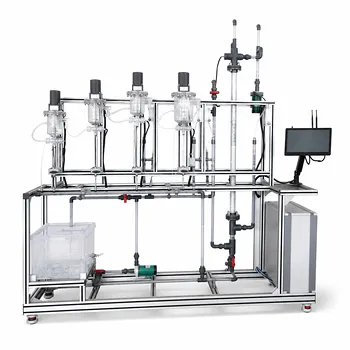
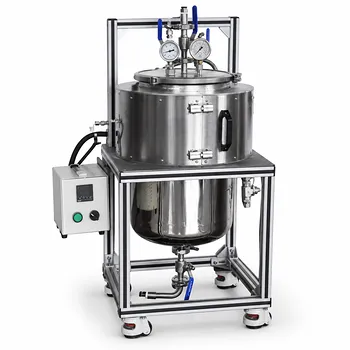
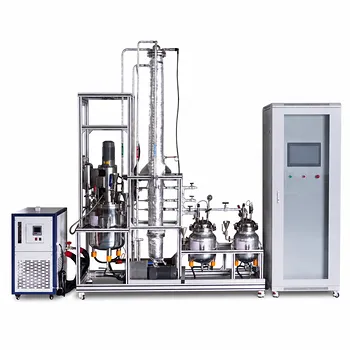
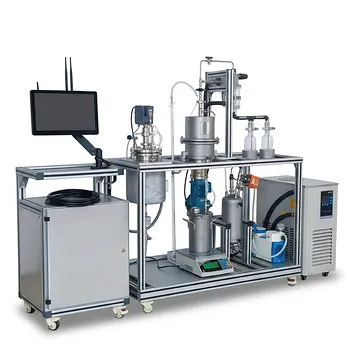
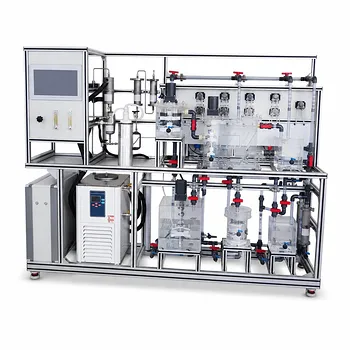
A pilot-scale distillation unit with recycle loops converts a theoretical etherification flowsheet into a hands-on separation laboratory. It directly addresses the process's core challenge: isolating the target ether product from unreacted methanol and unconverted C4 hydrocarbons. Users physically manipulate the column's reflux ratio, feed tray location, and operating pressure to maximize methanol recovery for recycling while minimizing the loss of valuable hydrocarbons. This setup allows them to perform rigorous mass and energy balances and empirically evaluate how effectively unconverted materials can be sent back to the reactor inlet—closing the loop between batch chemistry idealizations and continuous industrial reality.
The real skill in etherification is not forming the ether—it is reclaiming what did not react. A pilot distillation plant with an integrated recycle loop compels students and researchers to confront azeotropes, measure tray-level concentration gradients, and quantify the energy-versus-recovery trade-off that defines the economic viability of the entire process.
Why Etherification Separations Are So Difficult
The separation challenge is not trivial. It’s the make-or-break economics of the process. The product ether must be purified from a mixture that contains unreacted alcohols and light hydrocarbons.
The Separation Puzzle: Reactants, Products, and Azeotropes
In a typical etherification reaction, methanol is used in excess. The resulting stream contains the target ether, leftover methanol, and inert or unconverted C4 fractions. These components often form close-boiling mixtures and azeotropes that cannot be simply split with a single flash. Understanding their vapor-liquid equilibrium behavior under different pressures is the first critical step.
The Cost of Imperfect Separation
If the separation is poor, you either send valuable methanol and hydrocarbons to fuel gas or waste, or you contaminate the ether product. Because the process is designed around recycling these reactants, a sloppy separation directly increases raw material costs and reduces the reactor’s effective yield. The pilot plant makes this visible: you can measure exactly how much methanol slips out the bottom versus the top.
How the Pilot Plant Brings the Process to Life
A scaled-down distillation unit, complete with a reboiler, condenser, and multiple sampling ports, transforms this abstract challenge into a series of testable hypotheses. The integrated recycle loop is the critical feature that separates this experiment from a simple binary distillation lab.
Hands-On Manipulation of Key Variables
The primary reference’s value becomes concrete at the control panel. By increasing the reflux ratio, you send more condensed liquid back down the column, improving methanol recovery but at the cost of higher reboiler duty. Moving the feed tray location alters the composition profile, directly impacting the composition of the stream drawn off for the recycle loop. Adjusting column pressure can even shift azeotrope boundaries, a powerful lever that theoretical study alone cannot internalize.
Closing the Loop: Studying Recycle Dynamics
The recycle loop is not just a pipe. It represents the physical connection between the downstream purification and the upstream reactor. Researchers can sample the recycle stream continuously to quantify its composition. They can then experimentally determine how changes in the column’s operation alter the degree of unconverted reactant recovery. This allows them to directly measure the recycle efficiency, a crucial parameter for a global process mass balance.
Validating Theory with Physical Temperature Gradients
Every distillation is a thermodynamic story told through temperature. The pilot plant allows you to install sensors at each tray. By comparing the measured temperature profile against predictions from vapor-liquid equilibrium (VLE) data, you immediately see the gap between the ideal and the real. You can apply the McCabe-Thiele method, using the operating lines for the rectifying section (y_{n+1} = \frac{R}{R+1}x_n + \frac{x_D}{R+1}), and then sample the liquid on a specific tray to calculate that tray’s Murphree efficiency. Bridging this gap between the theoretical stage and the physical sieve tray is the essence of process engineering.
Understanding the Trade-offs
A pilot plant is a truth-teller. It exposes the painful compromises that simplified flowsheets hide. The core trade-off in these experiments is never about finding a single “perfect” setting.
Purity vs. Recovery: The Energy Penalty
You can draw a razor-sharp cut to produce nearly pure ether. But to do so, you may have to let more methanol slip into the product stream or consume steam in enormous quantities at the reboiler. Conversely, maximizing methanol recovery for the recycle loop often requires such a high reflux that the energy cost per kilogram of ether product skyrockets. The pilot plant forces you to navigate this Pareto frontier with real data, finding the economic sweet spot.
Steady-State Assumptions vs. Real Transients
The recycle loop creates a dynamic feedback system. A change in column pressure does not just alter the split; it changes the composition of the stream heading back to the reactor, which in turn could change the feed composition entering the column. The time it takes to reach a new steady state—and the stability during that transition—becomes a critical research topic that cannot be learned from a textbook diagram of a loop.
Scale-Down Limitations as Learning Opportunities
A pilot-scale column does not replicate the massive liquid holdups or complex tray hydraulics of an industrial unit exactly. However, this limitation is itself a teaching tool. It highlights the complexities of scale-up dynamics. Students confronted with a pilot plant’s lower-than-expected tray efficiency are forced to investigate the underlying hydrodynamics, such as weeping or entrainment, that fluid dynamic simulations often gloss over.
Making the Right Choice for Your Goal
Your experimental plan depends entirely on the insight you need most urgently. The same hardware can answer fundamentally different research or educational questions.
- If your primary focus is process design: Run the column at varying reflux ratios and feed stage locations to map the combinations that achieve >99% methanol recovery while keeping reboiler utility consumption within a target budget.
- If your primary focus is research on recycle integration: Deliberately perturb the recycle flow rate and record the transient temperature and composition responses across the column. Use this to build a dynamic model that predicts how a commercial reactor-separator system will behave during startup or upsets.
- If your primary focus is educational verification: Have students first calculate the required theoretical stages via the McCabe-Thiele method, then compare these ideal stages to the actual trays by sampling from the column and calculating individual Murphree efficiencies.
- If your primary focus is minimizing process waste: Experiment with adjusting the column’s bottom temperature to minimize the concentration of valuable organics in the heavy waste stream, directly calculating the reduction in the process’s E-factor.
This equipment does not just demonstrate a technique; it compresses years of operational intuition into a single, transparent experiment, revealing exactly where the energy and molecules go and why.
Summary Table:
| Key Variable / Feature | Operational Impact | Research & Learning Value |
|---|---|---|
| Reflux Ratio | Balances methanol recovery against reboiler energy duty. | Illustrates the energy-versus-recovery economic trade-off. |
| Feed Tray Location | Alters the composition profile inside the distillation column. | Teaches optimization of feed stage location using VLE data. |
| Recycle Loop | Directs unconverted reactants back to the reactor inlet. | Demonstrates steady-state dynamics and system-wide mass balances. |
| Temperature Sensors | Measures physical tray-level temperature gradients. | Enables calculation of actual Murphree tray efficiencies. |
Optimize Your Engineering Labs with LABPARK
Are you looking to bridge the gap between theoretical process engineering and industrial reality? LABPARK provides state-of-the-art Educational and Vocational Unit Operations Pilot Plants in chemical engineering, bioprocess & biotech, and environmental & water treatment tailored for universities, research institutes, and enterprises.
Our advanced pilot-scale distillation systems empower students and researchers to analyze real-world separation challenges, master thermodynamic trade-offs, and run rigorous mass balances.
Bring hands-on industrial simulation to your facility—contact us today to find the ideal pilot plant solution for your goals!
Related Products
- Green Anhydrous Ethanol Purification Extractive Distillation Unit Operations Training Pilot Plant
- Continuous Sieve-Plate Distillation Pilot Plant for Unit Operations Laboratory Education
- Residence Time Distribution and Reactor Flow Characteristics Determination Educational Pilot Plant
- Multi-Modal Distillation Unit Operations Training Pilot Plant
- Multi-Functional Special Distillation Educational Pilot Plant
People Also Ask
- How can energy balance equations for condensers & reboilers be validated experimentally? Guide
- Fugacity vs Activity Coefficient: How to Choose VLE Models for Distillation Pilot Plants
- How can real-time carbon number prediction improve distillation pilot plants? Optimize control.
- Why is vacuum operation capability an essential feature for a distillation unit operations pilot plant? Unlock Efficiency
- How Reflux Ratio Affects Distillation Pilot Plant Separation Efficiency & Limits