The most powerful lesson a multi-stage CSTR configuration teaches is that plug-flow behavior isn’t an all-or-nothing property—it’s a limit you can practically approach by dividing a single back-mixed volume into smaller, sequential stages.
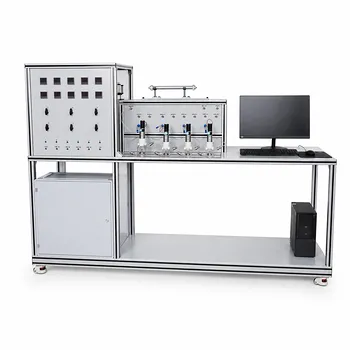
In a chemical engineering training plant, students physically connect two, three, or more continuous stirred-tank reactors in series. At each interstage sampling port, they measure the stepwise drop in reactant concentration, visually confirming that each additional stage reduces the axial mixing that wastes volume. By comparing the total volume needed for a target conversion against a single CSTR and an ideal plug-flow reactor, they quantify exactly how staging suppresses back‑mixing and moves the system toward plug‑flow performance.
A single CSTR’s complete back‑mixing requires the largest volume for a given conversion. As you add identical CSTRs in series, the overall residence‑time distribution narrows and the concentration profile becomes a staircase that mimics the smooth exponential decay of a plug‑flow reactor—teaching students that discretizing back‑mixed zones is a direct, measurable path to plug‑flow efficiency.
The Fundamental Divide: Back‑Mixing vs. Plug Flow
The Single CSTR: Complete Back‑Mixing as a Worst‑Case Scenario
An ideal CSTR assumes instantaneous, perfect mixing. A reactant molecule can—and often does—leave the reactor immediately after entering, while another stays for many residence times.
This broad residence‑time distribution creates a long tail of unreacted material, forcing the reactor to be much larger to achieve high conversion.
The Ideal PFR: Zero Axial Mixing, Maximum Efficiency
A plug‑flow reactor assumes no mixing in the flow direction. Every fluid element spends exactly the same time in the reactor, moving as a uniform plug from inlet to outlet.
The concentration declines smoothly and exponentially along the length, using the absolute minimum reactor volume for a given conversion (for positive‑order kinetics).
Why the Gap Matters to a Student Engineer
The gulf between these two ideal extremes is where real reactors operate. Understanding how to traverse that gap—deliberately reducing back‑mixing—is a core reactor‑engineering skill.
A training plant that lets you build the bridge, stage by stage, transforms an abstract equation into a physical, measurable journey.
Why a Staged CSTR Cascade Approaches Plug Flow
The Mathematics of Staging: Discretizing the PFR
Each CSTR in a cascade creates a discrete step in concentration, as the outlet of one vessel becomes the feed to the next.
As the number of stages N increases, the staircase of concentration steps becomes finer. In the limit N → ∞, the total volume and the smooth concentration profile converge exactly to those of an ideal PFR.
Residence‑Time Distribution Evolution
The residence‑time distribution (RTD) of a single CSTR is a broad exponential decay.
With two tanks in series, the RTD sharpens; with five or ten, the coefficient of variation collapses, and the distribution becomes a narrow, nearly symmetric curve that approaches the single‑point RTD spike of a true plug‑flow reactor.
Volume Reduction: The Quantitative Payoff
For a first‑order reaction, a single CSTR needs far more volume than a PFR to reach 90% conversion.
By connecting just three CSTRs of equal size in series, students can measure how the total required volume drops dramatically. At five to ten stages, the volume becomes nearly indistinguishable from the PFR limit—a discovery they can make with their own hands.
Experiential Learning in the Pilot Plant: From Sampling to Synthesis
Bypassing Simulation with Physical Reality
A textbook can show you the design equation; a training plant lets you live it. Students adjust feed flow rates, set the active liquid volume in each stage, and then physically draw samples from ports between reactors.
This tactile, step‑by‑step data collection replaces spreadsheet‑only learning with an intuitive feel for how a concentration wave propagates through staged back‑mixed zones.
Plotting a Living Concentration Profile
Each sample yields a data point: the conversion after one CSTR, after two, after three. When plotted against cumulative volume (or cumulative space time), the points trace a downward staircase.
Students immediately see that this staircase wraps around—and undercuts—the smooth PFR decay line. The “gap” between the staircase and the PFR curve is the volume penalty of back‑mixing, and it shrinks visibly with every added stage.
Verifying the Minimum‑Volume Principle
The pilot plant exercise is not just qualitative. Students calculate the total volume they used to reach a target conversion and compare it with the single‑CSTR volume and the ideal PFR volume.
This direct, side‑by‑side comparison anchors the principle that staging minimizes total volume—and does so in a way that a single simulation never could.
Closing the Loop with Residence‑Time Distribution Experiments
Tracer Tests as the RTD Microscope
Instead of only measuring conversion, students can inject a pulse of inert tracer at the inlet and record the concentration at the exit of the entire cascade.
The shape of the outlet pulse is the RTD of the whole system. With one tank, it’s an exponential decay; with two, it curves and peaks; with five, it’s a tight bell‑shaped hump that visually screams “approaching plug flow.”
Quantifying the Coefficient of Variation
By calculating the variance or coefficient of variation of the RTD, students can put a number on how closely their cascade mimics plug flow.
A single CSTR has a coefficient of variation of 1.0 (very broad). A cascade of 10 CSTRs plunges that number toward 0.1—an objective, reproducible metric that connects the physical experiment back to the mathematical models they studied in class.
Understanding the Trade‑offs of Multi‑Stage CSTR Setups
You Are Stacking Up Real‑World Complexity
Adding more CSTRs multiplies the number of pumps, stirrers, level controls, and interconnecting piping. Each new stage introduces potential leaks, pressure drops, and maintenance points.
For an educational plant this is manageable and instructive. For a production environment, the practical limits are a genuine constraint that students must learn to weigh.
A CSTR Cascade Is Not a Perfect PFR—Ever
Even with ten or twenty stages, a cascade of perfectly mixed tanks still has a small amount of back‑mixing between stages. Dead zones, bypassing, or imperfect agitation in a single tank can distort the RTD further.
The experiment’s value lies precisely in revealing those deviations—teaching students that the asymptotic approach to plug flow is only as good as the physical implementation.
The Hidden Curriculum: Systems Thinking
Running a multi‑stage cascade demands careful adjustment of flow splits, level setpoints, and temperature control across all vessels.
This is a powerful introduction to plant‑wide control challenges and process integration, transforming a simple reaction‑engineering lab into a full systems‑engineering lesson.
Making the Right Choice for Your Learning Goal
The way you use a multi‑stage CSTR plant can be tuned to the lesson you most need to absorb. Consider these goal‑oriented strategies:
- If your primary focus is mastering RTD and macromixing concepts: Run tracer experiments with 1, 3, and 7 tanks in series. Measure the exit‑age distribution each time and compute the coefficient of variation to quantify the narrowing of the RTD.
- If your primary focus is reactor design and economic optimization: Choose a reaction with known kinetics, set a target conversion, and operate 1, 2, and 4 CSTRs. For each configuration, calculate the total volume required and compare it directly with the ideal PFR volume to internalize the capital‑cost penalty of back‑mixing.
- If your primary focus is developing a physical intuition for reactor behavior: Vary the feed flow rate or the active volume of only the middle tank while holding the others constant. Observe how a single “mis‑sized” CSTR distorts the entire concentration staircase, reinforcing the systems‑level interdependence of staged reactors.
The multi‑stage CSTR configuration transforms the abstract limit of “infinite tanks” into a concrete, measurable experience—empowering you to feel, see, and prove how back‑mixed stages evolve into plug‑flow character, one tank at a time.
Summary Table:
| Reactor Setup | Mixing Profile | RTD Characteristics | Required Volume |
|---|---|---|---|
| Single CSTR | Complete back-mixing | Broad exponential decay | Largest (least efficient) |
| Multi-Stage CSTR | Stepwise concentration drops | Narrowing curve (approaching spike) | Decreases as stages increase |
| Ideal PFR | Zero axial mixing (plug flow) | Single-point spike | Smallest (most efficient) |
Bring Reactor Theory to Life with LABPARK
Looking to enhance your chemical engineering curriculum or research capabilities? LABPARK provides premium Educational and Vocational Unit Operations Pilot Plants in chemical engineering, bioprocess & biotech, and environmental & water treatment. Designed for universities, research institutes, and enterprises, our pilot plants bridge the gap between textbook equations and hands-on operational reality.
Contact LABPARK today to discuss your lab requirements and find the perfect training plant for your institution!
Related Products
- Multi-Stage Stirred Tanks in Series Residence Time Distribution and Mixing Performance Determination Educational Pilot Plant
- Carbon Material Thermal Pretreatment Multiphase Separation Educational Pilot Plant
- Multi Functional Membrane Crystallization Educational Unit Operations Pilot Plant
- Gas Phase Mixing and Residence Time Distribution Determination Educational Unit Operations Pilot Plant
- Residence Time Distribution and Reactor Flow Characteristics Determination Educational Pilot Plant
People Also Ask
- How does MRF model impeller rotation in CFD? Key Boundary Conditions Explained
- How can a CSTR pilot plant demonstrate reactor staging? Visualize volume savings.
- How does steady-state multiplicity affect the operation and safety of exothermic reactions within a CSTR pilot plant? - Guide
- What parameters to monitor transitioning from Batch to CSTR? Master Pilot Plant Setup
- Why is temperature regulation via a cooling jacket a critical feature in CSTR pilot plants used for laboratory training?