Knowledge Chemical Engineering Education How does a gas-liquid absorption pilot plant assist researchers? Key insights for validating thermodynamic models.
Author avatar

Tech Team · LABPARK

Updated 1 month ago

How does a gas-liquid absorption pilot plant assist researchers? Key insights for validating thermodynamic models.


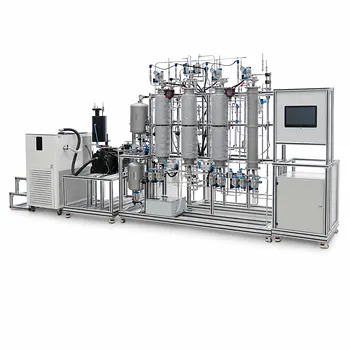
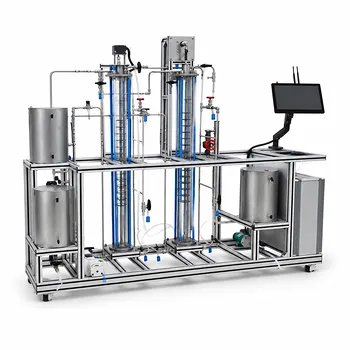
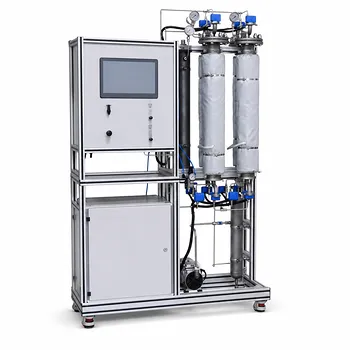
A gas-liquid absorption pilot plant is a researcher’s tangible link between theoretical models and industrial reality.
It allows scientists to directly measure equilibrium gas and liquid concentrations under precisely controlled temperature and pressure. These measurements enable the calculation of phase equilibrium constants ((m_i = y_i / x_i)), verification of Henry’s law constants, and evaluation of activity coefficients and fugacities for non-ideal mixtures. In essence, it transforms abstract thermodynamic equations into validated, predictive tools essential for designing real-world separation columns.

By operating absorption columns at pilot scale, researchers collect the hard data needed to confirm Henry’s Law in physical absorption, or to quantify how a chemical reaction can dramatically lower equilibrium partial pressures—directly validating both simple and complex thermodynamic models.

How a Pilot Plant Captures True Equilibrium Data

The Experimental Setup as a Controlled Laboratory

A pilot plant uses a packed or plate absorption column where gas and liquid phases flow counter‑currently at set temperatures and pressures. This controlled environment allows researchers to isolate specific variables and reach steady-state conditions. Once stable operation is achieved, the phases are carefully sampled and analyzed.

From Concentration Measurements to Phase Equilibrium Constants

Analyzing the samples yields the mole fractions of the solute in the gas phase ((y_i)) and the liquid phase ((x_i)). With these two numbers, the phase equilibrium constant (m_i) can be directly calculated for that exact set of conditions. This single measurement provides the empirical anchor that theoretical models must reproduce.

Validating Henry’s Law Under Real Conditions

In physical absorption, the equilibrium relationship should follow Henry’s Law: the partial pressure of the solute is proportional to its liquid‑phase concentration. A pilot plant lets you measure both terms independently and test whether the proportionality constant truly remains constant across a range of temperatures and pressures. Any deviation signals that non‑ideal behavior is present and must be accounted for.

Probing Non‑Ideality: Activity Coefficients and Fugacity

Industrial mixtures are rarely ideal. Through pilot‑plant data, researchers can calculate activity coefficients and fugacity to quantify non‑ideality. This bridges the gap between simple textbook equations and the complex reality of gas‑liquid separations, providing the input needed to fine‑tune thermodynamic models like NRTL or UNIQUAC.

Uncovering the Effect of Chemical Reactions on Equilibrium

How Reactions Skew Apparent Henry’s Constants

When absorption involves a chemical reaction—such as scrubbing an acid gas with an alkaline solvent—the solute reacts with active components in the liquid. This reaction lowers the concentration of free, unreacted solute in the liquid phase. The equilibrium is now governed by a combination of Henry’s Law and the reaction equilibrium constant (K'). The result is an apparent Henry’s constant that is effectively reduced by a factor of ((1 + K' c_B^0)). A pilot plant running chemical absorption directly demonstrates this shift, providing data to validate the combined thermodynamic model.

Demonstrating Mass Transfer Enhancement

Because the reaction lowers the equilibrium partial pressure of the solute, the driving force for mass transfer is increased. In a pilot column, this manifests as faster absorption and a higher overall column capacity. Researchers can compare physical and chemical absorption runs under identical conditions to quantify how much the reaction enhances performance, turning a theoretical concept into a measured reality.

Understanding the Trade-offs and Pitfalls

A pilot plant is a powerful tool, but it comes with practical limitations that must be respected.

Data Only Within the Tested Window

Validation is strictly limited to the temperatures, pressures, and compositions actually tested. Extrapolating far beyond the pilot‑plant operating range remains risky and should only be done with a well‑founded model.

Scale and Complexity Costs

Pilot plants require significant space, capital, and skilled operators. Maintaining precise control over flow rates, temperature, and sampling can be challenging, and measurement errors—however small—can propagate into the calculated equilibrium constants.

Not a Substitute for Fundamental Understanding

The plant provides numbers; interpreting those numbers correctly still demands a deep grasp of thermodynamics and reaction kinetics. A pilot plant cannot explain why a model fails—only that it does, under the conditions you provide.

Making the Right Choice for Your Validation Goals

Your ideal use of a gas‑liquid absorption pilot plant depends on the specific gap between theory and application you aim to close.

  • If your primary focus is confirming ideal Henry’s Law constants for physical absorption: Use the pilot plant to gather equilibrium data over the temperature range of interest, keeping conditions simple to directly compare with the proportional relationship.
  • If your primary focus is developing activity coefficient models for non‑ideal, multi‑component industrial streams: Operate the pilot plant with realistic mixtures and capture composition data to fit interaction parameters, validating the model’s ability to handle non‑ideality.
  • If your primary focus is quantifying how a chemical reaction enhances absorption capacity and reduces equilibrium back‑pressure: Run side‑by‑side physical and chemical absorption trials in the same pilot column to measure the effective reduction in Henry’s constant and the increase in driving force.

Ultimately, the pilot plant is where theory confronts reality; it provides the empirical anchor every thermodynamic model needs to become a trustworthy design tool.

Summary Table:

Validation Goal Key Data Measured Model Validation Output
Physical Absorption Solute concentrations ($y_i$, $x_i$) Verifies Henry's Law constants and ideal behavior
Non-Ideal Mixtures Multi-component phase compositions Fits activity coefficients (e.g., NRTL, UNIQUAC)
Chemical Absorption Reaction-enhanced concentrations Quantifies apparent Henry's constant shifts & mass transfer enhancement

Accelerate Your Research & Training with LABPARK Pilot Plants

Bridging the gap between theoretical thermodynamics and industrial application requires robust, reliable experimental data. LABPARK provides state-of-the-art Educational and Vocational Unit Operations Pilot Plants in chemical engineering, bioprocess & biotech, and environmental & water treatment for universities, research institutes, and enterprises.

Our systems are designed to deliver precise temperature, pressure, and flow control, ensuring your students and researchers capture high-fidelity data.

Ready to elevate your laboratory capabilities? Contact LABPARK today to discuss your project requirements and receive a customized quote.

Related Products

People Also Ask

Related Products

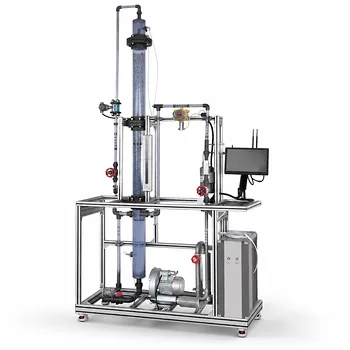
Packed Bed Absorption Educational Unit Operations Pilot Plant

Packed Bed Absorption Educational Unit Operations Pilot Plant

Study gas-liquid absorption, pressure drop, flooding, and mass transfer coefficients with this pilot plant. Transparent packed column, industrial touchscreen, real-time sensor data, automated analysis. Investigate two-phase flow, loading points, column efficiency. Comprehensive data logging and assessment software included.

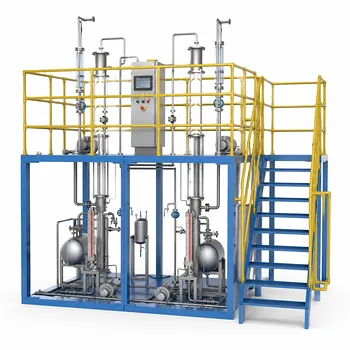
Dual-Mode Gas Absorption and Desorption Unit Operations Training Pilot Plant

Dual-Mode Gas Absorption and Desorption Unit Operations Training Pilot Plant

Industrial-scale pilot plant for gas absorption and desorption training in chemical engineering. Features dual-mode operation with real and simulated materials, transparent columns for flow visualization, and customizable design. Supports independent or combined loops for hands-on unit operations experiments.

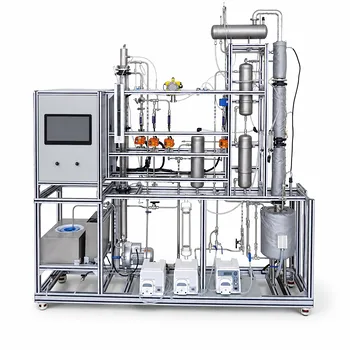
Absorption and Desorption Educational Unit Operations Pilot Plant

Absorption and Desorption Educational Unit Operations Pilot Plant

Dual packed column absorption and desorption pilot plant for chemical engineering education, offering real-time mass transfer coefficient measurement, durable mobile frame, industrial touch-screen interface, and customizable design for varied laboratory curricula, enabling hands-on study of gas absorption and stripping.

Carbon Dioxide Absorption and Desorption Educational Pilot Plant for Carbon Capture Studies

Carbon Dioxide Absorption and Desorption Educational Pilot Plant for Carbon Capture Studies

Explore carbon dioxide absorption and desorption with this educational pilot plant. Transparent columns visualize mass transfer; electric heating simulates industrial solvent regeneration; touchscreen interface enables data monitoring. Ideal for chemical engineering, bridging theory and practice.

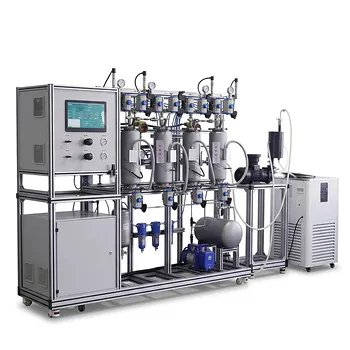
Multi-Component Gas Pressure Swing Adsorption Pilot Plant for Unit Operations Education

Multi-Component Gas Pressure Swing Adsorption Pilot Plant for Unit Operations Education

Multi-component gas pressure swing adsorption pilot plant designed for unit operations education. Features four-tower configuration, IoT touchscreen control, dual regeneration, and real-time breakthrough curve analysis for engineering training with safety interlocks and mobile frame simulates industrial PSA processes.

Carbon Dioxide Adsorption and Capture Educational Unit Operations Pilot Plant

Carbon Dioxide Adsorption and Capture Educational Unit Operations Pilot Plant

Advanced laboratory pilot plant for teaching carbon dioxide adsorption and capture unit operations. Features four-tower adsorption system with 400°C heating jackets, high-precision CO2 and O2 sensors, and 15.6-inch touchscreen with wireless data logging. Ideal for chemical engineering education.

Bench Scale Dual Column Gas Separation and Capture Educational Pilot Plant

Bench Scale Dual Column Gas Separation and Capture Educational Pilot Plant

This dual-column educational pilot plant provides hands-on teaching of gas adsorption, separation, and capture processes. It features stainless steel columns, regeneration up to 400°C, and a 15.6-inch touchscreen PLC for TSA and PSA studies in chemical engineering curricula, process simulation.

Bench Scale Carbon Dioxide Capture Educational Unit Operations Pilot Plant

Bench Scale Carbon Dioxide Capture Educational Unit Operations Pilot Plant

This bench-scale educational pilot plant simulates industrial CO₂ separation using a multi-tower adsorption system for hands-on engineering training. Students achieve ≥90% CO₂ purity while studying pressure swing adsorption, desorption kinetics, and process control in gas purification experiments.

Thermal Desorption Exhaust Gas and Tail Water Treatment Educational Pilot Plant

Thermal Desorption Exhaust Gas and Tail Water Treatment Educational Pilot Plant

Bench-scale educational pilot plant for treating thermal desorption exhaust gas and tail water integrates condensation, Fenton oxidation, precipitation, filtration, and carbon adsorption. Ideal for chemical engineering and environmental labs, teaching unit operations, process control, and real-time data analysis.

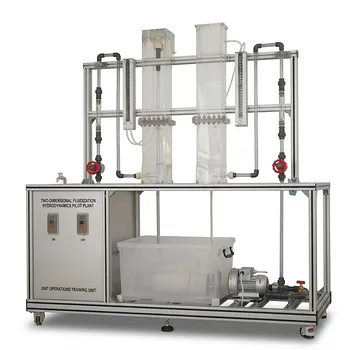
Two-Dimensional Fluidization Hydrodynamics Educational Pilot Plant for Unit Operations Training

Two-Dimensional Fluidization Hydrodynamics Educational Pilot Plant for Unit Operations Training

Explore gas-solid and liquid-solid fluidization hydrodynamics with our transparent 2D educational pilot plant. Ideal for chemical engineering unit operations labs, it demonstrates fixed to fluidized bed regimes, measures pressure drop, and integrates QR-code digital learning for enhanced student training.

Gallium and Indium Selective Extraction Educational Pilot Plant

Gallium and Indium Selective Extraction Educational Pilot Plant

Integrated pilot-scale laboratory system for engineering education bridging theoretical concepts with industrial practice enabling hands-on study of liquid liquid extraction reaction kinetics and mass transfer for selective gallium and indium separation featuring real-time IoT connectivity with integrated safety

Two Phase Flow Pattern Velocity Resistance Measurement Educational Pilot Plant

Two Phase Flow Pattern Velocity Resistance Measurement Educational Pilot Plant

Benchtop educational pilot plant for university labs studying gas-liquid two-phase flow patterns, velocity, and resistance across circular, square, and rectangular conduits. Features 15.6-inch touchscreen, 5G connectivity, differential pressure sensors, safe water-air operation. Supports chemical engineering curricula.

Pressure Swing Adsorption Educational Unit Operations Pilot Plant

Pressure Swing Adsorption Educational Unit Operations Pilot Plant

Integrated bench-scale pressure swing adsorption pilot plant for hands-on teaching of gas-solid separation, mass transfer, and process optimization using nitrogen-oxygen model, featuring dual-column design, industrial touchscreen control, digital assessment suite, and customizable hardware and software configurations for educational laboratories.

Educational Pressure Swing Adsorption Ethylene Capture Unit Operations Pilot Plant

Educational Pressure Swing Adsorption Ethylene Capture Unit Operations Pilot Plant

Advanced educational pilot plant for pressure swing adsorption ethylene capture provides comprehensive hands-on training in industrial gas separation processes, featuring an eight-column PSA system, real-time data acquisition, and fully customizable design for chemical engineering unit operations laboratories and research.

Multimodal Absorption and Desorption Pilot Plant for Unit Operations Training

Multimodal Absorption and Desorption Pilot Plant for Unit Operations Training

Multimodal absorption and desorption pilot plant for higher education labs. Bridges theory and industrial practice with transparent packed columns, three operational modes (real-material, simulated, semi-physical), and SCADA control. Students explore mass transfer, column hydraulics, and process control. Customizable.

Comprehensive Liquid-Liquid Extraction Pilot Plant for Engineering Education

Comprehensive Liquid-Liquid Extraction Pilot Plant for Engineering Education

Comprehensive liquid-liquid extraction pilot plant for engineering education, integrating rotary and vibratory columns for hands-on observation of phase behavior, flooding limits, and mass transfer efficiency, enabling precise HTU and mass transfer coefficient calculations.

Low Concentration Carbon Dioxide Capture Pressure Swing Adsorption Educational Pilot Plant

Low Concentration Carbon Dioxide Capture Pressure Swing Adsorption Educational Pilot Plant

Low-concentration CO2 capture pilot plant using Pressure Swing Adsorption for engineering education. Students gain practical experience in breakthrough curve measurement, adsorption dynamics, and variable analysis in a hands-on lab setting. Ideal for unit operations, mass transfer, and chemical engineering labs.

Fixed-Bed Chemical Reaction and Gas Dust Tar Removal Unit Operations Pilot Plant

Fixed-Bed Chemical Reaction and Gas Dust Tar Removal Unit Operations Pilot Plant

Integrated educational pilot plant for studying catalytic gas-solid reactions and downstream gas purification. Features dual fixed-bed reactor, three-stage heating, and touchscreen control for hands-on engineering training. Ideal for chemical and environmental engineering curricula.

Fluidized Bed Gas Solid Catalytic Reaction Educational Pilot Plant

Fluidized Bed Gas Solid Catalytic Reaction Educational Pilot Plant

Our educational fluidized bed gas-solid catalytic reaction pilot plant is ideal for chemical engineering labs. Students study fluidization dynamics, catalyst evaluation, and process control hands-on. Features include a customizable reactor, touchscreen HMI, and safety interlocks for safe, curriculum-aligned experiments.

Educational Unit Operations Pilot Plant for Intraparticle Diffusion Effective Factor Measurement

Educational Unit Operations Pilot Plant for Intraparticle Diffusion Effective Factor Measurement

Designed for chemical engineering university labs, this pilot plant allows hands-on determination of catalyst particle intraparticle diffusion effective factors and gas-solid reaction kinetics using a fixed-bed tubular reactor with industrial touchscreen control, bridging theory and practical reactor design.


Leave Your Message