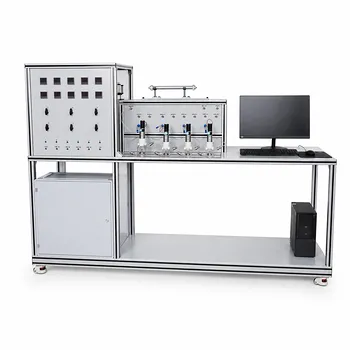
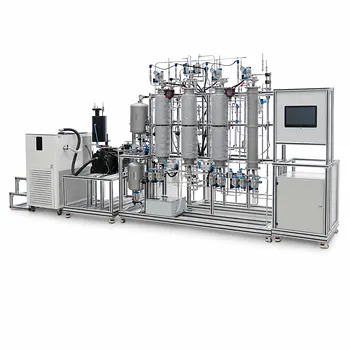
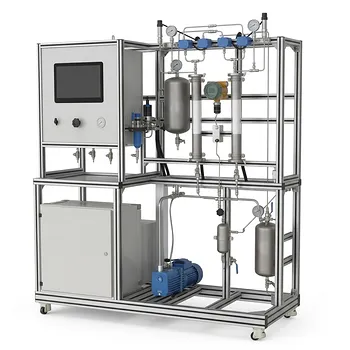
The sulfuric acid gas drying pilot plant is a living textbook. It transforms abstract mass transfer equations into a tangible, controllable process where the removal of moisture from a gas stream occurs right before your eyes. Through direct manipulation of the acid’s temperature, concentration, and circulation rate, you can observe exactly how the vapor pressure driving force and equilibrium thermodynamics dictate the final moisture content, targeting the critical industrial threshold of less than 0.1 g/m³.
While many absorption columns just mix gas and liquid, this specific system reveals the core principle: the immense difference between the water’s partial pressure in the wet gas and the near-zero water vapor pressure above concentrated sulfuric acid creates the powerful driving force responsible for mass transfer. The pilot plant then shows you how seemingly minor adjustments to operating parameters make or break your ability to hit ultra-dry gas specifications.
The Fundamental Driving Force: A Vapor Pressure Gap
All mass transfer requires a deviation from equilibrium. This pilot plant illustrates that principle with exceptional clarity because the driving force is so stark.
Why Mass Transfer Happens at All
The process is driven by the system's relentless push toward equilibrium. The wet gas entering the column carries water vapor at a certain partial pressure.
Concentrated sulfuric acid (93–95%) has an extraordinarily high affinity for water. Its surface exhibits a water vapor pressure that is far lower than that in the gas phase.
The mass transfer direction is unambiguous: Because the actual gas-phase partial pressure of water (p) is much greater than the equilibrium partial pressure (p*) above the acid’s surface, absorption occurs spontaneously. Water molecules transfer from the gas phase into the liquid acid until the gas is stripped of moisture.
The Magnitude of the Driving Force
This gap between the actual and equilibrium partial pressures (Δp = p - p*) is the mass transfer driving force. The pilot plant makes this concept real because you can measure how widening this gap—by altering temperature or concentration—directly boosts the drying rate.
A larger deviation from equilibrium accelerates the transfer, allowing a more compact column height to achieve the same outlet moisture spec. The plant becomes a proving ground for the two-film theory, where the concentration gradient across the gas and liquid films dictates the overall rate.
The Operating Parameters That Control Equilibrium
The pilot plant’s real educational power lies in demonstrating that you don't just "turn it on and wait." You actively manage three interdependent levers that shift the equilibrium and, therefore, the driving force.
Managing Acid Temperature
Temperature is the most dynamic control knob. The primary operating window of 40°C to 50°C is not arbitrary; it represents a critical balance.
Raising the acid temperature increases its surface water vapor pressure (p* moves up), effectively shrinking the driving force (Δp) and reducing absorption efficiency. You can observe this immediately as the outlet gas dew point climbs.
Conversely, lowering the temperature increases the driving force, seemingly improving drying. However, the pilot plant also teaches the practical limit: excessively cold acid becomes highly viscous, leading to poor liquid distribution in the packed column, channeling, and ultimately a collapse in effective contact area. The 40°C lower bound ensures fluidity and proper wetting of the packing.
Maintaining Acid Concentration
The concentration of H₂SO₄ defines the floor for the water vapor pressure. The 93–95% range is the industrial sweet spot.
As the acid absorbs moisture, it becomes diluted. A drop in concentration causes its equilibrium water vapor pressure to rise sharply, weakening the driving force. The pilot plant typically includes a circulation loop where a slipstream is sent to a re-concentrator or fresh acid is added, visually demonstrating the concept of steady-state operation.
By tracking the outlet moisture against acid strength, an operator can directly plot the operating line against the vapor-liquid equilibrium curve, validating how the distance between them (the driving force) shrinks as acid weakens.
Regulating Acid Circulation Flow
Flow rate governs the liquid-side mass transfer resistance. Increasing the acid circulation rate refreshes the liquid film on the packing, maintaining a surface with the lowest possible water vapor pressure.
Higher flow ensures the acid's surface isn't locally saturated with absorbed water, which would momentarily raise the local p* and stall the driving force. The pilot plant shows that insufficient circulation causes a measurable drop in performance even if the bulk acid tank is at the correct temperature and concentration.
This parameter also teaches the concept of the liquid-to-gas ratio (L/G) . The pilot plant allows you to find the minimum L/G to achieve the target 0.1 g/m³ spec, and observe the law of diminishing returns beyond that point.
Understanding the Trade-offs and System Integration
No single parameter works in isolation. The pilot plant forces you to understand the equipment's physical limits.
The Temperature-Viscosity-Absorption Triangle
The cool-temperature advantage has a hard stop. Dropping the acid below 40°C maximizes the driving force but introduces flow distribution problems. The pilot plant’s transparent sections or differential pressure sensors will reveal signs of maldistribution or high pressure drop as viscosity spikes.
You learn that an optimum temperature isn't just about equilibrium; it’s a system-level compromise between mass transfer kinetics and fluid mechanics. This mirrors real industrial design, where a slight loss in driving force is tolerated to guarantee perfect packing wetting.
Heat of Absorption Management
The absorption process is exothermic. As water vapor condenses into the acid, it releases latent heat, which can raise the acid's temperature within the column. The pilot plant illustrates the need for an intermediate cooling heat exchanger in the circulation loop to strip this heat and maintain the narrow 40–50°C target. Without this cooling, the column would drift toward a higher equilibrium vapor pressure, forfeiting drying efficiency in a runaway feedback loop.
Making the Right Choice for Your Drying Goal
Operating this pilot plant gives you direct, actionable insight into how to steer a gas drying process toward the desired outcome. The parameter adjustments should align with your final objective.
- If your primary focus is achieving the deepest possible gas dryness: You must maximize the driving force by tightly controlling acid concentration at the upper end (95%) and operating at the coolest temperature that still permits adequate acid flow (near 40°C). You’ll also need to ensure the heat exchanger can handle the higher heat load from the accelerated absorption.
- If your primary focus is energy efficiency and process stability: You might accept a slightly higher acid temperature to reduce the chilling load and pumping costs, while compensating with a slightly higher acid circulation rate to maintain mass transfer. The pilot plant helps you pinpoint the L/G ratio that meets the 0.1 g/m³ target without wasteful over-circulation.
- If your primary focus is scaling up to an industrial dryer: The pilot plant data becomes your physical validation of the equilibrium line. You can calculate the Number of Transfer Units (NTU) required for your target moisture reduction and then use your observed Height of a Transfer Unit (HTU) under optimal conditions to confidently specify the full-scale column height.
The pilot plant strips away the complexity of abstract equations and replaces it with the clear, logical relationship between a measurable vapor pressure gap and the resulting water removal. Mastering these levers in the pilot plant translates directly to designing and troubleshooting full-scale drying operations with complete certainty.
Summary Table:
| Operating Parameter | Target Range | Direct Impact on Absorption & Mass Transfer |
|---|---|---|
| Acid Temperature | 40°C – 50°C | Balances driving force and viscosity; lower temp improves absorption but increases viscosity/channeling risk. |
| Acid Concentration | 93% – 95% H₂SO₄ | Dictates the equilibrium water vapor pressure floor; higher concentration maximizes driving force (Δp). |
| Circulation Flow Rate | Optimized L/G Ratio | Minimizes liquid-side mass transfer resistance, prevents surface saturation, and removes exothermic heat. |
Bring Chemical Engineering Concepts to Life with LABPARK
Struggling to bridge the gap between abstract mass transfer equations and practical industrial applications? LABPARK provides state-of-the-art Educational and Vocational Unit Operations Pilot Plants in chemical engineering, bioprocess & biotech, and environmental & water treatment.
Designed specifically for universities, research institutes, and enterprises, our pilot plants enable students and researchers to:
- Visualize Real-Time Dynamics: Observe gas-liquid absorption, fluid mechanics, and thermodynamics firsthand.
- Master Process Controls: Gain hands-on experience adjusting temperature, concentration, and flow rates to meet industrial specs.
- Scale Up with Confidence: Validate equilibrium lines and calculate NTU/HTU parameters for industrial application.
Ready to elevate your engineering curriculum or research capabilities? Contact us today to explore our customizable pilot plant solutions!
Related Products
- Multi-Functional Drying Educational Unit Operations Pilot Plant
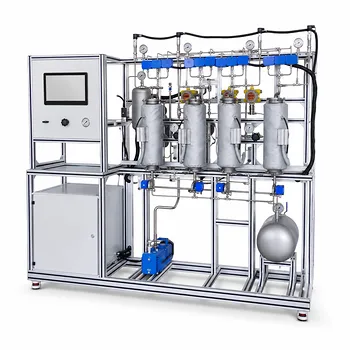
- Fixed-Bed Chemical Reaction and Gas Dust Tar Removal Unit Operations Pilot Plant
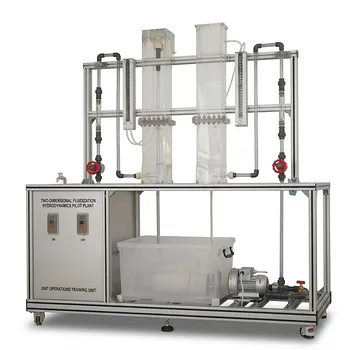
- Two-Dimensional Fluidization Hydrodynamics Educational Pilot Plant for Unit Operations Training
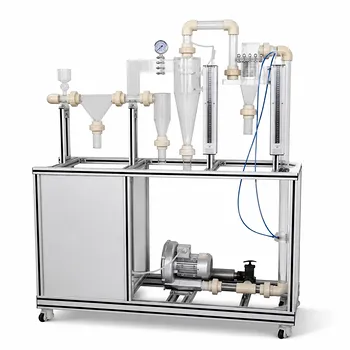
- Gas-Solid Heterogeneous Separation Demonstration Educational Unit Operations Pilot Plant
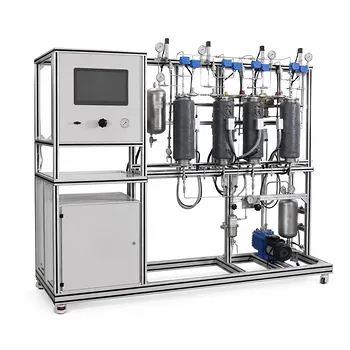
- Carbon Dioxide Adsorption and Capture Educational Unit Operations Pilot Plant
People Also Ask
- How do deviations in estimating latent heat impact pilot plant thermal systems? Avoid hardware mis-sizing.
- How to study gasification in pilot plants? Compare exit gas composition & efficiency
- Why Use PTFE & Hastelloy in Chemical Pilot Plants? Prevent Corrosion & Ensure Safety
- Why is the chemical plant startup schedule crucial? De-risk scale-up with pilot plants.
- When to transition from PID to adaptive control in pilot plants? Key process indicators.