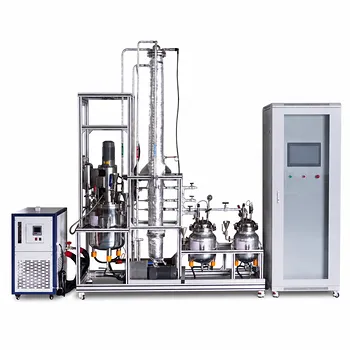
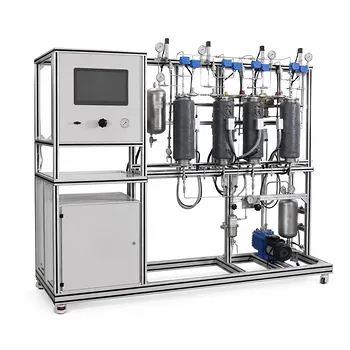
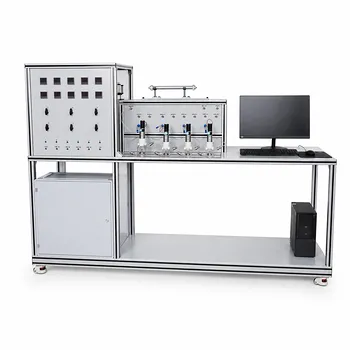
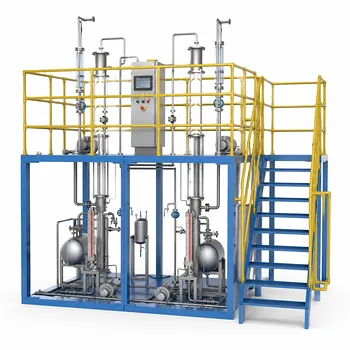
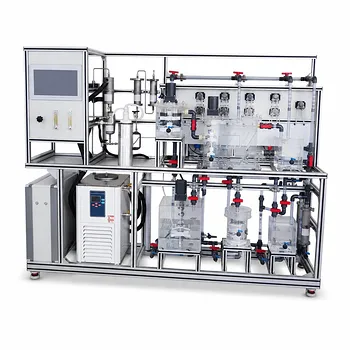
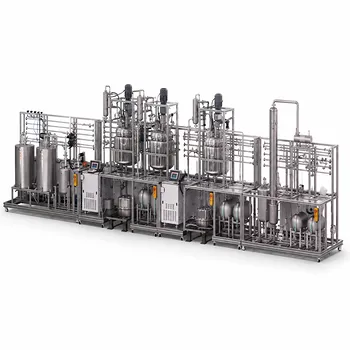
The core necessity is demonstrated in real time: A chemical engineering pilot plant that stages a primary reformer, high- and low-temperature shift reactors, and a methanation reactor visually proves that multi-step gas conditioning is not optional—it’s mandatory to protect a downstream synthesis catalyst from immediate, irreversible poisoning by carbon oxides.
A multi-stage gas conditioning train in a pilot plant turns an abstract threat into a measurable reality. By sampling the gas after each purification step, students and researchers directly observe how sequential conversion of CO to CO₂ and then to inert CH₄ prevents the catastrophic deactivation of sensitive catalysts, such as the iron-based catalysts used in ammonia synthesis. This hands-on evidence solidifies the principle that catalyst life and process economics demand rigorous impurity removal.
Why a Single Purification Step Falls Short
The raw gas leaving a reformer—often called synthesis gas—is a cocktail of hydrogen, carbon monoxide, and carbon dioxide. While hydrogen is the desired product, the carbon oxides are silent assassins for many downstream catalysts.
The Poisoning Mechanism
Iron-based ammonia synthesis catalysts, for example, form surface carbides and oxides when exposed to CO and CO₂. This permanently blocks active sites. Even a few parts per million of residual carbon oxides can slash catalyst activity in hours.
A single scrubber or adsorption bed cannot economically reduce concentrations from the 5–15% range down to the single-digit ppm level required. The thermodynamic driving force simply isn’t there in one stage.
Pressure and Temperature Constraints
A single-stage physical or chemical wash would demand enormous solvent flows, extreme pressures, or impractical temperatures. It’s like trying to drain a lake with a teaspoon—the kinetics and equilibrium don’t cooperate.
How a Pilot Plant Makes the Necessity Visible
An educational pilot plant, designed around a catalytic synthesis loop, places the entire conditioing sequence right on the benchtop. Students feed a simulated reformate blend and watch the transformation happen in stages.
From Reformer to Raw Synthesis Gas
The primary reformer reacts methane with steam over a nickel catalyst. The effluent is rich in H₂, but also contains 8–12% CO and 5–8% CO₂. If this gas touched an iron synthesis catalyst, the run would end within minutes.
The High-Temperature Shift (HTS) Stage
The gas first enters a high-temperature shift reactor, typically packed with an iron-chrome catalyst and operated around 350–450°C. Here, steam reacts with CO:
CO + H₂O ⇌ CO₂ + H₂ (exothermic)
The CO content drops to around 2–3%. The exothermicity makes temperature control a key learning point—too much adiabatic rise would limit conversion, just as it does in SO₂ oxidation pilot plants.
The Low-Temperature Shift (LTS) Stage
Next, the gas passes through a low-temperature shift reactor, using a copper-zinc-alumina catalyst at 190–250°C. Thermodynamics favor lower temperatures, so the CO slips further to roughly 0.1–0.5%.
Students measure the CO concentration at the LTS outlet using a gas chromatograph. They see the curve flatten—proof that equilibrium, not kinetics, now dominates. A single-stage simply couldn’t bridge this gap without an intermediate temperature reduction.
The Methanation Clean-Up
Even 0.1% CO is still 1000 ppm, which is still lethal to many synthesis catalysts. The final conditioning stage is a methanation reactor: a nickel bed at 250–350°C that converts residual carbon oxides into methane:
CO + 3 H₂ → CH₄ + H₂O CO₂ + 4 H₂ → CH₄ + 2 H₂O
After this step, the combined CO+CO₂ concentration drops below 10 ppm. The methane acts as an inert diluent and does not poison the downstream catalyst. A pilot plant demonstrates that this last polishing step consumes minimal hydrogen but buys the catalyst a long, productive life.
Understanding the Trade-offs
Multi-stage gas conditioning is essential, but it isn’t free. An honest look at the pilot plant reveals inherent compromises.
Hydrogen Consumption vs. Catalyst Protection
Every methanation reaction consumes valuable hydrogen. For a low-CO₂ stream, the loss is under 1%. But if the shift stages underperform, the methanation penalty rises sharply. The pilot plant teaches students to find the sweet spot between shift reactor efficiency and methanation hydrogen loss.
Complexity and Heat Management
Adding more reactors means more heat exchangers, pressure drop, and control loops. The pilot plant’s interstage coolers mimic industrial designs, showing how quenching or boiler feed water heating can recover energy. This physical confrontation with hardware pushes learners to appreciate that process integration trumps individual unit performance.
Methane Inert Build-Up
In a recycle loop, methane from the methanator can accumulate, diluting the reactants. The pilot plant reveals that a small purge stream is necessary, teaching the delicate balance between catalyst purity and synthesis loop productivity.
More Than Just Impurity Removal: A Broader Lesson in Process Integration
The multi-stage pilot plant echoes the logic seen in other critical catalytic processes, reinforcing the lesson that no single unit operation stands alone.
The Parallel with Multi-Bed SO₂ Oxidation
Like the four-bed SO₂ converter with interstage cooling pushes conversion to 98%, the shift-methanation train pushes impurity removal to nearly 100%. In both cases, sequential steps overcome a single-stage equilibrium or kinetic bottleneck. The pilot plant turns this abstract chemical engineering principle into a repeatable, measurable experiment.
Protecting the Final Synthesis Catalyst is the Anchor
Whether it’s ammonia synthesis, methanol production, or Fischer-Tropsch, all are preceded by some form of gas conditioning. The pilot plant’s modular approach—reformer, HTS, LTS, methanator—teaches that the cost of conditioning is always lower than the cost of catalyst replacement and lost production.
How to Apply This to Your Project
Whether you’re designing a new pilot plant or interpreting data from one, focus on the specific goal the gas conditioning serves.
- If your primary focus is education: Build the pilot plant with sample ports after each reactor. This allows students to plot the CO and CO₂ concentration staircase, turning a theoretical necessity into a visceral experience.
- If your primary focus is catalyst protection: Rigorously measure the outlet of the final purification stage. Confirm that CO+CO₂ is below the catalyst supplier’s limit before allowing synthesis reactor feed, and use the pilot data to set alarm thresholds.
- If your primary focus is process efficiency: Use the pilot plant to test different shift reactor operating temperatures and steam-to-carbon ratios. Find the minimum hydrogen loss in the methanator that still guarantees a safe impurity floor.
The pilot plant doesn’t just demonstrate a process—it ingrains the engineering discipline that a catalyst is only as good as the gas you feed it.
Summary Table:
| Conditioning Stage | Typical Catalyst & Temp | Core Reaction / Purpose | Exit CO Level |
|---|---|---|---|
| Primary Reformer | Nickel, 700–1000°C | Hydrocarbon reforming to produce syngas | 8 – 12% |
| High-Temp Shift (HTS) | Iron-Chrome, 350–450°C | $CO + H_2O \rightleftharpoons CO_2 + H_2$ (Bulk conversion) | 2 – 3% |
| Low-Temp Shift (LTS) | Copper-Zinc-Alumina, 190–250°C | Equilibrate CO levels at lower temperatures | 0.1 – 0.5% (1000–5000 ppm) |
| Methanation | Nickel, 250–350°C | $CO + 3 H_2 \rightarrow CH_4 + H_2O$ (Trace cleanup) | < 10 ppm |
Bring Industrial-Scale Insights to Your Lab with LABPARK
Teaching process integration and catalyst protection requires hands-on tools that turn abstract thermodynamics into measurable reality. LABPARK provides premium Educational and Vocational Unit Operations Pilot Plants in chemical engineering, bioprocess & biotech, and environmental & water treatment.
Designed specifically for universities, research institutes, and enterprises, our pilot plants feature multi-stage sampling ports, precise temperature controls, and industry-grade reactors. We help your students and researchers master critical concepts like equilibrium limitations, catalyst poisoning prevention, and energy integration.
Ready to upgrade your lab's capabilities? Contact LABPARK today to discuss your custom training and research equipment needs!
Related Products
- Methanol Synthesis and Catalyst Performance Evaluation Educational Unit Operations Pilot Plant
- Micro-Scale Gas-Solid Catalytic Reaction Educational Pilot Plant
- Carbon Dioxide Hydrogen Methanol Synthesis Educational Unit Operations Pilot Plant
- Fixed Bed Gas Solid Catalytic Reaction Educational Pilot Plant
- Multi Functional Catalytic Reaction and Reactor Evaluation Educational Unit Operations Pilot Plant
People Also Ask
- Why is a purge system necessary when operating a gas recirculation loop in a methanol synthesis pilot plant? (Guide)
- How do temp & pressure affect methanol synthesis pilot plants? Optimize equilibrium and catalyst performance.
- Why do modern methanol pilot plants operate at lower pressures? Catalyst & Feed Requirements Explained
- What are the operational requirements for catalyst activation? Safe Methanol Pilot Plant Operation
- Why Compare Predicted and Experimental Excess Enthalpy? Key to Accurate Pilot Plant Scale-up