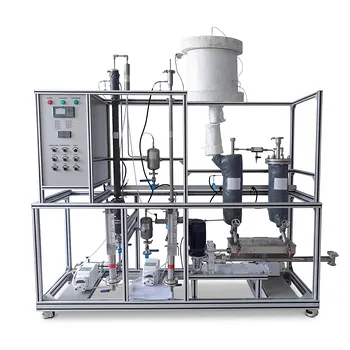
Voting systems and safety control architectures are the operational backbone of modern chemical pilot plants, translating abstract risk assessments into real-time hardware decisions. A Basic Process Control System (BPCS) actively maintains variables like temperature and pressure within safe operating ranges. An independent Safety Instrumented System (SIS) stands as the last line of defense, using redundant sensors and voting logic to trigger a shutdown only when a true hazard is detected. In educational pilot plants, architectures like ‘1oo2’ and ‘2oo3’ voting mirror industrial practice, teaching how to precisely balance safety integrity against the costly disruption of false trips—a core principle of the ALARP (As Low As Reasonably Practicable) framework.
The critical insight is that voting architectures resolve the direct conflict between safety and availability. While a BPCS handles the day‑to‑day dance of process control, the SIS applies a pre‑defined voting logic to sensor inputs, ensuring a shutdown happens only when the evidence is credible. For pilot plants handling real energy and hazardous materials, this dual‑layer, redundancy‑driven approach is not optional—it is the foundation of both safe operation and effective risk management education.
The Two-Layer Safety Architecture: BPCS and SIS
A pilot plant’s safety and process control depends on a clear separation of duties between two independent systems. Understanding this layered defense is the first step toward designing a system that is both reliable and instructive.
The Role of the BPCS: Keeping Processes Within Bounds
The BPCS is the active, continuous operator of the plant. Its job is to maintain temperature, pressure, flow, level, and concentration within predetermined limits.
In continuous processes, it sustains steady-state conditions. In batch operations, it controls rates of change (gradients) to prevent dangerous overshoot. Alarm flooding—overwhelming operators with minor deviations—must be avoided by configuring alarms only when variables genuinely leave safe boundaries. The BPCS, with its computer control, can even apply a safety compensation factor (credit factor 0.93–0.99) to lower the overall process risk index, directly reducing the calculated consequence of an accident.
The Role of the SIS: The Independent Safety Layer
The SIS is a separate, dormant shield. It wakes only when the BPCS has failed or a disturbance is too fast for normal control. Its sole purpose is to execute a predetermined safe state—typically a shutdown.
SIS loops consist of sensors, a logic solver (like a safety PLC), and final elements (valves, relays). Crucially, the SIS must be independent from the BPCS so that a common software bug or operator error does not disable both protection layers. This separation enforces the IEC 61511 standard’s logic of layered protection.
Redundancy and Voting: The Heart of SIS Integrity
The reliability of an SIS is not just about using high‑quality components. It is about how you combine their signals—and that is where voting logic becomes the central design lever.
Why Simple Redundancy (1oo2) Increases Nuisance Trips
A ‘1 out of 2’ (1oo2) architecture shuts the plant down if any single sensor detects a hazard. This drastically lowers the Probability of Failure on Demand (PFD) because both sensors would have to fail simultaneously to miss a real danger.
However, every sensor has a random failure mode that can falsely indicate a hazard. In a 1oo2 system, a single spurious failure immediately triggers a spurious trip. The system is highly safe but punishes continuous operation with frequent, unnecessary shutdowns—a serious drawback in a pilot plant where repeated restarts waste time, materials, and can even create new transient risks.
The 2oo3 Solution: Balancing Safety and Availability
A ‘2 out of 3’ (2oo3) architecture solves the false‑trip problem. A shutdown is commanded only when at least two of the three independent sensors agree that a hazardous condition exists.
This configuration retains a very low PFD (two simultaneous dangerous failures are needed to miss a real event) while tolerating a single, false signal without a trip. For a pilot plant, this means process continuity is preserved while safety integrity is maintained. Programmable Logic Controllers (PLCs) or Distributed Control Systems (DCS) execute this voting logic, giving students a tangible lesson in how industrial facilities stay safely online.
Understanding the Trade-offs
No voting architecture is universally superior. The choice comes with specific pitfalls that an informed design must address.
Spurious Trips vs. Missed Detections
The fundamental trade‑off is between spurious trips (availability) and missed detections (safety). 1oo2 maximizes safety at the expense of production; 2oo3 brings them into a more harmonious balance but requires more hardware and careful common‑cause failure analysis. In a research pilot plant, an unplanned shutdown might ruin a month‑long catalyst study, making availability a legitimate concern alongside baseline safety.
Data Quality and Model Extrapolation Risks
Pilot plants often use empirical chemometric models for advanced control. These models are blind outside their calibration dataset. Extrapolating to new temperatures or concentrations is dangerously unreliable, and overfitting can hide this limp. A BPCS driven by a flawed model can violate safe limits without warning. The SIS voting logic must therefore act on raw, hard‑wired trip points and not on model‑derived estimates, unless the model’s uncertainty is rigorously quantified.
Alarm Management and Operator Response
Voting logic reduces false trips, but alarms still demand human attention. When a 2oo3 system registers a single channel deviation, it should generate a diagnostic alert, not a plant‑wide alarm. This prevents alarm flooding and ensures the operator has adequate response time before the SIS escalates to a shutdown. Good voting architectures are invisible during normal operations but crystal clear during events.
How These Architectures Serve the Educational Mission
Pilot plants are not just miniature factories; they are classrooms. The way voting and safety layers are implemented directly teaches the principles of inherently safer design.
Embodying the ALARP Principle
By requiring students to calculate risk reduction factors and justify whether a 1oo2 or 2oo3 system achieves ALARP, the pilot plant converts theory into practice. Redundant voting architectures visually demonstrate how compensation factors (like emergency shutdown systems with a credit of 0.96–0.99) stack to reduce risk. Students learn that safety is engineered, not added on.
Validating SIS and Interlocks
A pilot plant must incorporate routine validation: testing safety interlocks, confirming alarm logic, and inspecting pressure relief devices. For a 2oo3 system, this means verifying that the plant shuts down correctly on a 2‑out‑of‑3 signal but stays online with one channel bypassed. Such hands‑on testing ingrains an understanding of functional safety testing that no lecture can replace.
Making the Right Choice for Your Pilot Plant
The optimal voting and control architecture depends on what you are trying to achieve—safety integrity, operational uptime, educational breadth, or all three.
- If your primary focus is maximum safety integrity: Use a 1oo2 or even a 2oo3 architecture with a stringent PFD target. Prioritize sensor diversity and frequent proof testing. Understand that spurious trips will be higher, so plan batch operations around potential interruptions.
- If your primary focus is operational continuity for long‑duration experiments: Implement a 2oo3 voting SIS. Tolerate a single sensor failure without trip. Pair this with a robust BPCS that uses validated control models and conservative alarm thresholds to keep the plant stable without drifting into unsafe territory.
- If your primary goal is teaching IEC 61511 / ALARP principles: Design a flexible system where students can reconfigure between 1oo2 and 2oo3 logic (using a configurable safety PLC). Let them measure PFD, spurious trip rates, and risk reduction factors. This turns the plant into a living laboratory for risk management.
- If you are constrained by budget or hardware complexity: A 1oo2 SIS is simpler and cheaper. Compensate by investing in a top‑quality BPCS with well‑designed alarms and a strong operator‑training program. Remember that the BPCS’s own safety compensation factor can lower your overall risk index, reducing the SIL requirement on the SIS.
The voting architecture you choose becomes the physical philosophy of your plant. It quietly teaches everyone who operates it that safety is not a binary switch but a reasoned, measured decision between competing risks.
Summary Table:
| Architecture | Safety Integrity (PFD) | Spurious Trip Rate (Availability) | Ideal Application |
|---|---|---|---|
| 1oo2 (1 out of 2) | High Safety (Low PFD) | High (Lower Availability) | Budget-constrained setups, high-risk batch processes |
| 2oo3 (2 out of 3) | High Safety (Low PFD) | Very Low (High Availability) | Continuous pilot runs, advanced industrial safety training |
Elevate Safety and Process Control in Your Labs
Designing safe, industrially relevant learning environments requires the right equipment. LABPARK provides state-of-the-art Educational and Vocational Unit Operations Pilot Plants in chemical engineering, bioprocess & biotech, and environmental & water treatment.
We help universities, research institutes, and enterprises bridge the gap between theory and industrial reality with systems featuring standard BPCS and SIS architectures.
Ready to upgrade your laboratory with compliant, high-performance pilot systems? Contact LABPARK today to discuss your custom specifications.
Related Products
- Fixed Bed Gas Solid Catalytic Reaction Educational Pilot Plant
- Carbon Dioxide Hydrogen Methanol Synthesis Educational Unit Operations Pilot Plant
- Ethyl Acetate Synthesis Unit Operations Pilot Plant for Practical Training
- Natural Product Extraction Unit Operations Training Pilot Plant
- Green Anhydrous Ethanol Refining Practical Training Pilot Plant
People Also Ask
- How do reactor pilot plants safely study gas-solid reactions? Master kinetics with thermal & flow control.
- How does the Mears criterion evaluate transport resistance? Key Guide to Intrinsic Kinetics
- Why is a multibed configuration necessary for exothermic reactions? Optimize your pilot plant trajectory.
- Fluidized vs. Fixed Bed Reactors: Comparing Heat & Complexity in Pilot Plants
- How is the friction factor determined for fixed-bed pilot plants? Select the best pressure drop correlation.