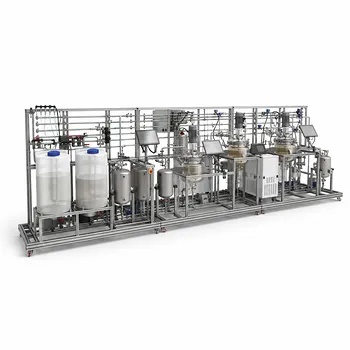
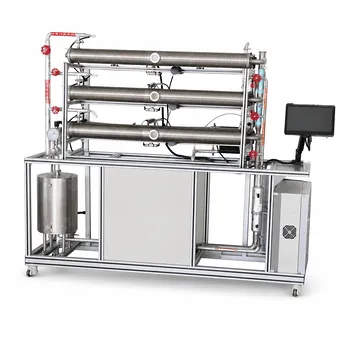
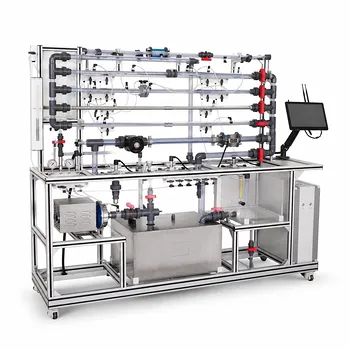
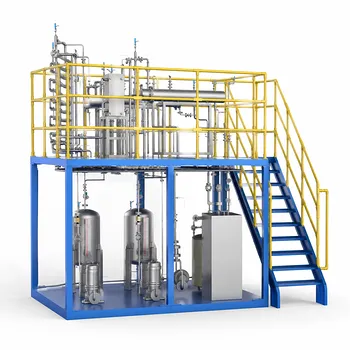
The answer is straightforward but profound: pilot plants transform utility costs from abstract numbers into a physical, measurable reality. By operating scaled-down versions of industrial processes like distillation columns, reactors, and heat exchangers, students can directly meter steam flow, electrical power draw, and cooling water usage under controlled conditions. This hands-on data becomes the raw material for accurate cost estimation, bridging the gap between textbook formulas and the messy, real-world variables that define industrial profitability.
Utility costs are not just a line item—they are the physical manifestation of energy and mass flows. Unit operations pilot plants give students the unique ability to measure these flows directly, apply scaling principles, and build the engineering judgment needed to estimate, optimize, and defend utility cost calculations for any process.
From Theory to Reality: Why Pilot Plants Are Essential
Chemical process economics relies heavily on utility estimates, yet classroom models often feel disconnected from the noisy, heat-leaking, scale-dependent world of a real plant. Pilot plants solve that disconnect by placing students directly in the path of physical flows.
Bridging the Gap Between Textbooks and Industrial Practice
Theoretical calculations assume perfect insulation and fixed efficiencies. Pilot plants reveal the truth: heat loss from uninsulated pipe sections, variable pump efficiencies, and the real cost of transient operations. By confronting these imperfections, students learn that utility estimation is not a single number but a range shaped by operating conditions and plant design.
Direct Measurement of Critical Utility Flows
In a pilot-scale distillation column, students can install a steam flowmeter on the reboiler, a power meter on the feed pump, and a rotameter on the condenser cooling water line. This transforms abstract concepts into tangible data. A logged electrical load of 1.2 kW or a steam consumption of 15 kg/h at 3 bar becomes a concrete foundation for economic analysis, no longer a hypothetical variable plucked from a simulator.
Estimating Steam Costs: More Than Just a Number
Steam is often the largest single utility cost in chemical plants, yet its true price is a complex function of generation method, pressure level, and condensate recovery. Pilot plants provide the ideal sandbox for exploring these layers.
Calculating the True Cost of Steam Generation
Students can trace steam costs back to fundamentals. Using pilot-plant data, they quantify the heat duty actually delivered to the process and then back-calculate the fuel required at the boiler. With a boiler efficiency of $0.8$–$0.9$ and the heat needed for preheating, vaporization, and superheating, they estimate cost as a function of local fuel price. Pilot plants make this exercise tangible—students can tweak reboiler duty and immediately see the fuel-cost impact.
Accounting for Steam Pressure Levels and Cogeneration Value
High-pressure steam generated for a pilot reactor or distillation column can be passed through a turbine, producing shaft work (electricity equivalent) before being used at a lower pressure. By measuring inlet and outlet conditions, students calculate the economic value of the lower-pressure steam as the high-pressure cost minus the value of the generated electricity. This hands-on application embeds the principles of energy cascading and cogeneration far more deeply than a lecture slide ever could.
The Role of Condensate Recovery and Energy Integration
In a pilot plant, condensate can be collected and returned, giving students a direct measurement of how much boiler feedwater makeup is saved. Feedwater cost—often estimated at twice the raw water price due to treatment and deaeration—becomes a visible line item. Students see that every liter of condensate not recovered is not just wasted water but wasted chemical treatment and energy, reinforcing the financial logic of heat integration networks like pinch analysis.
Electricity and Cooling Water: Tracking the Invisible Costs
While steam grabs attention, electricity and cooling water are silent, steady cost drivers that can decimate profitability if ignored. Pilot plants make these invisible flows visible.
Measuring Electrical Load in Pumps, Compressors, and Agitators
Every pump, agitator, and compressor in a modular pilot plant draws a measurable electrical load. Students log real-time power data and correlate it with process conditions—a higher reflux ratio demands more pump work, a faster stirrer speed raises motor current. This causal link between operational decisions and utility cost builds an intuitive grasp of variable production expenses.
Cooling Water Flow and Thermal Duty: Turning Delta T into Dollars
A pilot-scale condenser with a known cooling water flow and temperature rise gives a direct measurement of thermal duty. Students can immediately convert that thermal removal into a cost, using local water tariffs and pumping energy. They quickly discover that a small increase in reflux ratio can double cooling water consumption—a lesson that programs the brain to question the default settings on any industrial design.
Scaling Up: From Pilot Data to Industrial Cost Projections
The pilot plant is not the final answer; it is a data generator for scaling. The most valuable skill students gain is translating their measurements into credible industrial estimates.
Applying the Capacity Ratio Exponent to Utility Demands
Industrial investment estimates frequently use the scaling factor $n \approx 0.6$ for capital costs, but utility demands often scale differently—sometimes linearly with capacity, sometimes with a similar exponent. By running pilot plants at multiple throughputs, students collect their own empirical scaling curves for steam, power, and cooling water. They see firsthand that utility consumption does not double when capacity doubles, and they learn to justify the exponent they choose.
Understanding the Chemical Supply Curve Through Pilot Plant Data
Pilot plants give students a tangible experience of the chemical supply curve. They measure utility costs per kilogram of product at pilot scale and compare it to published industrial benchmarks. The pilot unit’s higher specific utility consumption (due to greater surface-to-volume heat losses and smaller economies of scale) directly demonstrates why large, efficient plants near cheap raw materials dominate the low-cost end of the supply curve. This insight transforms cost estimation from a sterile exercise into a strategic design driver.
Understanding the Trade-offs and Limitations
No educational tool is perfect, and pilot plants come with their own cautionary tales. A responsible advisor must highlight where uncritical extrapolation can mislead.
Accuracy Limitations at Small Scale
Pilot-scale units often suffer from proportionally larger heat losses and wall effects that do not scale linearly. A student who naively multiplies pilot-level steam consumption by a capacity factor may overestimate industrial utility costs. The real lesson is learning to isolate scale-independent variables and apply correction factors—a critical skill in professional cost engineering.
Infrastructure Constraints Shape the Learning
The available utility infrastructure in a university lab—limited cooling water flow, electrical panel capacity, or steam generator size—can constrain experimental design. Students must learn to match pilot plant demands to lab infrastructure, just as engineers do when siting a real plant. This constraint is a feature, not a bug, because it teaches realistic front-end planning.
The Risk of Over-Focusing on a Single Data Point
Pilot plants are powerful, but one experimental run does not make a reliable cost estimate. Students must be taught to view their measurements as part of a probabilistic range, influenced by ambient temperature, fouling, and measurement error. The true objective skill is not generating a single cost figure but building a defensible cost model with justified assumptions.
Making the Right Choice for Your Learning Goal
How you leverage a unit operations pilot plant depends on what you need to achieve. Tailor your approach to the specific skill you want to build.
- If your primary focus is mastering cost estimation fundamentals: Use the pilot plant to run full mass and energy balances, then convert every measured joule and kilogram of steam into a cost using local fuel and water prices. Anchor every number in physical measurement.
- If your primary focus is learning scale-up methodology: Collect utility data at three to four different throughputs, develop empirical scaling exponents, and critically compare them to the classic $n=0.6$ rule. Discuss why your exponents differ for steam versus electricity versus cooling water.
- If your primary focus is process optimization and energy integration: Vary operating parameters like reflux ratio, feed preheat, or reactor temperature to map utility sensitivity. Then implement a simple heat recovery loop and measure the tangible savings—the pilot plant becomes your energy-integration laboratory.
- If your primary focus is building front-end loading and feasibility skills: Assess the utility infrastructure demand of a candidate pilot process (e.g., hydrocracking’s high electrical need versus extraction’s large cooling water demand) and compare it to your lab’s capacity. This mirrors the real-world exercise of matching a plant design to a site’s utility envelope.
Ultimately, a unit operations pilot plant does more than compute costs—it builds the engineering intuition to ask the right questions when the spreadsheet cells are blank. That’s the difference between estimating a utility cost and truly understanding it.
Summary Table:
| Utility Type | Key Pilot Plant Measurement | Educational Value / Scaling Insight |
|---|---|---|
| Steam | Flowmeter on reboiler, fuel-to-steam tracking | Teaches cogeneration value, boiler efficiency, and condensate recovery economics. |
| Electricity | Real-time power draw on pumps, compressors | Connects operational choices (e.g., reflux ratio, motor speed) directly to power costs. |
| Cooling Water | Flow rate and temp rise ($\Delta T$) across condenser | Shows how thermal duty translates to cost, reinforcing the need for heat integration. |
Empower Your Students with Hands-On Engineering Experience
Bridge the gap between textbook formulas and real-world process economics. LABPARK provides high-quality Educational and Vocational Unit Operations Pilot Plants in chemical engineering, bioprocess & biotech, and environmental & water treatment.
Tailored for universities, research institutes, and enterprises, our systems enable students and researchers to master utility cost estimation, scale-up principles, and process optimization under real-world conditions.
Ready to upgrade your laboratory's capabilities? Contact LABPARK today to find the ideal pilot plant solution for your institution!
Related Products
- Multi-Functional Drying Educational Unit Operations Pilot Plant
- General Purpose Cosmetics Production Unit Operations Training Pilot Plant
- Multi-Reactor Educational Pilot Plant for Reaction Engineering Unit Operations
- Dual-Mode Rectification Pilot Plant for Practical Training Unit Operations
- Multimodal Absorption and Desorption Pilot Plant for Unit Operations Training
People Also Ask
- How do deviations in estimating latent heat impact pilot plant thermal systems? Avoid hardware mis-sizing.
- How to study gasification in pilot plants? Compare exit gas composition & efficiency
- Why Use PTFE & Hastelloy in Chemical Pilot Plants? Prevent Corrosion & Ensure Safety
- Why is the chemical plant startup schedule crucial? De-risk scale-up with pilot plants.
- When to transition from PID to adaptive control in pilot plants? Key process indicators.