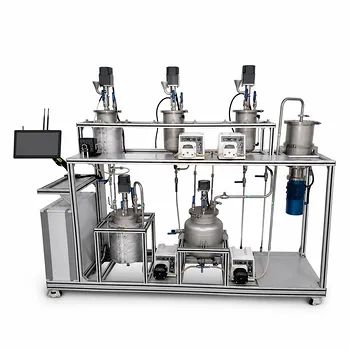
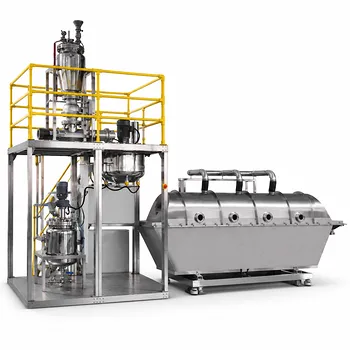
The answer lies in how a fluid resists flow. In chemical engineering pilot plants, the viscous and non-Newtonian properties of a reaction mixture directly dictate every major decision in mixer and pump design. These properties determine the agitator type, motor power, impeller geometry, and the entire pumping strategy, forcing engineers to move beyond standard Newtonian assumptions and often adopt specialized equipment like extruders or motionless mixers for extreme conditions.
Effective pilot-scale design starts with recognizing that most real reaction mixtures are not water. Viscosity influences power draw and flow regime, while non-Newtonian behavior—shear-thinning, shear-thickening, or yield stress—determines whether a mixer will leave dead zones, a pump will cavitate, or a heat exchange surface will fail to remove exothermic heat. The core impact is a complete re‑engineering of agitation and transport systems to maintain safe, uniform processing.
The Rheological Challenge: Newtonian vs. Non-Newtonian Fluids
Your first design constraint is not “how much” fluid you have, but “how it flows.”
Newtonian Fluids: A Constant Baseline
Newtonian fluids like water or light oils maintain a constant dynamic viscosity regardless of how fast they are sheared.
Standard mixing correlations (power number, Reynolds number) assume this behavior.
You can predict power input and flow patterns reliably with textbook equations.
Non-Newtonian Fluids: The Complexity Multiplier
Non-Newtonian fluids change their apparent viscosity with shear rate, massively complicating design.
Pseudoplastic (shear-thinning) fluids become less viscous as you mix faster—a polymer solution may be thick at rest but flow easily under an impeller’s high‑shear zone.
Dilatant (shear-thickening) fluids do the opposite; they get more viscous under shear, risking sudden pump overloads or impeller stall.
Bingham plastics require a yield stress before they will move at all; they behave like a solid until you overcome that threshold.
Why This Matters for Mixing and Pumping
Dead zones appear around a vessel when an impeller cannot transmit high enough shear to the wall to lower viscosity and mobilize the fluid.
Non-Newtonian behavior directly alters the Reynolds number used to predict laminar/turbulent transition, making standard flow regime maps unreliable.
Without adjusting for rheology, you can end up with a well‑powered mixer that still leaves half the contents stagnant.
Designing Agitators for Viscous and Non-Newtonian Mixtures
The agitator is not just a spinning blade—it is a shear-delivery machine. Its design must match the fluid’s character.
Impeller Selection: From Turbines to Anchors
Low‑viscosity Newtonian mixtures work well with radial‑flow turbines that shear fluid outward.
For high‑viscosity or shear‑thinning fluids, you need geometries like anchor impellers or helical ribbons that sweep close to the wall and induce bulk circulation, not just local turbulence.
When a mixture exhibits a yield stress, the impeller must generate enough torque to initiate flow throughout the entire vessel, favoring large‑diameter, low‑clearance designs.
Motor Power and Torque Requirements
Viscosity directly governs power draw. As a polymerization progresses and viscosity rises, the agitator’s power input must increase substantially.
Standard motors with a fixed speed may stall; variable‑speed, high‑torque drives become essential in pilot‑scale reactors to maintain agitation across the whole reaction profile.
The motor must be sized for the peak apparent viscosity, not the initial water‑like state.
The Role of Baffles and Flow Patterns
Without baffles, a rotating impeller creates a central vortex and tangential swirl, delivering poor mixing in viscous fluids because of minimal shear between layers.
Installing baffles converts tangential flow into axial or radial secondary circulation, dramatically improving mixing efficiency and reducing dead zones.
For shear‑sensitive non‑Newtonian fluids, baffle design becomes a delicate balance—enough circulation without over‑shearing that degrades product or causes unwanted shear-thickening.
Heat Transfer Implications
In exothermic polymerizations, rising viscosity collapses the heat transfer coefficient. Efficient mixing becomes the only way to push heat to the jacket or internal coils.
Pilot reactors must therefore pair heavy‑duty agitation with highly responsive cooling surfaces.
If the agitator fails to refresh the fluid at the wall, you risk runaway reactions and uneven product quality, even if the bulk temperature looks stable.
Conveying and Pumping Solutions for Challenging Rheologies
Transporting a reaction mixture from vessel to vessel is just as critical as mixing it inside one.
Centrifugal vs. Positive Displacement Pumps
Centrifugal pumps rely on kinetic energy and are excellent for low‑viscosity, Newtonian fluids. However, they perform poorly when viscosity spikes or when non‑Newtonian behavior reduces flow at a given speed.
Positive displacement pumps (gear, progressive cavity, or peristaltic) move a fixed volume per revolution, making them far more reliable for high‑viscosity or yield‑stress fluids.
In pilot plants, you often select the pump based on the fluid’s maximum apparent viscosity and its shear‑thickening tendency—a positive displacement pump can handle a sudden dilatant surge without stalling.
Alternative Devices: Extruders and Motionless Mixers
For extremely viscous pastes or melts (e.g., late‑stage polymerization), standard agitators and pumps become impractical.
Motionless (static) mixers use a series of fixed elements in a pipe to repeatedly split and recombine the flow, providing efficient mixing without moving parts and with minimal shear damage.
Extruders simultaneously convey and mix, applying intense shear in a controlled screw channel. In some pilot plant configurations, they replace both the reactor agitator and the transfer pump for handling materials that hardly flow under gravity.
Understanding the Trade-offs
No solution is without compromise. Acknowledge where the design must bend to reality.
High Torque vs. Shear Sensitivity
Large, high‑torque agitators can eliminate dead zones but may over‑shear sensitive polymers or biological molecules, degrading product performance.
This forces a trade‑off between mixing homogeneity and maintaining molecular integrity, often leading to the use of low‑shear impellers like marine propellers or hydrofoils operated at moderate speeds.
Energy Cost and Equipment Scalability
Heavy‑duty variable‑speed drives and positive‑displacement pumps are more expensive and energy‑intensive than simple centrifugal setups.
A pilot plant must balance the need for accurate scale‑down against these costs. A design that works perfectly at bench scale may not translate to pilot scale if the fluid properties change nonlinearly with volume.
The Danger of Stagnant Zones and Runaway
A conservative design might over‑shear, but an under‑engineered one risks catastrophic stagnant regions.
In exothermic polymerizations, a single dead zone can accumulate heat faster than the cooling system can remove it, leading to rapid product degradation or even a dangerous exotherm. The design must therefore fail on the side of over‑agitation, then be optimized down.
Making the Right Choice for Your Pilot Plant Goal
Every reactive system demands a custom engineering response. Align your design priorities with your primary objective.
- If your primary focus is homogeneous mixing of a shear‑thinning fluid: Choose a large‑diameter anchor or helical‑ribbon impeller with wall‑scraping capability, supported by a variable‑speed drive that can increase torque as the reaction proceeds, and ensure baffles are present to break tangential flow.
- If your primary focus is safe removal of exothermic heat in a high‑viscosity polymerization: Size the agitator for the peak viscosity, couple it with a highly responsive heating/cooling jacket or internal coils, and use a positive‑displacement pump to reliably transfer the reactor contents without flow starvation.
- If your primary focus is conveying a yield‑stress or extremely viscous product between unit operations: Skip the centrifugal pump and evaluate a progressive‑cavity pump or, for paste‑like materials, an extruder that simultaneously mixes and moves the fluid.
- If your primary focus is maintaining fluid integrity and avoiding shear‑induced degradation: Move to low‑shear axial impellers, eliminate unnecessary baffle edges, and consider motionless mixers for in‑line blending to minimize exposure to high shear zones.
Your pilot plant is a physical hypothesis. The fluid’s viscosity and non-Newtonian identity will tell you, unambiguously, whether your equipment passes the test—design it to listen.
Summary Table:
| Fluid / Property Type | Mixing Component Design | Pumping & Conveying Solution |
|---|---|---|
| Newtonian (Low Viscosity) | Radial-flow turbines, standard baffles | Centrifugal pumps |
| Shear-Thinning (Pseudoplastic) | Anchor or helical ribbon impellers, variable-speed drives | Positive displacement pumps (gear, peristaltic) |
| Shear-Thickening (Dilatant) | High-torque, variable-speed drives, careful baffle spacing | Positive displacement pumps (sized for peak viscosity) |
| Yield Stress & High Viscosity | High-torque wall-scraping impellers, large diameters | Progressive cavity pumps, extruders, static mixers |
Optimize Your Pilot Scale Operations with LABPARK
Handling complex viscous and non-Newtonian reaction mixtures requires specialized, precisely engineered equipment. LABPARK provides state-of-the-art Educational and Vocational Unit Operations Pilot Plants in chemical engineering, bioprocess & biotech, and environmental & water treatment.
We help universities, research institutes, and enterprises design systems that eliminate dead zones, handle high shear, and prevent runaway reactions.
Contact LABPARK today to discuss your custom pilot plant configuration with our engineering experts!
Related Products
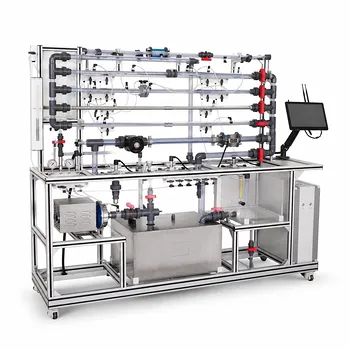
- Multi Pump Fluid Transport Process Piping Unit Operations Training Pilot Plant
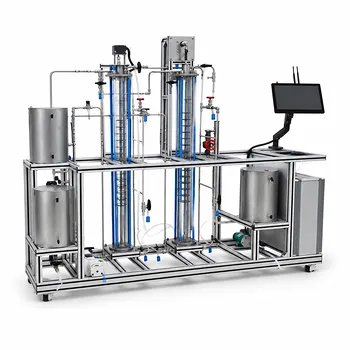
- Chemical Pipeline Assembly and Fluid Transport Practical Training Unit Operations Pilot Plant
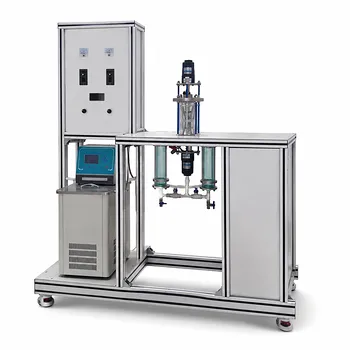
- Agitation and Mixing Educational Unit Operations Pilot Plant
- Gas Phase Mixing and Residence Time Distribution Determination Educational Unit Operations Pilot Plant
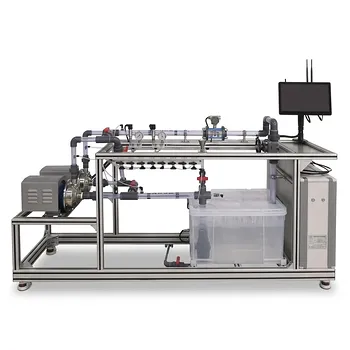
- Fluid Transport and Piping Dynamics Practical Training Unit Operations Pilot Plant
People Also Ask
- Why distinguish Newtonian & non-Newtonian fluids in pilot plants? Prevent design errors.
- Why is the chemical plant startup schedule crucial? De-risk scale-up with pilot plants.
- When to transition from PID to adaptive control in pilot plants? Key process indicators.
- How to study gasification in pilot plants? Compare exit gas composition & efficiency
- How do deviations in estimating latent heat impact pilot plant thermal systems? Avoid hardware mis-sizing.