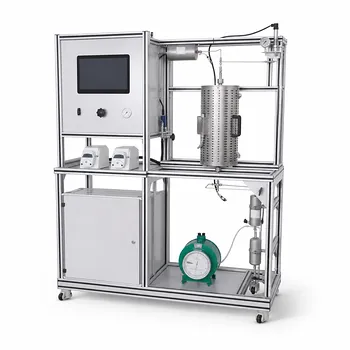
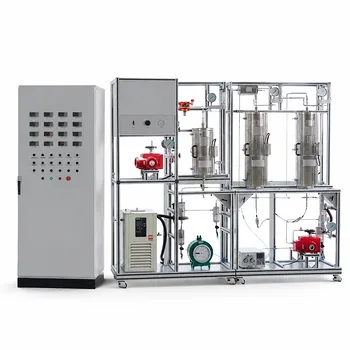
Bulk polymerization’s runaway heat and syrupy viscosity aren’t just lab curiosities—they are the central design constraints of any pilot plant reactor. As monomer converts to polymer, the reaction releases intense heat while viscosity skyrockets. This triggers the “gel effect” (auto‑acceleration), which generates heat faster than conventional cooling can remove it. In turn, pilot plants must integrate high‑torque agitation, highly responsive heating/cooling surfaces, and precision temperature‑monitoring safety systems to prevent hot spots, product degradation, and thermal runaway.
Bulk polymerization’s auto‑acceleration and soaring viscosity force pilot‑plant designs to focus on three imperatives: moving high‑viscosity fluids with powerful, specialized agitators; removing heat through large, fast‑responding jackets or coils; and continuously tracking temperature to catch runaway events before they start. Every other design decision—impeller type, pre‑polymerization strategy, even batch vs. continuous mode—flows from this heat‑and‑viscosity bottleneck.
The Twin Challenges of Bulk Polymerization
The Thermal Runaway Risk
The reaction is highly exothermic. As conversion climbs beyond roughly 15–25%, the growing chain population makes it harder for radicals to terminate, yet propagation continues unhindered. The result is a self‑reinforcing heat surge—the auto‑acceleration or gel effect. Without rapid heat removal, bulk temperature can spike locally, broadening the molecular‑weight distribution and, in severe cases, triggering a runaway that over‑pressurizes the reactor. Pilot plants must faithfully reproduce this dangerous transient, so their design starts with the assumption that thermal control can fail quickly if not engineered for the worst‑case rate of heat release.
Viscosity Soars and Mixing Fails
Almost simultaneously, the reaction mass thickens to a syrupy or paste‑like state (melt viscosities can reach 600 Pa·s in some systems). This collapse in fluidity dismantles natural convection and dampens turbulent mixing. The heat transfer coefficient at the vessel wall plummets, and concentration gradients appear. In a pilot plant, if the agitator cannot keep the material moving, the sensor‑to‑jacket control loop becomes useless—you’ll cool the wall while the core overheats unseen. So the design must solve a mechanical problem first: move the unstirrable before you can cool it.
How These Challenges Shape Reactor Design
High‑Torque Agitation Systems
Standard impellers stall or break when viscosity rises to the non‑Newtonian regime. Pilot‑plant reactors therefore deploy high‑torque, variable‑speed agitators built for the peak load. The impeller type matters: close‑clearance designs such as anchors, helical ribbons, or frames scrape the wall to renew the heat‑transfer surface and pull the bulk radially. For the thickest stages, some pilots even use twin‑screw extruders as combined pump‑mixers, trading shear intensity for positive conveyance. The drive train is reinforced to handle the motor’s full torque without twisting, and speed control allows a gentle ramp‑up during the early, low‑viscosity phase to avoid splashing or entrained air.
Maximized Heat Transfer Surface
Jackets alone often cannot pull heat fast enough when viscosity kills the wall film coefficient. Pilots compensate by adding internal coils, half‑pipe jackets, or multiple‑zone cooling circuits. These are fed by thermal fluid systems that can switch between heating and cooling within seconds—critical when the onset of auto‑acceleration demands an abrupt shift from a gentle warm‑up to full‑scale heat rejection. Surface‑area‑to‑volume ratios are deliberately larger than in production units because the small scale already penalizes heat removal; pilot reactors frequently run at the edge of what a given surface can manage, teaching operators exactly where the limit lies.
Precision Temperature Control and Safety Systems
A single bulk thermocouple often misreads the core temperature in a viscous, poorly mixed medium. Therefore pilot plants employ multiple, distributed sensors—side‑wall thermocouples, fast‑response RTDs inserted at several depths, and sometimes infrared monitoring of the outer jacket return fluid to infer the real heat flux. These feed an interlock system that can trigger short‑stop inhibitor injection, emergency cooling, or even reactor quench if the temperature ramps beyond a defined trajectory. Such a network transforms the vessel from a passive container into an active safety instrument, allowing researchers to study runaway scenarios under controlled conditions.
Understanding the Trade‑offs and Pitfalls
While these design features solve the heat‑and‑viscosity problem, they introduce their own compromises that a good pilot‑plant design must acknowledge:
- Shear‑induced degradation: High‑torque, close‑clearance agitators can snap polymer backbones, especially at later stages when molecular weight is high. The pilot plant must balance mixing intensity against mechanical chain scission—often by limiting tip speed and selecting impellers that move the fluid with minimal stretch.
- Pre‑polymerization complexity: To bypass the worst viscosity surge and volume shrinkage, many pilots add a pre‑polymerization step (15–25% conversion) in a separate vessel or zone. This complicates the flowsheet but drastically reduces the heat load in the main reactor. The trade‑off is an extra transfer step that can introduce oxygen or contamination.
- Batch vs. continuous operation: A stirred tank might struggle with post‑gel viscosity, while a continuous loop reactor can exploit fresh, low‑viscosity feed to lubricate the mixture. However, continuous systems require elaborate residence‑time control to keep product distribution narrow. Pilot plants must often be reconfigurable to test both modes, raising cost.
- Instrument lag: All the temperature sensors and actuators in the world won’t help if the controller cannot anticipate the gel effect’s speed. Model‑predictive or cascade loops are often needed, adding software complexity that smaller pilots may find daunting.
Making the Right Choice for Your Pilot Plant Goal
The heat‑and‑viscosity challenge isn’t a one‑size‑fits‑all problem. Tailor your pilot‑plant design to your primary research or production‑scale‑up objective:
- If your primary focus is studying fundamental kinetics and the gel effect: Build a highly instrumented, small‑volume autoclave with extraordinarily fast cooling response and multi‑point temperature sensing. Accept limited mechanical mixing if it means you can catch every thermal inflection.
- If your primary focus is scaling‑up to an industrial bulk process: Invest in a mid‑scale pilot with a heavy‑duty anchor or helical‑ribbon agitator, large internal coil area, and a staged temperature control that mimics planned production cycles. Include a pre‑polymerization loop to validate the full flowsheet.
- If your primary focus is product quality and molecular‑weight control: Prioritize shear‑minimizing impellers and gentle temperature ramps. Consider feeding a partially converted, viscous “seed” into the reactor to dampen runaway while maintaining narrow distribution. Add online viscometry or in‑situ spectroscopy to watch conversion in real time.
- If your primary focus is safety and runaway characterisation: Design the pilot with deliberate fail‑safe triggers—emergency quench tanks, short‑stop injection, and burst discs sized for the worst‑case gas generation. Use a smaller diameter vessel to reduce the ratio of core volume to cooled surface.
Ultimately, a bulk polymerization pilot plant is not a scaled‑down factory; it is a risk‑amplifier and learning tool that forces you to confront heat and viscosity at their most dangerous intersection, directly informing whether your chemistry can survive the jump from beaker to market.
Summary Table:
| Challenge | Key Impact | Reactor Design Solution |
|---|---|---|
| Thermal Runaway (Gel Effect) | Auto-acceleration; rapid, dangerous heat release | Multi-zone cooling jackets, internal coils, emergency quenches |
| Soaring Viscosity | Loss of convection, poor mixing, wall film breakdown | High-torque variable-speed agitators, anchor/helical impellers |
| Shear Degradation | Chain scission of high-MW polymers | Shear-minimizing impellers, speed ramp-up control |
| Control/Sensor Lag | Inaccurate core temp readings, slow thermal response | Multi-point distributed RTD sensors, model-predictive controls |
Safely Scale Your Chemical Reactions with LABPARK
Handling the extreme heat and viscosity of bulk polymerization requires highly specialized reactor engineering. LABPARK provides state-of-the-art Educational and Vocational Unit Operations Pilot Plants in chemical engineering, bioprocess & biotech, and environmental & water treatment tailored for universities, research institutes, and enterprises.
We help you safely study kinetics, optimize product quality, and scale up processes with robust, high-torque, and thermally responsive pilot systems.
Let’s build a safer, more efficient pilot plant together—contact us today to get started!
Related Products
- Polymerization Granulation and Pellet Processing Educational Unit Operations Pilot Plant
- Methanol Synthesis and Catalyst Performance Evaluation Educational Unit Operations Pilot Plant
- Multi-Reactor Educational Pilot Plant for Reaction Engineering Unit Operations
- Fixed-Bed Chemical Reaction and Gas Dust Tar Removal Unit Operations Pilot Plant
- Methane Cracking Educational Unit Operations Pilot Plant
People Also Ask
- How do educational unit operations pilot plants address safety and waste management when scaling up?
- How do educational unit operations pilot plants bridge theory and design? Bridge the Engineering Gap
- What role do educational pilot plants play in scaling green chemistry? Bridging the Lab-to-Industry Gap
- Why Compare Predicted and Experimental Excess Enthalpy? Key to Accurate Pilot Plant Scale-up
- When to transition from PID to adaptive control in pilot plants? Key process indicators.