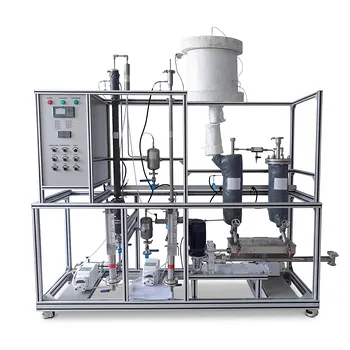
The kinetic divergence between anionic and cationic polymerization directly shapes the very hardware of a pilot plant. For anionic systems, the near-total absence of termination demands an ultra-pure, air-free environment—so the plant is built around inert-gas blanketing. For cationic systems, rapid reversible initiation with acidic cocatalysts dictates corrosion-resistant dosing and highly responsive cooling to tame an intense, immediate exotherm.
Designing an educational pilot plant for ionic polymerizations isn’t about choosing one “best” reactor. It’s about understanding that kinetics dictate safety and hardware: anionic polymerization is a battle for purity, while cationic polymerization is a battle for heat and chemical resistance. The supplementary challenge of rising viscosity—common to both—then demands agitation systems that can handle the transition from water-thin to honey-thick without losing control.
The Divergent Worlds of Ionic Polymerization Kinetics
The fundamental kinetic mechanisms—how chains start, grow, and end—create entirely different demands on plant equipment. This is why an anionic pilot plant looks nothing like a cationic one at the component level.
Anionic Polymerization: The Unforgiving Need for Absolute Purity
In anionic polymerization, initiation can be instantaneous relative to propagation, and there is no inherent termination step. That is a blessing for producing narrow molecular weight distributions, but a curse for plant design.
Because living chain ends remain active, any water or oxygen acts as a permanent terminator. A single molecule of moisture can kill a growing chain, ruining the stoichiometric control and the resulting polymer’s architecture. This means the pilot plant must provide a hermetically sealed, moisture- and oxygen-free zone from solvent purification to the reactor outlet.
The practical design answer is a robust inert-gas distribution system. Argon or nitrogen blanketing, glovebox-style transfer ports for air-sensitive initiators, and meticulously dried solvents via columns or molecular sieves are not optional add-ons—they are the core of the plant. Every flange, valve, and seal is chosen for leak-tight integrity under pressure-vacuum cycling.
Cationic Polymerization: Managing a Corrosive, Explosive Dance
Cationic kinetics paint a completely different picture. Initiation is rapid and reversible, often using a protogen (like water) combined with a Lewis acid catalyst such as boron trifluoride or aluminum chloride. The active center is, chemically speaking, a persistent acid.
This creates two urgent design imperatives. First, the catalyst system is inherently corrosive. A pilot plant cannot rely on standard stainless steel; it demands glass-lined steel, Hastelloy, or PTFE-lined components in the dosing lines, reactor body, and any wetted parts of the cooling system.
Second, the kinetics are extremely fast and highly exothermic. The “rapid, reversible initiation” described in the primary reference means that as soon as catalyst contacts monomer, heat evolves almost instantly. Without design intervention, this creates dangerous hotspots that broaden molecular weight distribution or, worse, trigger a runaway reaction. The plant must therefore incorporate a highly responsive, jacketed cooling loop with a large surface-area-to-volume ratio and short response time from the temperature controller.
The Overarching Physical Challenge: Viscosity, Mixing, and Heat Transfer
Kinetic specificity gets the most attention, but a shared physical reality profoundly shapes the reactor’s mechanical design: as polymer chains grow, the reaction medium undergoes a massive viscosity increase.
How Rising Viscosity Defeats Standard Cooling
Polymerization is typically exothermic. Heat removal relies on fluid flow against a cooled surface. As viscosity soars, the heat transfer coefficient can plummet by orders of magnitude, transforming a well-behaved reaction into a near-adiabatic bomb.
This is where the supplementary reference’s insight becomes critical. The plant’s jacket or internal cooling coils must be oversized relative to a solvent-only benchmark and paired with a circulation system capable of delivering high coolant flow at a controlled, stable temperature even when heat loads spike.
The Agitation System as a Safety Feature
When the medium becomes thick, a standard low-torque mixer will simply create a stagnant zone around the impeller, leaving the bulk material uncooled and unmixed.
The pilot plant therefore requires a heavy-duty, variable-speed agitator designed for high torque at low speeds. Wide-pitched impellers or helical ribbons that can sweep the entire wall surface become essential. In an educational setting, this mechanical robustness serves a dual purpose: it ensures product quality (uniform molecular weight distribution) and teaches students that agitation often acts as the first line of defense against runaway reactions.
Understanding the Design Trade-offs for Educational Plants
No single pilot plant can optimally replicate both anionic and cationic processes without compromise. Acknowledging these trade-offs builds a deeper engineering intuition.
The ultra-dry, oxygen-free infrastructure (glove ports, solvent purification columns, high-purity gas manifolds) that makes an anionic system possible is expensive and complex. It adds a significant training burden for students. Conversely, a plant designed for cationic chemistry—with its glass-lined reactor, Lewis acid dosing pump, and aggressive quench systems—introduces a heavy corrosion resistance requirement that limits material choices for other chemistries.
The most important educational trade-off is versatility versus authenticity. A multi-purpose plant that swaps out wetted parts can teach both kinetics, but the changeover process itself becomes a lesson in the protocols of purity or acid handling. The deep need is not to build two separate pilot plants, but to craft a single system whose design demonstrates these kinetic differences through modularity and sensor transparency—letting students see the temperature ramps, the catalyst injection spikes, and the chain-chain termination by oxygen as data curves in real time.
Making the Right Design Choice for Your Educational Goal
Your specific curriculum and learning objectives will determine which kinetic demands take priority. Use these recommendations as a focused framework.
- If your primary focus is demonstrating living anionic polymerization and block copolymer formation: Invest heavily in the purity infrastructure first. A recirculating inert gas purification loop, solvent drying columns, and a glovebox interface for initiator handling are non-negotiable. A basic jacketed stirred tank with good temperature control will suffice, provided it is absolutely leak-tight to the atmosphere.
- If your primary focus is studying cationic kinetics and industrial catalyst systems: Prioritize a corrosion-resistant reactor (glass-lined or high-alloy) paired with a precision dosing pump for the catalyst-cocatalyst mixture. The cooling system must have a high turndown ratio to handle rapid heat spikes, and the agitator must be designed for high viscosity from the start.
- If your goal is a versatile teaching platform that contrasts both mechanisms: Design a modular skid-mounted reactor. Use a corrosion-resistant base vessel with interchangeable heads—one configured with inert atmosphere ports and an oxygen sensor, another with a catalyst injection probe and Hastelloy internals. Transparent data acquisition on jacket temperature, agitator torque, and monomer conversion turns these hardware differences into a comparative kinetics lesson for students.
The art of pilot plant design is encoding the reaction’s molecular drama directly into the metal and glass. By letting kinetics dictate the hardware, you build not just a machine, but the most honest teacher an engineering student can have.
Summary Table:
| Design Element | Anionic Polymerization | Cationic Polymerization |
|---|---|---|
| Primary Challenge | High sensitivity to moisture & oxygen (no termination) | Rapid, highly exothermic initiation & corrosive catalysts |
| Hardware Requirement | Hermetically sealed, inert-gas (N2/Ar) blanketing | Corrosion-resistant materials (PTFE, Hastelloy, Glass-lined) |
| Thermal Management | Standard cooling jacket for steady propagation | Ultra-responsive, high-surface-area cooling loops |
| Viscosity & Mixing | High-torque agitators to prevent stagnant zones | Heavy-duty, variable-speed mixers to assist heat transfer |
| Key Educational Focus | Purity protocols and anaerobic liquid transfers | Exotherm control, acid handling, and quenching |
Bring Industrial Reality to Your Chemical Engineering Labs
Translating complex reaction kinetics into safe, educational hardware requires expert pilot plant engineering. LABPARK designs and manufactures premium Educational and Vocational Unit Operations Pilot Plants across chemical engineering, bioprocess & biotech, and environmental & water treatment.
We help universities, research institutes, and enterprises build modular, data-rich training systems that bridge the gap between textbook theory and industrial practice.
Looking to customize a polymerization or unit operations reactor for your curriculum? Contact LABPARK today to collaborate with our engineering team!
Related Products
- Fixed Bed Gas Solid Catalytic Reaction Educational Pilot Plant
- Ethyl Acetate Synthesis Unit Operations Pilot Plant for Practical Training
- Carbon Dioxide Hydrogen Methanol Synthesis Educational Unit Operations Pilot Plant
- Natural Product Extraction Unit Operations Training Pilot Plant
- Multi-Reactor Educational Pilot Plant for Reaction Engineering Unit Operations
People Also Ask
- How do reactor pilot plants safely study gas-solid reactions? Master kinetics with thermal & flow control.
- How does the Mears criterion evaluate transport resistance? Key Guide to Intrinsic Kinetics
- Why is a multibed configuration necessary for exothermic reactions? Optimize your pilot plant trajectory.
- Fluidized vs. Fixed Bed Reactors: Comparing Heat & Complexity in Pilot Plants
- How is the friction factor determined for fixed-bed pilot plants? Select the best pressure drop correlation.