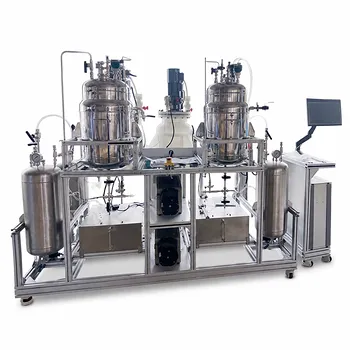
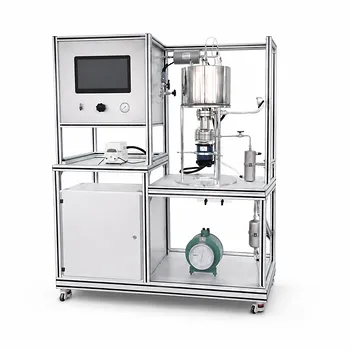
The fundamental design divergence between aerobic and anaerobic bioreactors in a bioprocess training pilot plant boils down to a single variable: oxygen. Aerobic systems must aggressively manage gas-liquid-solid multiphase mixing to overcome oxygen limitation, while anaerobic systems focus on precise environmental control in the complete absence of air. Implementing both configurations in a single pilot plant turns it into a powerful pedagogical tool, allowing students to study these contrasting transport limitations and control strategies side-by-side.
The core insight is that a pilot plant’s value lies not just in the hardware, but in its ability to make invisible physical constraints visible. Aerobic designs teach students to think like a bubble—optimizing mass transfer across a gas–liquid interface—while anaerobic designs train them to think like a sealed ecosystem, where metabolic control is everything.
The Physical Logic: Why Mixing Defines Aerobic Design
The primary reference identifies the heart of the matter: aerobic bioreactors contend with a fundamental transport limitation. The goal is no longer just mixing liquids; it’s moving oxygen molecules from a gas bubble, across a film, into a liquid, and finally into a cell—a complex multiphase journey.
The Oxygen Wall: Overcoming the Rate-Limiting Step
In high-density aerobic cultures, dissolved oxygen (DO) levels plummet within seconds if supply is interrupted. The reactor’s entire physical structure is therefore engineered to maximize the oxygen mass transfer coefficient (kLa). This demands not just aeration, but raw power.
Without aggressive agitation, air bubbles simply rise. An aerobic pilot plant must deploy high-shear impellers and baffles to break those bubbles into the smallest possible size, creating massive interfacial surface area. This is what separates a fermenter from a simple bubbler.
The Anatomy of an Aerobic Pilot Plant
The physical manifestation of this need is visible in the equipment list. An educational aerobic setup will invariably include:
- Sparging Systems and Mass Flow Controllers: Not just a tube, but a precision-engineered distribution ring paired with meters that track every milliliter of air or pure oxygen.
- High-Torque Agitation: Variable-speed drives powering Rushton turbines or similar impellers, designed to shear gas. The aspect ratio (H/D) is typically tall (~2.0) to increase gas hold-up time.
- Sensors as Process Windows: Redundant DO probes are non-negotiable, often backed by exhaust gas analyzers to calculate Oxygen Uptake Rate (OUR)—the true, real-time metabolic pulse of the batch.
The Sealed System: Anaerobic Design as a Thermodynamic Puzzle
In stark contrast, the anaerobic pilot plant’s design motivation is not to inject a gas but to create a hermetically sealed, perfectly homogenous thermal environment. The limiting transport phenomenon shifts from gas–liquid mass transfer to simple liquid–solid heat distribution.
Why Temperature and pH Dominate
The primary reference highlights precise temperature and pH control as the top priority. This isn't because mixing doesn’t matter; it’s because the mixing is conceptually simpler (single liquid phase) and the metabolic drivers are exquisitely sensitive. Anaerobic consortia in an ethanol fermenter or a waste digester function within very narrow pH and temperature windows. A deviation of 0.5 pH units or 2°C can permanently shift the metabolic pathway, stopping ethanol production cold. Therefore, the vessel becomes a meticulously stirred, jacketed vessel with zero leaks.
Design Hardware for an Oxygen-Free World
The engineering choices reflect a philosophy of exclusion. An anaerobic pilot plant in a training environment will showcase:
- Gas-Tight Seals and Headspace Purging: The agitator shaft seal is a critical sterile barrier, and the headspace is sparged with inert nitrogen (N₂) to sweep out any atmospheric oxygen.
- Off-Gas Management and Collection: Instead of an exhaust analyzer that measures oxygen, the system employs condensers, foam traps, and volumetric gas meters to measure the valuable biogas (CH₄/CO₂) produced, often using a gas holder or corrosivity-resistant plumbing.
- Heating/Cooling Jackets with Automatic Valves: A fully mixed configuration ensures the temperature sensor’s reading is representative, allowing precise on/off or PID control of cooling water to manage the heat generated by intense metabolic activity.
Bridging the Gap: The Role of Flexible Pilot Plant Architecture
A truly modern training pilot plant does not force a choice; it creates a single, reconfigurable skid. The primary reference explicitly notes that providing both configurations is the point—students learn by comparison.
The Metabolic Switch and Universal Utilities
The trick is a shared control system with exchangeable modules. At the metabolic level, a single organism can often be run aerobically and then, upon reaching a target cell density, switched to an anaerobic production phase. This demands a plant with flexible gas-mixing manifolds and variable-speed agitation. The supplementary references confirm that such setups let labs "switch seamlessly between these two distinct types of biological operations."
Unit Operations that Teach Contrast
The educational value explodes when students can run both modes simultaneously. They observe that an airlift loop fermenter (low-shear aerobic) solves a different problem than a packed bed bioreactor (often anaerobic with a supportive matrix). A comprehensive pilot plant might include:
- Aerobic loop: A stirred-tank with a sparger ring and air compressor.
- Anaerobic loop: A completely mixed, sealed vessel with a nitrogen purge and a biogas flare.
- Kinetic comparison tools: Software overlay showing OUR (aerobic) versus gas production rate (anaerobic) over time.
Understanding the Trade-offs
Objective trust demands we confront the limits of each configuration. A pilot plant that promises everything often obscures the hard choices that real bioprocess engineers face.
The Self-Aspirating Temptation
Supplementary references highlight the self-aspirating bioreactor: an impeller that pulls air in via a vacuum, saving up to 30% in capital cost and one-third in power. For a training lab, this is seductive. However, it comes with a brutal trade-off: the vessel operates under negative pressure, dramatically raising the risk of pulling in contaminants if a seal fails. It also has a lower maximum oxygen transfer rate and a squat aspect ratio (H/D ~1.6). A good training plant teaches this: efficiency has a sterility cost.
The Complexity of True Anaerobiosis
A common pitfall is underestimating the rigor of “anaerobic.” In a pilot lab, even a tiny, invisible leak in a sampling valve or a worn O-ring can introduce enough oxygen to wipe out a methanogen culture. The design trade-off is between the convenience of standard stainless steel flanges and the need for exclusively welded, pressure-tested, and helium-leak-detected piping. This teaches that contamination in an anaerobic context is not about bacteria; it’s about the gas itself.
Making the Right Choice for Your Training Goal
Your specific educational or R&D goal will dictate which set of design requirements you emphasize in your pilot plant layout.
- If your primary focus is teaching industrial fermentation fundamentals: Prioritize a robust, stirred-tank aerobic system with a powerful agitator and DO cascade control, as this exposes students to the most common mass-transfer bottleneck in the industry.
- If your primary focus is advanced biofuels or waste-to-energy training: Build the core around a rigorously sealed, completely mixed anaerobic vessel with precise temperature and pH control, complete with gas flow measurement, to make consumption stoichiometry tangible.
- If your primary focus is comparative process economics: Invest in a dual-mode pilot plant with exchangeable sparging and gas-handling modules; the real lesson is in the utility bill, showing students the massive energy cost of aeration versus the valuable gas income from anaerobiosis.
The design of a training pilot plant is itself a lesson—it should make the invisible forces that control biology so obvious that students can't help but design better processes.
Summary Table:
| Feature | Aerobic Bioreactors | Anaerobic Bioreactors |
|---|---|---|
| Primary Design Goal | Maximize oxygen mass transfer ($k_L a$) | Ensure airtight sealing & precise PID control |
| Mixing & Agitation | High-shear impellers (e.g., Rushton) & baffles | Low-shear, uniform thermal and liquid mixing |
| Gas Management | Continuous air/oxygen sparging | Nitrogen headspace purging & biogas collection |
| Critical Controls | Dissolved oxygen (DO) & exhaust gas (OUR) | Strict pH, temperature, & biogas flow monitoring |
| Aspect Ratio (H/D) | Tall (~2.0) to maximize gas hold-up | Standard jacketed vessel configuration |
Scale Up Your Bioprocess Training with LABPARK
Are you looking to provide hands-on, industry-ready training for your students or research team?
LABPARK design and manufactures premium Educational and Vocational Unit Operations Pilot Plants in chemical engineering, bioprocess & biotech, and environmental & water treatment. Crafted specifically for universities, research institutes, and enterprises, our dual-mode and reconfigurable pilot systems make complex mass transfer and thermodynamic constraints visible and tangible.
Equip your laboratory with the tools to bridge the gap between theory and industrial reality. Contact LABPARK today to customize your pilot plant solution!
Related Products
- Multi Functional Catalytic Reaction and Reactor Evaluation Educational Unit Operations Pilot Plant
- Bio-fermentation Ethanol Production Practical Training Unit Operations Pilot Plant
- Multi-Reactor Educational Pilot Plant for Reaction Engineering Unit Operations
- Micro-Scale Gas-Solid Catalytic Reaction Educational Pilot Plant
- Fixed-Bed Chemical Reaction and Gas Dust Tar Removal Unit Operations Pilot Plant
People Also Ask
- What reaction engineering principles are shown in a catalytic reactor pilot plant? SO2 Oxidation Guide
- Why is FTIR integration in catalytic pilot plants important? Real-Time Student Insights
- How to analyze active metal distribution & identify catalyst poisoning in pilot plants? Expert Diagnostic Guide
- How do temperature limits and WHSV influence catalytic reactor optimization? Scale-Up Guide
- Why is XPS Critical for Catalytic Reactor Pilot Plants? Optimize Catalyst Performance