The immediate answer is that solid mixing and attrition rates are a performance tug-of-war.
In a fluidized bed reactor, vigorous mixing delivers the thermal uniformity and mass transfer needed for precise reactions, but the same particle motion causes attrition—breaking solids into fine dust. These fines can escape the bed, clog downstream equipment, and represent a direct loss of valuable material. For a unit operations pilot plant, this means you must select particle properties (size, hardness, shape) and operating velocity to strike a deliberate balance between mixing quality and particle durability.
In pilot plants, solid mixing defines temperature control and reaction efficiency, while attrition determines material loss and equipment longevity. The central engineering challenge is finding the gas velocity and particle specification that optimize mixing without causing destructive mechanical wear—and then designing the peripherals (cyclones, filters, liners) to manage the inevitable trade-off.
The Role of Solid Mixing in Fluidized Bed Performance
Solid mixing is the engine behind a fluidized bed’s most prized advantage: nearly isothermal operation.
Why Thermal Uniformity is Non-Negotiable
Exothermic or endothermic reactions demand tight temperature control to avoid runaway conditions, hot spots, or selectivity losses.
In a pilot plant, uniform solid mixing ensures that the entire catalyst inventory acts as a heat sink and distributor, rapidly smoothing out thermal gradients.
This direct link between mixing rate and thermal uniformity is why fluidized beds are preferred for highly exothermic processes like partial oxidations or polymerization.
The Critical Influence of Bubble Dynamics and Feed Rate
The solids feed rate can shift the mixing regime.
A higher feed rate can promote a net upward movement of solids in the emulsion phase, altering bubble volume fraction and reducing gas bypassing through bubbles.
In shallow beds, lateral mixing becomes a dominant factor in solid conversion, whereas in deep beds with large bubbles, mass transfer across the bubble/emulsion interface takes over.
Pilot plant operators use these dynamics to teach how fluidization stability and contact efficiency are controlled.
Why Poor Mixing Destroys Reactor Validity
Without adequate mixing, a pilot plant cannot reliably scale up data.
Hot spots can deactivate catalyst locally, and temperature-sensing thermocouples may read averages that hide dangerous maldistribution.
The entire data set becomes suspect if the bed is not well-mixed.
The Cost of Motion: Understanding Particle Attrition
Every collision of a fluidized particle is a tiny fracture event, and the cumulative effect is attrition.
The Mechanics of Attrition
Attrition is the mechanical breakdown of solid particles due to collisions, friction, and thermal shock.
It is driven primarily by excess velocity (U₀ – U_mf) and the total bed mass (M). The higher the velocity above minimum fluidization, the more energetic the particle impacts.
This produces fines—particles far smaller than the original size distribution—that are easily entrained out of the bed.
The Downstream Cascade of Fines
Those fines do not simply disappear.
They are carried into cyclones, where incomplete separation leads to material loss and potential blockages.
Fines that escape the cyclone become a loading problem for secondary bag filters or scrubbers, increasing operational costs and downtime.
In a pilot plant, sudden catalyst loss means losing an experiment’s reproducibility and wasting expensive materials.
How Attrition Forces Material and Equipment Choices
Attrition is not just a particle problem; it is an equipment problem.
The continuous impact of solids erodes reactor walls, distributor plates, and internals.
This forces you to select erosion-resistant materials or hard liners for high-wear zones, which is a direct material selection decision driven by your attrition rate.
How Mixing and Attrition Drive Material Selection
The need for high mixing and low attrition creates a powerful constraint on what you can put into—and around—your reactor.
Selecting the Geldart Group for Stable Fluidization
Particles are classified into four groups by size and density, and your choice dictates fluidization quality.
- Group A (fine, low density): Ideal for catalytic fluidized beds; exhibit bed expansion before bubbling, providing gentle mixing and reduced attrition potential compared to coarser groups.
- Group B (sand-like): Bubbling starts immediately at U_mf; vigorous mixing but more aggressive particle collisions.
- Group C (cohesive fines): Almost impossible to fluidize without channeling; not a practical choice.
- Group D (large, dense): Prone to slugging and intense particle impacts; high attrition risk.
For pilot plants aiming to minimize attrition while retaining good mixing, Group A materials are the typical starting point.
Particle Size, Shape, and Hardness: The Attrition Triangle
The primary reference confirms that engineers select appropriate particle sizes and hardness to minimize wear.
- Size: A typical range of 0.07 mm to 3.0 mm balances gas-solid contact area against carryover. Too fine, and dust carryover spikes; too large, and mixing suffers.
- Shape: Spherical particles are preferred because they resist fracture at asperities and generate less dust. Irregular shapes have weak corners that break off easily.
- Hardness: Mechanically strong catalysts with high crush strength directly reduce attrition rate. This is often achieved through advanced manufacturing (spray-dried microspheres).
Selecting Reactor Wall and Internals Materials
Attrition data informs where you need protection.
High-attrition zones include the grid plate region and the disengaging space where particles decelerate.
Pilot plants frequently line these sections with refractory ceramics or hard-faced alloys to extend service life, a cost directly traced back to the measured or estimated attrition rate.
The Downstream Train: Cyclones, Filters, and Resilience
Material selection extends beyond the reactor vessel.
Because fines will be generated, you must install cyclone separators sized for the expected fines load.
For the finest particles, secondary bag filters or wet scrubbers are mandatory. These choices are not optional; they are consequences of the mixing-attrition balance you set inside the reactor.
Understanding the Trade-offs
No single parameter solves everything; you must accept and manage inherent contradictions.
The Velocity Tightrope
Increasing gas velocity improves mixing and heat transfer but exponentially raises attrition.
The optimum is usually a modest multiple of U_mf—enough to ensure turbulent mixing but not so high that it shatters the catalyst.
Every pilot plant campaign must find this operating window by deliberately varying flow rate and monitoring pressure drop and fines elutriation.
Mixing Quality vs. Catalyst Longevity
A perfectly uniform temperature profile may require such violent mixing that catalyst is lost in hours.
This is unacceptable for long-duration pilot plant trials.
The compromise often involves accepting a slightly wider temperature distribution to extend catalyst life, or accepting more frequent catalyst top-ups while running at a higher mixing intensity.
Bubble Size and Lateral Mixing: A Hidden Switch
The supplementary references highlight that lateral mixing’s importance shifts with bubble size.
In shallow beds with small bubbles, you must pay attention to lateral mixing to avoid dead zones.
In deep beds with large bubbles, the vertical bubble/emulsion mass transfer becomes the bottleneck, and you can afford to be less concerned with lateral mixing.
This directly affects how you position your feed injection points and where you install internal heat exchangers.
The Cost of Managing Attrition
Adding cyclones, filters, and erosion liners increases capital cost and maintenance complexity.
If you can reduce attrition at the source (via particle selection and velocity control), you can simplify the downstream train.
However, in some pilot plants where reaction conditions demand high velocity, heavy attrition is the price of good data, and the downstream equipment is non-negotiable.
Making the Right Choices for Your Pilot Plant
The specific balance depends on what you are trying to achieve with the pilot plant.
Use the following goal-based guidelines to frame your decisions.
- If your primary focus is accurate kinetic data and scale-up: Prioritize mixing and thermal uniformity. Choose Group A particles with high sphericity and acceptable hardness, and operate at a fluidization velocity that keeps the bed well-mixed. Accept that you will need a cyclonic and filtration train to manage attrition fines, and budget for catalyst replenishment.
- If your primary focus is demonstrating a stable, long-run continuous operation: Shift the balance toward particle durability. Select a slightly coarser particle within the Group A/B boundary, reduce gas velocity to just above U_mf, and invest in erosion-resistant liners on the reactor internals. Monitor pressure drop across the cyclone to detect early filter blinding.
- If your primary focus is teaching fluidization fundamentals: Intentionally run experiments at multiple velocities to show students the onset of bubbling, the growth of fines elutriation, and the degradation of mixing at low rates. Use a standard, inexpensive Group B material like silica sand to make attrition visible and the lessons tangible.
- If your primary focus is catalyst screening: Treat the catalyst inventory as a consumable. Pre-screen catalysts for crush strength, but operate the bed to simulate commercial conditions (higher velocity). Use the resulting attrition rate as a performance metric to identify robust formulations.
Your fluidized bed pilot plant is only as good as the decisions you make about the solid phase. Every choice about particle properties and gas flow rate resonates through mixing quality, attrition damage, and equipment survivability.
Summary Table:
| Design Factor | High Solid Mixing (Impact) | High Attrition Rate (Impact) | Mitigation & Material Strategy |
|---|---|---|---|
| Gas Velocity | Improves heat transfer & reaction efficiency | Accelerates particle collisions and dust generation | Operate at a modest multiple of minimum fluidization velocity ($U_{mf}$). |
| Particle Selection | Best achieved with Geldart Group A/B particles | Irregular shapes and low hardness cause high material loss | Select spherical, high-crush-strength Group A catalysts. |
| Reactor Internals | Ensures isothermal operation | erodes reactor walls and distributor plates | Use erosion-resistant materials or hard refractory ceramic liners. |
| Downstream System | Lower impact on downstream equipment | Clogs secondary bag filters and overloads cyclones | Install high-efficiency cyclones and appropriately sized scrubbers. |
Optimize Your Unit Operations Lab with LABPARK
Designing pilot plants that balance reaction kinetics with mechanical wear requires precise engineering. LABPARK provides state-of-the-art Educational and Vocational Unit Operations Pilot Plants across chemical engineering, bioprocess & biotech, and environmental & water treatment fields. Built to withstand demanding research and teaching environments, our systems help universities, research institutes, and enterprises achieve reliable, scale-up-ready data.
Ready to elevate your laboratory setup? Contact us today to discuss your project requirements!
Related Products
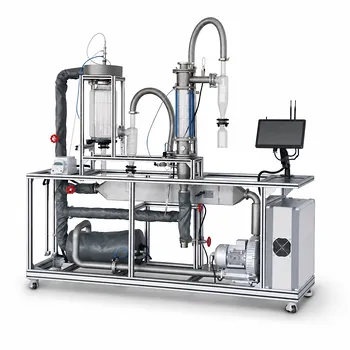
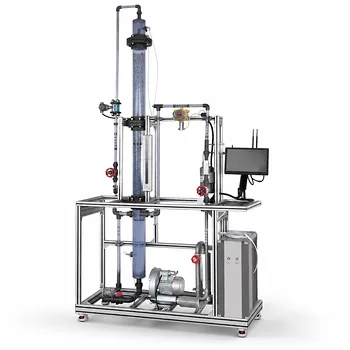
- Fluidized Bed Gas Solid Catalytic Reaction Educational Pilot Plant
- Multi-Reactor Educational Pilot Plant for Reaction Engineering Unit Operations
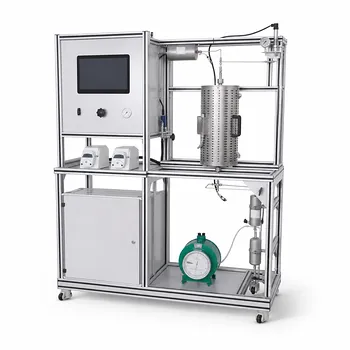
- Multi Functional Catalytic Reaction and Reactor Evaluation Educational Unit Operations Pilot Plant
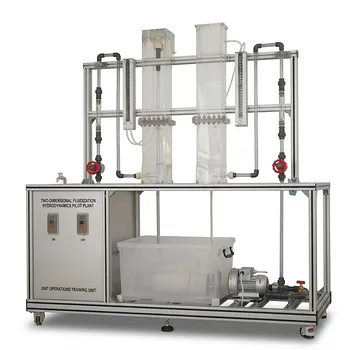
- Two-Dimensional Fluidization Hydrodynamics Educational Pilot Plant for Unit Operations Training
- Multi-Functional Drying Educational Unit Operations Pilot Plant
People Also Ask
- Why is the bed height-to-diameter ratio (L/dt) critical? Fluidized bed pilot plant selection guide.
- How is the minimum fluidization velocity (U_mf) determined and utilized? A Unit Operations Guide
- How does the Mears criterion evaluate transport resistance? Key Guide to Intrinsic Kinetics
- How do reactor pilot plants safely study gas-solid reactions? Master kinetics with thermal & flow control.
- How do pilot plants demonstrate fluidized-bed reactor advantages over fixed-bed? Find Out Now