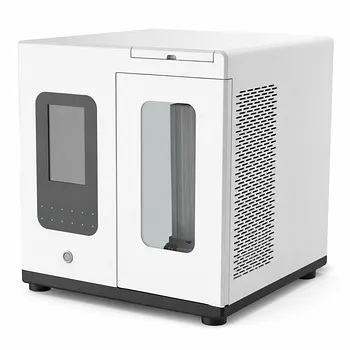
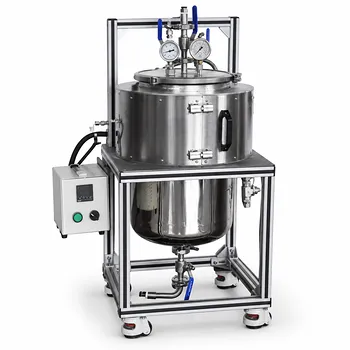
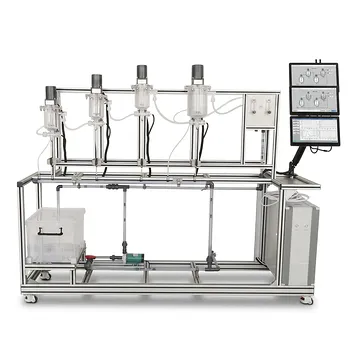
Students are not prepared by merely reading about powder mixing; they are forged by confronting its chaotic reality in a pilot plant. A pilot plant bridges the gap between theoretical knowledge of a formulation—like blending an active ingredient with microcrystalline cellulose and magnesium stearate—and the hands-on skill needed to make that blend uniform, stable, and scalable. It transforms abstract concepts like segregation and shear sensitivity into tangible, measurable problems that demand a solution.
The core value of a solid-handling pilot plant is that it forces students to stop treating powders like simple liquids and start understanding them as complex, sensitive solids. This experience is the single most critical step in learning to manage the segregation, flow, and over-blending risks that determine whether a drug product succeeds or fails during scale-up.
The Physics You Can't Learn from a Textbook
A simulation will tell you that mixing ends when a perfect statistical distribution is reached. A pilot plant shows you how quickly that perfect state can be destroyed. The unpredictability of solid particles, caused by variations in size, shape, and density, governs everything.
The Segregation Nightmare
The primary challenge in blending a low-dose active with larger-volume excipients like microcrystalline cellulose is segregation. A student might design a perfect mixture, but then watch it separate as it's discharged from the blender or transferred to a bin.
In the pilot plant, they learn that tiny, dense active particles can sift through the gaps between larger excipient particles, collecting at the bottom. They then must physically characterize the powders—measuring equivalent diameters and sphericity—to analyze why a process is failing and adjust it, not just calculate it.
When "Well Mixed" Becomes a Liability
Over-blending is a counter-intuitive danger that becomes vividly real in a pilot plant. A student learns that an ingredient like magnesium stearate is a shear-sensitive lubricant.
The lesson is brutal: mixing for too long or at too high a speed coats every particle, not just the ones that need it. The powder's flowability and tabletability are destroyed. Seeing a batch fail a compressibility test because they blended it for 10 minutes instead of 5 imprints the concept of shear sensitivity more deeply than any lecture.
Translating Particle Properties into Process Parameters
Pilot plants teach students to connect microscopic properties to macroscopic industrial problems. Understanding powder characterization is not an academic exercise; it’s a troubleshooting tool.
Diagnosing Flow from Particle Physics
When a hopper stops flowing due to a rathole or mechanical bridge, a student in a pilot plant can't just call a maintenance crew. They must diagnose the cause by examining the powder's physical properties.
They learn to use a sieve analysis with ASTM mesh screens to correlate particle size distribution with flow problems. They see firsthand that a broad, fine particle distribution can explain high interparticulate friction, leading to a blockage, while a more uniform, coarser blend might flow freely.
The Critical Path to Scale-Up
The pilot plant is the proving ground for dimensional analysis. A process that works in a 1-kg lab V-blender can fail catastrophically in a 100-kg industrial bin blender because the forces experienced by the powder—the crush depth and shear rates—are completely different.
Students learn to respect and control scale-dependent parameters. They might find that an impeller speed that provided gentle blending at lab scale induces destructive shear at pilot scale. This hands-on experience with matching blend uniformity across scales is the bedrock of technical transfer, teaching them to navigate the jump from engineering batches to full commercial production.
Understanding the Trade-offs
The pilot plant teaches that perfection is a myth and every process choice is a calculated compromise. The goal is not to eliminate every risk but to understand it well enough to control it.
- Flowability vs. Blend Uniformity: A coarse, free-flowing powder might segregate severely, while a fine, cohesive powder that stays mixed might adhere to equipment surfaces and resist flow.
- Mixing Intensity vs. Lubricant Efficacy: High-speed mixing speeds up blend uniformity but risks over-lubrication by shearing materials like magnesium stearate, turning a flowing powder into a hydrophobic, non-compactable mess.
- Sampling Error vs. True Segregation: Students learn that the very act of taking a sample with a thief probe can disturb a powder bed and cause apparent segregation. They must critically evaluate whether their measurement is showing a real process issue or an artifact of their own testing method.
Developing a Quality-by-Design Mindset
Pilot plant experiments force a shift from "test the final product" to "control the process." Students apply Design of Experiments (DOE) to understand a process space, not just find a single working setpoint.
By systematically varying feed rates and blend times and then measuring the resulting blend uniformity and powder flow, they learn to build a robust process. This training in applying engineering first principles to real-time data—measuring inputs, outputs, and accumulation to find system inefficiencies—equips them with the process-understanding skills central to modern regulatory expectations.
Making the Right Choice for Your Plant's Educational Goals
The design of your pilot plant curriculum will dictate the depth of this learning. The focus should be on creating the space for structured, hands-on failure analysis.
- If your primary focus is teaching fundamental engineering: Structure exercises around measuring segregation kinetics and building mass balance models around the blender to reveal system inefficiencies.
- If your primary focus is industrial formulation science: Build the core experience around a "failure to success" project. Let students over-blend a lubricated mix, diagnose the resulting tablet capping, and then use DOE to map a safe, scalable operating space for impeller speed and blend time.
- If your goal is to train for scale-up and tech transfer: Lead students through a project where they must match the blend uniformity of a lab-scale benchmark batch at pilot scale by identifying and adjusting for scale-dependent parameters like blend time and fill level.
The true value of these pilot plants is that they let students fail safely with a $500 batch of powder, so they know how to succeed when millions of dollars are on the line in an industrial plant.
Summary Table:
| Powder Formulation Challenge | Key Risk & Cause | Pilot Plant Learning Objective |
|---|---|---|
| Segregation | Sifting of fine active ingredients from larger excipients | Characterize particle sphericity & design discharge processes |
| Over-blending | Shear-sensitive lubricants coating particles and ruining compaction | Optimize blend times and speeds via failure analysis |
| Flow Obstruction | Ratholing and bridging due to high interparticulate friction | Use sieve analysis to diagnose flow and design hoppers |
| Scale-up Failure | Non-linear shear forces and volume dynamics in larger blenders | Apply dimensional analysis to transition from lab to pilot |
Equip Your Students for Real-World Engineering Success with LABPARK
Theoretical textbooks aren't enough to prepare future engineers for the complexities of powder formulation and process scale-up.
LABPARK offers high-quality Educational and Vocational Unit Operations Pilot Plants in chemical engineering, bioprocess & biotech, and environmental & water treatment. Designed specifically for universities, research institutes, and enterprises, our pilot plants provide students with the hands-on environment needed to troubleshoot real-world failures, analyze process parameters, and transition safely from lab scale to industrial production.
Ready to elevate your engineering curriculum and research capabilities? Contact LABPARK today to explore our custom pilot plant solutions.
Related Products
- Solid Waste Pyrolysis and Refining Educational Pilot Plant for Unit Operations
- Micro-Scale Gas-Solid Catalytic Reaction Educational Pilot Plant
- Fluidized Bed Gas Solid Catalytic Reaction Educational Pilot Plant
- Gas-Solid Heterogeneous Separation Demonstration Educational Unit Operations Pilot Plant
- Fixed-Bed Chemical Reaction and Gas Dust Tar Removal Unit Operations Pilot Plant
People Also Ask
- How do educational unit operations pilot plants bridge theory and design? Bridge the Engineering Gap
- How do educational unit operations pilot plants address safety and waste management when scaling up?
- When to transition from PID to adaptive control in pilot plants? Key process indicators.
- Why is the chemical plant startup schedule crucial? De-risk scale-up with pilot plants.
- Why Compare Predicted and Experimental Excess Enthalpy? Key to Accurate Pilot Plant Scale-up