Knowledge Chemical Engineering Education How do 1-, 2-, and 3-element boiler control configurations differ? Optimize your pilot plant setup.
Author avatar

Tech Team · LABPARK

Updated 1 month ago

How do 1-, 2-, and 3-element boiler control configurations differ? Optimize your pilot plant setup.


The defining difference is in how each strategy counters the boiler's two most disruptive forces: a rapidly changing steam load and uneven feedwater supply pressure. A single-element controller reacts to drum level alone, which is simple but easily misled during load swings. A double-element design adds steam flow as a feedforward predictor, so it can start matching feedwater even before the level visibly shifts. A three-element system layers an inner cascade loop around feedwater flow, creating a configuration that simultaneously neutralizes steam-side transients and feedwater-side pressure hiccups—making it the benchmark for pilot plants that need true industrial fidelity.

Boiler drum level control is a battle against "false water level" (shrink and swell) and fluctuating feed system pressure. Single-element control handles neither adequately; double-element tackles the steam disturbance; three-element conquers both—giving you the highest dynamic accuracy for research and training.

The Three Control Architectures Explained

Single-Element: Level Only

The simplest arrangement: a level transmitter sends the drum water height to a controller, which adjusts the feedwater valve. The loop’s only instruction is “keep the level at setpoint.”

This works well under steady conditions but breaks down when the steam load changes quickly. A sudden increase in steam draw drops the drum pressure, causing the water to swell and momentarily raise the level reading. The controller then closes the feedwater valve—exactly the wrong move when more water is needed. The opposite “shrink” effect happens on a load decrease. This false water level drives a delayed, inverse response that can lead to swings or even a low-level trip.

Double-Element: Adding Steam Flow Feedforward

To outsmart shrink and swell, a steam flow transmitter is added as a feedforward signal. The control output becomes the drum level signal plus a direct addition of the measured steam flow. When steam demand rises, a flow-scaling term immediately increases the feedwater command, bypassing the sluggish level dynamics.

The result: feedwater flow tracks steam flow almost instantly, and the drum level controller only has to correct the small residual error. False-level-induced reversals are largely neutralized. However, this scheme still assumes that a command to the valve translates into a predictable water flow—a weak spot if feedwater header pressure changes or if a pump starts/ stops.

Three-Element: Cascade of Flow and Feedforward

This is the gold standard for pilot plant boilers. A primary level controller sends a setpoint to a secondary flow controller that directly manipulates the feedwater valve. The steam flow feedforward is summed into that flow setpoint.

The inner cascade loop on feedwater flow compensates for any pressure disturbance before it can upset the level. If the header pressure sags, the flow controller instantly repositions the valve to maintain the commanded flow. Meanwhile, steam flow feedforward handles the load-induced swell/shrink deception. The outer level loop trims for long-term accuracy. Together, the three elements deliver tight, responsive control even under aggressive load ramps or when multiple boilers share a common feedwater header.

Understanding the Trade-offs and Operational Limits

Simplicity Versus Robustness

Single-element control is easy to understand, tune, and instrument. In a small teaching pilot where loads are purposely held constant, it can illustrate basic level control without extra complexity. But once you introduce meaningful load swings, its vulnerability to false water level becomes both a performance problem and a latent safety risk.

Double-element control dramatically improves load-following, yet it is blind to feedwater pressure fluctuations. If your pilot plant uses a positive-displacement pump with a speed drive, the pressure may stay constant, so the limitation is hidden. But with a centrifugal pump or a common header shared by other equipment, the flow will wander even with a stable controller output.

The Price of High Fidelity

Three-element control requires additional instrumentation: a steam flow meter (often an orifice or vortex meter) and a feedwater flow meter (typically a magnetic or Coriolis meter), along with the extra controller logic. Tuning a cascade loop takes more skill; a sluggish inner loop can degrade rather than improve performance. In a pilot plant meant purely to demonstrate basic boiling phenomena, this overhead may be unnecessary noise. But for any work that mirrors industrial dynamics—such as testing advanced model-predictive control or training operators on upset scenarios—the extra investment is essential.

Making the Right Choice for Your Pilot Plant

The configuration you choose should align with the operational story you want the plant to tell. Below are practical guidelines for three common pilot-plant missions.

  • If your primary focus is demonstrating basic closed-loop control or running at constant load: A single-element loop provides a clear, observable response. Keep load steps small and slow to stay out of shrink/swell trouble.
  • If your primary focus is illustrating load-following behavior or studying the effect of steam demand on level: Double-element control greatly reduces false-level trips and shows how feedforward can preempt a disturbance.
  • If your primary focus is replicating industrial boiler tuning, validating digital twins, or testing advanced control strategies: Three-element control is the only architecture that faithfully reproduces real-world dynamics, delivering results that transfer directly to plant-scale operations.

The right drum-level strategy isn’t about having the most elements—it’s about having the right ones for the process story you need to tell.

Summary Table:

Configuration Key Inputs Best Suited For Key Advantage Limitation
Single-Element Drum Level Constant load, basic teaching Simple setup, easy tuning High risk of shrink/swell errors
Double-Element Level + Steam Flow Load-following operations Counteracts steam demand swings Ignores feedwater pressure fluctuations
Three-Element Level + Steam & Feedwater Flow Industrial fidelity, research Full control against pressure & load changes More complex instrumentation & tuning

Bring Industrial-Scale Control to Your Lab

To prepare the next generation of engineers or validate advanced research, your lab needs systems that match industrial reality. LABPARK provides state-of-the-art Educational and Vocational Unit Operations Pilot Plants in chemical engineering, bioprocess & biotech, and environmental & water treatment.

Designed specifically for universities, research institutes, and enterprises, our pilot systems support everything from basic single-loop configurations to complex three-element cascade controls, ensuring your students and researchers gain hands-on experience with industry-standard technologies.

Contact our engineering experts today to find the perfect pilot plant solution for your facility!

Related Products

People Also Ask

Related Products

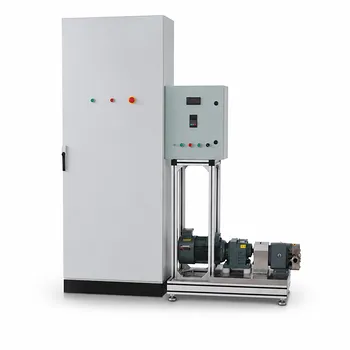
Quantitative Dosing and Liquid Flow Control Educational Unit Operations Pilot Plant

Quantitative Dosing and Liquid Flow Control Educational Unit Operations Pilot Plant

Explore industrial fluid transport and automated process control with this quantitative dosing and liquid flow control educational pilot plant, featuring local and remote control cabinets, variable speed metering pump, high-precision flow sensors, and PLC-based SCADA integration for engineering students.

Dual-Mode Rectification Pilot Plant for Practical Training Unit Operations

Dual-Mode Rectification Pilot Plant for Practical Training Unit Operations

Industrial-scale dual-mode rectification pilot plant for chemical engineering practical training. Features real-material and simulated-material operation modes, sieve-plate column with sight glasses for visual observation of hydrodynamics, and customizable SCADA control for safe, hands-on learning of unit operations and mass transfer.

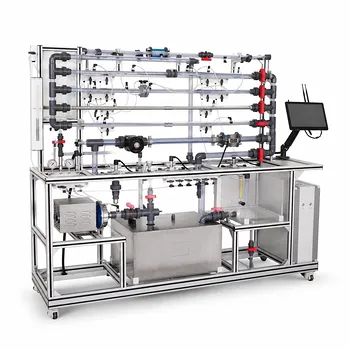
Centrifugal Pump Performance Determination Educational Unit Operations Pilot Plant

Centrifugal Pump Performance Determination Educational Unit Operations Pilot Plant

This lab system determines centrifugal pump performance curves for unit operations. Students configure dual pumps in series or parallel for hands-on learning. Includes industrial controls, clear piping, and data logging. Customizable for chemical, mechanical, and environmental engineering programs.

Multi-Modal Distillation Unit Operations Training Pilot Plant

Multi-Modal Distillation Unit Operations Training Pilot Plant

Multi-modal distillation pilot plant for practical unit operations training in chemical engineering education. Features real, analog, and semi-physical simulation modes, industrial construction, customizable for university labs. Hands-on fractionation columns, SCADA control, safety systems. Includes sight glasses, sampling ports, closed-loop recycling.

Two-Dimensional Fluidization Hydrodynamics Educational Pilot Plant for Unit Operations Training

Two-Dimensional Fluidization Hydrodynamics Educational Pilot Plant for Unit Operations Training

Explore gas-solid and liquid-solid fluidization hydrodynamics with our transparent 2D educational pilot plant. Ideal for chemical engineering unit operations labs, it demonstrates fixed to fluidized bed regimes, measures pressure drop, and integrates QR-code digital learning for enhanced student training.

Continuous Sieve-Plate Distillation Pilot Plant for Unit Operations Laboratory Education

Continuous Sieve-Plate Distillation Pilot Plant for Unit Operations Laboratory Education

Integrated pilot-scale teaching system for continuous sieve-plate distillation studies. Visual demonstration of tray hydraulics, flexible feed positions, and automatic reflux control for hands-on unit operations education in engineering labs. Designed for higher education engineering laboratories.

Rising and Falling Film Evaporation Educational Unit Operations Pilot Plant

Rising and Falling Film Evaporation Educational Unit Operations Pilot Plant

Hands-on educational pilot plant for studying rising and falling film evaporation, flow regimes, and heat transfer. Customizable for university labs with industrial instrumentation and data acquisition. Enables comparative evaluation of evaporation modes and energy efficiency.

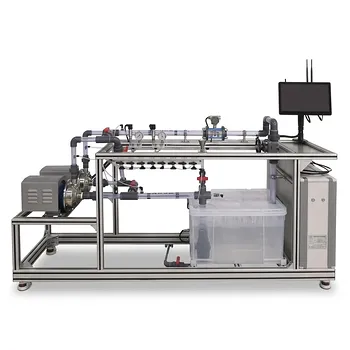
Comprehensive Fluid Mechanics Educational Unit Operations Pilot Plant

Comprehensive Fluid Mechanics Educational Unit Operations Pilot Plant

Hands-on fluid mechanics pilot plant for engineering education covering over 13 principles including pipe flow, minor losses, flowmeter calibration, and pump performance with industrial-grade components, smooth and rough piping, venturi and orifice flowmeters, and centrifugal pump testing and analysis.

Dual Mode Heat Transfer Pilot Plant for Unit Operations Training

Dual Mode Heat Transfer Pilot Plant for Unit Operations Training

Engineering-scale dual-mode heat transfer pilot plant for hands-on unit operations training in chemical engineering. Features real and simulated modes, multiple heat exchanger types, comprehensive coefficient determination, and advanced process control with data acquisition for engineering students and researchers.

Constant Pressure Filtration Educational Unit Operations Pilot Plant

Constant Pressure Filtration Educational Unit Operations Pilot Plant

Hands-on educational pilot plant for constant pressure filtration. Classic plate and frame filter press allows students to study kinetics, determine specific cake resistance, perform cake washing and evaluate washing rates. Ideal for chemical engineering curriculum. Mobile, customizable, safety-compliant design.

Three-Tube Heat Transfer Educational Pilot Plant for Unit Operations Training

Three-Tube Heat Transfer Educational Pilot Plant for Unit Operations Training

Three-tube heat transfer pilot plant for studying convective heat transfer enhancement and condensation. Allows comparison of smooth, corrugated, turbulent tubes, verifying empirical correlations. Ideal for chemical engineering education with safety and closed-loop steam recovery.

100L Continuous Loop Hydrogenation Educational Unit Operations Pilot Plant

100L Continuous Loop Hydrogenation Educational Unit Operations Pilot Plant

This 100L continuous loop hydrogenation pilot plant is designed for chemical engineering education, featuring 316 stainless steel construction, advanced gas-liquid mass transfer components, explosion-proof safety systems, and a 15.6-inch touchscreen with 5G connectivity, cloud data logging, bridging theory and industry.

Supercritical High-Gravity Flash Evaporation Educational Unit Operations Pilot Plant

Supercritical High-Gravity Flash Evaporation Educational Unit Operations Pilot Plant

Bench-scale integrated teaching system for advanced separation and mass transfer, combining supercritical high-gravity flash evaporation with heating, chemical reaction, and material collection, featuring modular design, Stainless Steel 316L construction, transparent visualization, touchscreen control, and safety systems for chemical engineering education.

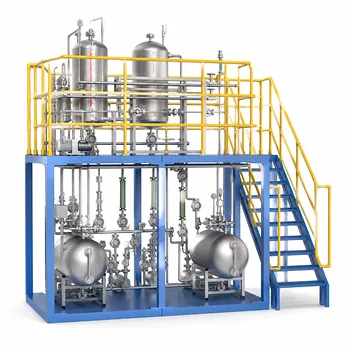
Multi Pump Fluid Transport Process Piping Unit Operations Training Pilot Plant

Multi Pump Fluid Transport Process Piping Unit Operations Training Pilot Plant

Industrial-scale multi-pump pilot plant for unit operations training in fluid transport and process piping, featuring real-material and semi-physical simulation modes, comprehensive pump and flowmeter calibration, and safety-enhanced two-tier platform, bridging academic theory and industrial practice for chemical engineering education.

Multi-Reactor Educational Pilot Plant for Reaction Engineering Unit Operations

Multi-Reactor Educational Pilot Plant for Reaction Engineering Unit Operations

Integrated bench-scale educational pilot plant for chemical engineering teaching featuring fixed bed fluidized bed and stirred tank reactors with web-based digital twin controls and safety interlocks for hands-on unit operations and reaction engineering comparative studies in one compact system.

Educational Unit Operations Pilot Plant for Intraparticle Diffusion Effective Factor Measurement

Educational Unit Operations Pilot Plant for Intraparticle Diffusion Effective Factor Measurement

Designed for chemical engineering university labs, this pilot plant allows hands-on determination of catalyst particle intraparticle diffusion effective factors and gas-solid reaction kinetics using a fixed-bed tubular reactor with industrial touchscreen control, bridging theory and practical reactor design.

Polymerization Granulation and Pellet Processing Educational Unit Operations Pilot Plant

Polymerization Granulation and Pellet Processing Educational Unit Operations Pilot Plant

Integrated pilot plant for teaching polymer processing from polymerization to pelletizing. Includes 30L reactor, hydrolyzer, extruder-granulator, vibration dryer, crusher, and sieve. Atmospheric pressure operation for safety, corrosion-resistant SS, customizable for chemical and polymer engineering education. Ideal for university labs.

Fluid Transport and Piping Dynamics Practical Training Unit Operations Pilot Plant

Fluid Transport and Piping Dynamics Practical Training Unit Operations Pilot Plant

This industrial-scale fluid transport and piping dynamics training pilot plant provides essential hands-on experience with pump operations, cavitation, piping resistance, flow metering, and process control. Customizable to fit specific academic engineering curricula.

Multi-Functional Drying Educational Unit Operations Pilot Plant

Multi-Functional Drying Educational Unit Operations Pilot Plant

Versatile multi-functional drying educational unit operations pilot plant integrating tunnel, fluidized bed, and spray drying. Enables hands-on study of drying curves, psychrometry, and gas-solid separation for chemical engineering curriculum in higher education labs.

Natural Product Extraction Unit Operations Training Pilot Plant

Natural Product Extraction Unit Operations Training Pilot Plant

Integrated natural product extraction pilot plant for chemical engineering training bridges theory and industrial practice with modular extraction and evaporation/concentration units, hybrid touchscreen and manual control, realistic process simulation, and self-contained softened water and vacuum utilities.


Leave Your Message