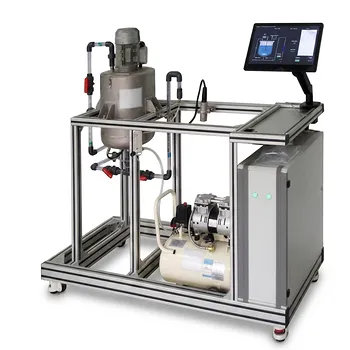
Scaling and order-of-magnitude analysis make transport mechanisms understandable and measurable in educational unit operations pilot plants. They simplify governing partial differential equations by revealing which effects dominate, such as convection, diffusion, viscous forces, pressure loss, or heat transfer. Scaling then connects those simplified models to physical equipment by identifying the dimensionless relationships that must remain comparable across different sizes.
Scaling determines how a pilot plant represents a larger process, while order-of-magnitude analysis determines which physical mechanisms matter most. Together, they produce simpler, more transparent models that can be tested experimentally before more complex numerical methods are used.
Why Complex Pilot-Plant Models Need Simplification
Transport equations contain competing mechanisms
Transport in a pilot plant is governed by conservation laws for mass, momentum, and energy. Their partial differential equations may include several terms representing convection, diffusion, viscous forces, pressure gradients, heat conduction, or mass transfer.
Not every term contributes equally under every operating condition. Order-of-magnitude analysis compares their approximate sizes so students can identify the mechanisms that control the observed behavior.
Simplification exposes the dominant physics
If one term is much larger than another, the smaller term may be neglected as a first approximation. For example, a flow may be modeled primarily through convection when convective transport is much larger than molecular diffusion.
This does not mean the neglected mechanism is physically absent. It means its influence is small enough, within the selected operating range, that including it would add complexity without materially improving the initial model.
Geometry can reduce model complexity
Pilot plants often contain geometries with useful symmetry, such as cylindrical tubes, radial heat exchangers, or packed columns. Symmetry and large aspect ratios can reduce a three-dimensional description to one or two independent spatial coordinates.
A tubular system, for instance, may be represented mainly through radial variations when axial changes are comparatively gradual. This reduction makes the model easier to derive, interpret, and compare with measurements.
How Order-of-Magnitude Analysis Identifies Transport Regimes
Dimensionless ratios compare competing effects
The relative importance of transport mechanisms is expressed through dimensionless groups. These groups compare quantities such as inertial and viscous forces, convective and diffusive transport, or convective and conductive heat transfer.
Examples include the Reynolds number, which indicates the relative importance of inertial and viscous effects; the Péclet number, which compares convection with diffusion; and the Nusselt number, which characterizes convective heat transfer relative to conduction.
Dominant terms guide mathematical model selection
Large or small dimensionless numbers indicate which terms are likely to dominate the governing equations. A high Reynolds number suggests that inertial effects are important relative to viscosity, while a low Reynolds number indicates stronger viscous control.
For heat and mass transfer, corresponding comparisons help determine whether transport is controlled mainly by bulk motion, molecular diffusion, conduction, or interfacial resistance.
Operating changes can alter the dominant mechanism
A mechanism that is negligible at one flow rate, temperature, or concentration may become important under another condition. Order-of-magnitude analysis therefore helps students understand why a single model may not apply across the entire operating range of a pilot plant.
This is especially valuable in teaching because students can connect changes in pump speed, fluid properties, geometry, or temperature difference to changes in transport behavior.
How Scaling Connects Pilot Plants to Larger Equipment
Geometric similarity is not enough
Simply enlarging every dimension does not preserve the same physical behavior. Changing the size of a flow channel or heat exchanger can alter velocity distributions, pressure losses, mixing, heat transfer, and residence times.
Dynamic scaling addresses this problem by preserving relevant dimensionless relationships rather than relying only on proportional dimensions.
Dimensionless groups provide scale-up criteria
To make a pilot plant representative of a larger installation, engineers compare dimensionless parameters for the model and prototype. Reynolds number similarity helps preserve the flow regime, while pressure-drop relationships such as the Euler number help represent hydraulic behavior.
For heat-transfer equipment, maintaining relevant Nusselt and Prandtl relationships helps preserve the connection between fluid properties, flow conditions, and heat-transfer performance.
Essential variables define the scaling problem
Scaling analysis identifies the physical quantities that control behavior, such as length, velocity, density, viscosity, gravity, pressure, temperature, and time. These variables are combined into dimensionless groups that can be matched or used to derive correlations.
This allows a compact educational unit to provide evidence about a larger process, provided the selected similarity conditions are physically relevant to the transport mechanism being studied.
Pilot plants provide experimental validation
Mathematical models are only useful when their predictions are checked against physical behavior. Pilot plants allow students and researchers to compare calculated pressure drops, temperature profiles, flow regimes, separation performance, or transfer rates with measured results.
The comparison exposes model limitations and shows where empirical correlations or additional transport mechanisms are needed.
Applications in Educational Unit Operations
Boundary-layer flow
In boundary-layer problems, order-of-magnitude analysis compares changes along and across the flow direction. Because gradients normal to the surface can be much larger than gradients along it, the governing equations may be simplified accordingly.
Students can then relate boundary-layer thickness and flow behavior to fluid velocity, viscosity, and geometric scale without solving the full three-dimensional equations immediately.
Heat exchangers
Heat-exchanger analysis requires distinguishing between bulk fluid motion, conduction through walls, and convection at interfaces. Scaling and dimensionless analysis help identify whether the equipment is primarily limited by fluid-side transport, wall conduction, or another resistance.
Pilot-scale measurements can then be used to evaluate heat-transfer correlations and assess how changes in flow conditions influence exchanger performance.
Mass-transfer columns
In absorption, stripping, and other column operations, transport may involve bulk flow, molecular diffusion, interfacial area, and phase distribution. Order-of-magnitude analysis helps determine which resistances are significant under the selected operating conditions.
Scaling also helps relate column geometry and flow conditions to mass-transfer performance, while experiments provide a basis for testing the resulting model.
Particle settling and clarification
Directly measuring industrial settling behavior may be impractical when particles are very small or settling is extremely slow. A pilot experiment can use a more convenient physical system if the relevant dimensionless groups are matched.
This approach can support predictions of terminal velocity, drag behavior, and clarification rates, provided the scaled experiment preserves the governing force balances.
Understanding the Trade-offs
Similarity conditions can conflict
It is often impossible to match every relevant dimensionless group simultaneously between a pilot plant and an industrial system. For example, preserving Reynolds-number similarity may require operating conditions that do not also preserve gravitational or heat-transfer relationships.
The correct priority depends on the process question. A model focused on flow regime may emphasize Reynolds similarity, while a heat-transfer study may prioritize Nusselt and Prandtl relationships.
Simplified models have a defined range of validity
Neglecting a term is justified only within the conditions used for the order-of-magnitude comparison. A simplified model may fail when flow rate, geometry, fluid properties, or temperature changes significantly.
Students should therefore treat simplification as an explicit modeling assumption and verify it against measurements or a more complete formulation.
Geometric effects can become important
Small-scale equipment may have different surface-to-volume ratios, entrance effects, wall influences, and residence-time distributions from full-scale equipment. These differences can distort direct extrapolation if they are not included in the scaling analysis.
Geometric similarity must therefore be considered alongside dynamic and, where relevant, thermal or mass-transfer similarity.
Empirical correlations require careful use
Dimensionless correlations are valuable because they summarize experimental behavior, but they are not universally valid. Their reliability depends on the geometry, fluid regime, boundary conditions, and range of dimensionless parameters from which they were developed.
A pilot plant should be used to test whether a correlation applies to the specific equipment and operating regime under study.
How to Apply This to a Pilot Plant
Scaling and order-of-magnitude analysis should be applied as a sequence of modeling and experimental decisions:
- If your primary focus is identifying the controlling mechanism: Estimate the relative sizes of the governing transport terms and retain the terms that dominate under the intended operating conditions.
- If your primary focus is simplifying the equations: Use symmetry, aspect ratios, and characteristic scales to reduce unnecessary spatial and temporal variables.
- If your primary focus is preserving flow behavior during scale-up: Match the relevant Reynolds, Euler, or other hydrodynamic dimensionless groups between the pilot plant and the larger system.
- If your primary focus is heat-transfer prediction: Examine Nusselt and Prandtl relationships together with the thermal properties, geometry, and flow conditions of both systems.
- If your primary focus is validating a mathematical model: Compare predicted temperatures, pressure drops, transfer rates, or separation outcomes with pilot-plant measurements.
- If your primary focus is teaching transport phenomena: Use the pilot plant to connect dimensionless analysis and simplified equations with observable physical behavior.
Used carefully, these methods turn pilot plants into practical laboratories for determining, testing, and scaling the transport mechanisms that control real processes.
Summary Table:
| Focus | Key insight | Pilot-plant application |
|---|---|---|
| Order-of-magnitude analysis | Identifies dominant transport terms and regimes | Simplifies governing equations |
| Dimensionless groups | Compare forces and transport mechanisms | Uses Reynolds, Péclet, Nusselt, Prandtl, and Euler numbers |
| Scaling | Preserves relevant physical relationships across equipment sizes | Supports reliable process scale-up |
| Model validation | Compares predictions with measured behavior | Evaluates pressure drop, heat transfer, mass transfer, and separation |
| Educational value | Connects theory with observable process behavior | Builds practical transport-phenomena skills |
Apply Transport Analysis with LABPARK
Help students, researchers, and process teams connect transport theory with measurable results. Contact LABPARK to discuss Educational and Vocational Unit Operations Pilot Plants for chemical engineering, bioprocess and biotechnology, and environmental and water-treatment applications.
LABPARK can help universities, research institutes, and enterprises evaluate flow behavior, pressure loss, heat transfer, mass transfer, separation performance, and scale-up assumptions through practical pilot-plant experiments. Our systems support hands-on teaching, model validation, process development, and clearer engineering decisions based on reliable operating data.
Related Products
- Multi-Reactor Educational Pilot Plant for Reaction Engineering Unit Operations
- Multi-Functional Membrane Separation Educational Pilot Plant for Unit Operations Lab
- Electrolytic Hydrogen Production Educational Unit Operations Pilot Plant
- Comprehensive Fluid Mechanics Educational Unit Operations Pilot Plant
- Multi-Functional Drying Educational Unit Operations Pilot Plant
People Also Ask
- How do reactor pilot plants define QbD design space? Master chemical process scale-up.
- When configuring a reactor unit operations pilot plant for highly exothermic reactions, how to prevent thermal runaway?
- How do metal ion-catalyzed reaction mechanisms inform chemical engineering pilot plant design? From kinetics to scale-up
- What are the barriers to process intensification & how do pilot plants help?
- What role do educational pilot plants play in scaling green chemistry? Bridging the Lab-to-Industry Gap