Higher reaction temperatures accelerate the sulphonation rate of micro-porous polymers, while higher acid concentrations increase its ultimate degree of conversion.
Both parameters directly control the reaction's speed and the final extent to which sulfonic acid groups are attached to the polymer backbone. The interplay between temperature and acid strength is a cornerstone of designing effective chemical engineering unit operations—especially in pilot-plant settings where precise polymer modification is required.
Temperature primarily governs how quickly the sulphonation reaction reaches its endpoint, whereas acid concentration dictates how far that endpoint can go. In practice, pushing both parameters higher increases the final degree of sulphonation, but only within the limits defined by mass‑transfer resistance and the polymer’s thermal stability.
Understanding the Reaction Dynamics
Temperature as the Kinetic Accelerator
Sulphonation of micro‑porous templates like polyHIPE is a solid‑liquid reaction.
Temperature increases the rate constant by providing the activation energy needed to overcome the reaction barrier.
In a typical pilot plant, raising the temperature from 150 °C to 200 °C dramatically speeds up the arrival at the asymptotic sulphonation value.
However, the asymptotic value itself may also rise—higher temperatures can reduce mass‑transfer resistance inside the porous structure, allowing more reagent to access internal surfaces before the reaction stalls.
Acid Concentration as the Thermodynamic and Mass‑Transfer Driver
Sulfuric acid concentration determines the chemical potential of the sulfonating agent.
Switching from a 10 % to a 70 % acid solution supplies more SO₃⁺ species per unit volume, pushing the equilibrium toward higher substitution.
A critical mass‑transfer effect comes into play: pre‑drying the polymer under vacuum at 60 °C removes water from its pores.
This effectively concentrates the acid inside the template from 10 % to 70 %, dramatically increasing the asymptotic degree of sulphonation (often reaching a plateau around 60 %).
Why Asymptotic Behavior Occurs
Sulphonation is not infinite—it reaches a finite limit.
This plateau arises from a balance between the irreversible attachment of sulfonic groups and the increasing steric hindrance and charge repulsion they create on the polymer.
In micro‑porous materials, pore diffusion limitations also play a role.
Once accessible surface sites are consumed, further reaction slows to a crawl, defining the plateau value.
Understanding the Trade‑offs
Thermal Stability Limits
Pushing temperatures above 200 °C can degrade the polymer backbone.
The micro‑porous template may collapse, reducing surface area and making the material useless for applications like ion exchange or catalysis.
Acid Handling and Corrosion
Using 70 % sulfuric acid demands corrosion‑resistant equipment (e.g., glass‑lined reactors, Hastelloy alloys).
In pilot plants, this adds capital cost and safety considerations, so the benefit of a higher asymptotic conversion must justify the investment.
Mass‑Transfer Rate vs. Final Conversion
Rapid temperature ramps can lead to uneven sulphonation if heat and mass transfer are not uniform.
A slower soak at a moderate temperature might deliver a more homogeneous product, even if the final degree is slightly lower.
Making the Right Choice for Your Goal
The optimal temperature and acid concentration depend on what your polymer‑engineering objective demands.
- If your primary focus is maximizing the ion‑exchange capacity of the final micro‑porous polymer: Use the highest acid concentration (e.g., 70 %) and a temperature near the upper safe limit (around 200 °C) to achieve the highest asymptotic degree of sulphonation—but verify the material remains intact.
- If your primary focus is scaling up a reproducible pilot‑plant operation: Prioritize process stability. Start with a moderate temperature (150–180 °C) and a pre‑drying step to concentrate acid internally; this balances a high conversion rate with manageable reactor corrosion risks and avoids thermal degradation.
- If your primary focus is gaining fundamental kinetic data for unit‑operation design: Run a series of isothermal experiments at different acid concentrations to map the rate constants and plateau values. This builds the kinetic model needed to predict performance in larger reactors.
Mastering these two levers transforms sulphonation from a black‑box art into a controlled, engineerable step in polymer modification.
Summary Table:
| Parameter | Primary Role | Kinetic/Thermodynamic Effect | Operational Risks & Limits |
|---|---|---|---|
| Reaction Temperature | Kinetic Accelerator | Increases reaction rate; reduces mass-transfer resistance | Polymer degradation & structural collapse (>200°C) |
| Acid Concentration | Thermodynamic & Mass-Transfer Driver | Dictates chemical potential; increases final conversion | High equipment corrosion; requires specialized alloys |
Optimize Your Chemical Engineering Unit Operations with LABPARK
Are you looking to bridge the gap between laboratory-scale research and industrial chemical engineering applications?
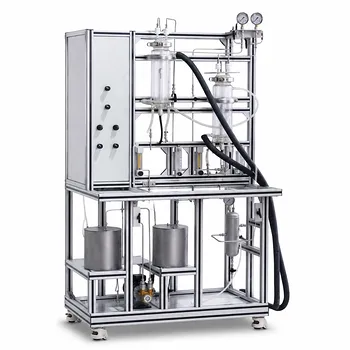
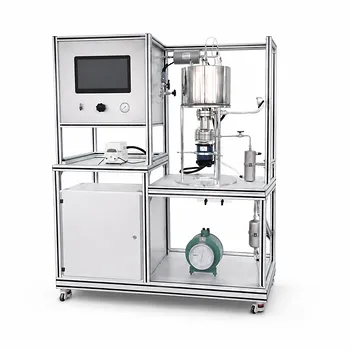
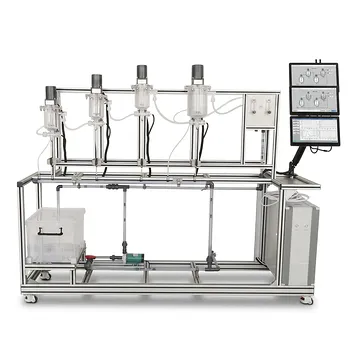
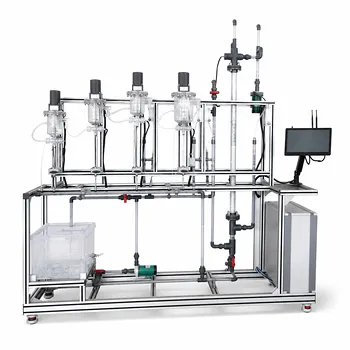
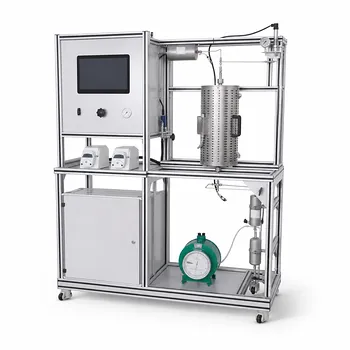
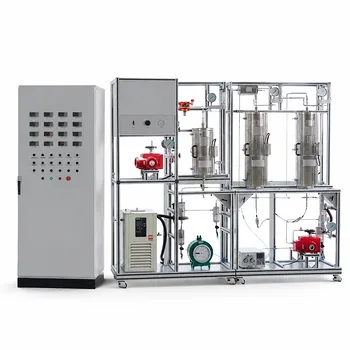
LABPARK provides state-of-the-art Educational and Vocational Unit Operations Pilot Plants designed specifically for universities, research institutes, and enterprises. Our pilot plants in chemical engineering, bioprocess & biotech, and environmental & water treatment enable students and researchers to safely study reaction kinetics, heat transfer, and polymer modifications (like sulphonation) under precise, real-world conditions.
Take your teaching and research capabilities to the next level—contact us today to find the perfect pilot plant configuration for your lab!
Related Products
- 100L Continuous Loop Hydrogenation Educational Unit Operations Pilot Plant
- Methane Cracking Educational Unit Operations Pilot Plant
- Micro-Scale Gas-Solid Catalytic Reaction Educational Pilot Plant
- Fixed-Bed Chemical Reaction and Gas Dust Tar Removal Unit Operations Pilot Plant
- Photocatalytic Membrane Separation and Degradation Unit Operations Pilot Plant
People Also Ask
- Why Use PTFE & Hastelloy in Chemical Pilot Plants? Prevent Corrosion & Ensure Safety
- Why is the chemical plant startup schedule crucial? De-risk scale-up with pilot plants.
- How to study gasification in pilot plants? Compare exit gas composition & efficiency
- How do deviations in estimating latent heat impact pilot plant thermal systems? Avoid hardware mis-sizing.
- Why Compare Predicted and Experimental Excess Enthalpy? Key to Accurate Pilot Plant Scale-up