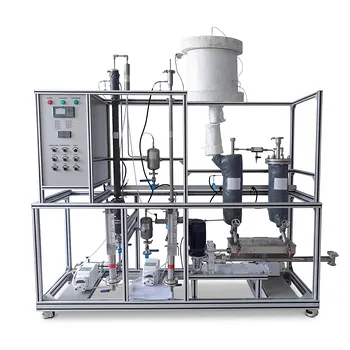
The physical state of a process fluid fundamentally reshapes the labor cost equation. In chemical engineering pilot plants, processes that handle only fluids in a continuous mode can often be operated by a single technician from a control room, while solid-fluid handling systems drastically increase the need for manual charging, monitoring, and mechanical intervention. For educational curricula, this contrast provides an unmatched opportunity to teach students that labor is not a fixed overhead—it scales directly with process complexity, material state, and batch-versus-continuous design choices.
Pilot plants that incorporate both fluid and solid-fluid unit operations transform an abstract cost factor into a tangible, measurable variable. By observing the shift from automated fluid pumping to hands-on solids handling, students can trace every additional operator hour back to a specific engineering decision, cementing their ability to estimate labor costs with industrial-grade accuracy.
The Direct Link Between Process Type and Labor Costs
Why Fluid-Only Processes Require Fewer Operators
Fluid-only continuous processes, such as distillation or liquid-liquid extraction, thrive on automation. Pumps, control valves, and inline analyzers allow the entire system to be managed from a centralized control room.
Because the material stays within pipes and vessels, there is minimal physical handling. Operator rounds are often limited to verifying instrument readings and sampling, tasks that can be scheduled rather than performed constantly.
The primary reference materials confirm that this setup demands significantly fewer operator hours per shift—sometimes a single operator can supervise an entire train. In educational settings, this reality teaches students that the capital cost of automation can be rapidly offset by sustained labor savings.
Why Solid-Fluid Handling Inflates Staffing Needs
Introducing solids changes everything. Powder charging, slurry transport, filter cake discharge, and dryer unloading all require manual or semi-manual intervention. Even with automated conveyors, someone must monitor blockages, adjust feed rates, and clean equipment between batches.
Batch operations, common in pharmaceuticals and specialty chemicals, add another layer of labor intensity. Each batch cycle requires setup, charging, reaction monitoring, and teardown. The primary reference explicitly states that these modes require significantly more operator hours for handling, charging, and monitoring.
This hands-on demand means students quickly learn that a solid-fluid pilot line can need two to three times the staffing of an equivalent fluid-only process—a powerful lesson in cost scalability.
How Batch vs. Continuous Logic Reshapes Staffing Efficiency
Continuous processes spread labor over a high, steady production rate, making the labor cost per kilogram of product extremely low. Batch processes concentrate that same labor into discrete cycles with variable output.
In a pilot plant curriculum, students can run the same synthesis via both a continuous fluid line and a batch solid-handling line. The resulting data on operator hours per run, setup time, and cleaning effort provides a real-world basis for estimating labor costs at scale.
This direct comparison demolishes the misconception that labor costs are a constant percentage of equipment cost. Students see that labor is a dynamic variable driven by operational philosophy.
How Pilot Plant Experiences Drive Accurate Labor Estimation
Moving Beyond Textbook Factors to Empirical Observation
Standard estimation methods—factored cost analysis, definitive estimates, detailed design—all apply multipliers for labor, but they are generic. Supplementary references note that factored analysis yields ±20-25% accuracy, often blending labor with indirect costs.
A pilot plant removes this abstraction. Students can time every manual task, log shift schedules, and calculate actual labor hours per unit of production. This hands-on data builds the intuition behind definitive and detailed estimating, where labor lines are built from activity-based costing.
When a student sees how a sticky filter cake adds 30 minutes to a shift, that experience becomes the foundation for a ±10% labor estimate in a future design project. The pilot plant converts cost estimation from a memory exercise into an engineering competency.
Bridging the Gap Between Process Synthesis and Economic Viability
In industry, a brilliant process scheme is worthless if its labor demand erases the profit margin. Pilot plants that combine fluid and solids handling force students to confront this economic reality early.
By designing and operating their own mini-plants, they can test how a switch from a centrifuged slurry to a pneumatic conveying system changes staffing. This iterative experimentation mirrors the process synthesis loop that engineers perform during preliminary design.
The curriculum thus embeds the principle that labor optimization is a design variable, not an afterthought. Students leave equipped to justify capital expenditures for automation based on a clear labor cost analysis.
Understanding the Trade-offs
When Over-Automation in Fluid Processes Misleads Students
A fully automated fluid pilot plant can create a false sense of simplicity. If students only run “digital” processes with no physical interaction, they may underestimate the labor needed for troubleshooting, maintenance, and non-routine events.
Supplementary references indicate that even fluid systems have maintenance costs (around 3% of ISBL), but labor for unexpected repairs or startup/shutdown is often excluded from textbook factors. A curriculum must include these anomalies—plugged instrument taps, pump cavitation—to teach that labor estimation must account for irregular but predictable manual interventions.
Balancing automation with manual override exercises ensures students aren’t blindsided when their first industrial project requires midnight operator call-outs.
The High Infrastructure Cost of Solid-Handling Pilot Teaching
Solid-fluid pilot units are expensive to build and maintain. Supplementary references note that solids handling systems can push maintenance costs to 5% of ISBL, and components like grinders may need annualized replacement. This cost burden can strain an educational budget.
However, skipping hands-on solids training creates a competency gap. The trade-off is that schools must carefully select a few modular, multi-purpose units (e.g., a filter-dryer combo) that demonstrate maximum labor complexity for the investment. Virtual simulations can supplement but never fully replace the tactile realities of bridging, agglomeration, or dust control.
Avoiding the Trap of Simple Labor-to-Equipment Ratios
Traditional cost texts may suggest that labor costs equal a flat percentage of equipment cost. Pilot plants expose this as dangerously inaccurate. A carbon steel fluid pump may have a low F_BM factor and minimal labor attachment, while a stainless steel solids conveyor demands constant attention despite a similar purchase price.
This insight directly connects to material selection, as the supplementary references highlight how material changes multiply installation factors. Educators must ensure students do not conflate equipment capital cost with operational labor intensity—pilot plants are the definitive tool to break that mental model.
Making the Right Choice for Your Curriculum
The design of a teaching curriculum should match the learning objective. Here’s how to align pilot plant process types with specific educational goals.
- If your primary focus is teaching rigorous labor cost estimation methodology: Incorporate at least one solid-fluid batch unit as a mandatory module. The manual operations data it generates will anchor all later classroom estimating exercises in real empirical evidence.
- If your primary focus is illustrating the economic dominance of material state on staffing: Dedicate a comparative lab where students run a fluid-only continuous distillation alongside a filtration-drying sequence. The side-by-side shift log analysis will cement the staffing scalability principle better than any lecture.
- If your primary focus is building a broad, foundational awareness for vocational trainees: Start with fluid processes to establish control-room proficiency, then introduce solids handling gradually. This progression lets trainees build confidence before confronting the chaos of real powder handling, making the labor-cost escalation obvious when it appears.
- If your primary focus is preparing students for capital project justification: Use the pilot plant to generate labor benchmarks. Then have students calculate the payback period for an automation upgrade. This links labor reduction directly to financial decision-making.
A well-designed pilot plant curriculum turns labor cost estimation from an abstract number into a lived, defendable engineering skill.
Summary Table:
| Process Type | Automation & Control | Labor Intensity | Key Operations | Impact on Labor Estimation |
|---|---|---|---|---|
| Fluid-Only | High (automated from control room) | Low (single operator shift) | Distillation, extraction | Highly predictable; labor is offset by automation. |
| Solid-Fluid | Low-Medium (hands-on intervention) | High (multiple operators) | Filtration, drying, slurry | Dynamic scaling; requires activity-based costing. |
Enhance Your Engineering Curriculum with LABPARK
Ready to transform abstract economic concepts into practical engineering skills? LABPARK provides premium Educational and Vocational Unit Operations Pilot Plants in chemical engineering, bioprocess & biotech, and environmental & water treatment.
We empower universities, research institutes, and enterprises to train the next generation of engineers with hands-on, realistic systems that accurately reflect industrial labor and operational costs.
Contact LABPARK today to build your custom pilot plant solution!
Related Products
- Fixed Bed Gas Solid Catalytic Reaction Educational Pilot Plant
- Multi Pump Fluid Transport Process Piping Unit Operations Training Pilot Plant
- Carbon Dioxide Hydrogen Methanol Synthesis Educational Unit Operations Pilot Plant
- Ethyl Acetate Synthesis Unit Operations Pilot Plant for Practical Training
- Natural Product Extraction Unit Operations Training Pilot Plant
People Also Ask
- How do reactor pilot plants safely study gas-solid reactions? Master kinetics with thermal & flow control.
- How does the Mears criterion evaluate transport resistance? Key Guide to Intrinsic Kinetics
- Fluidized vs. Fixed Bed Reactors: Comparing Heat & Complexity in Pilot Plants
- Why is a multibed configuration necessary for exothermic reactions? Optimize your pilot plant trajectory.
- What are the differences between pseudohomogeneous and heterogeneous models in pilot plants?