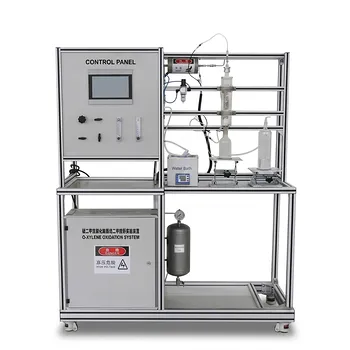
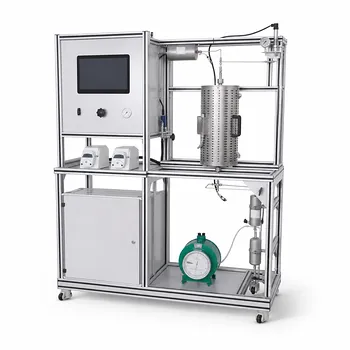
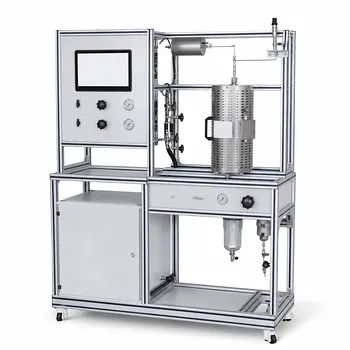
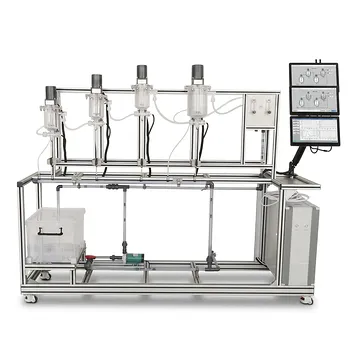
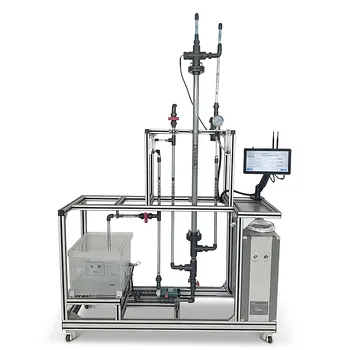
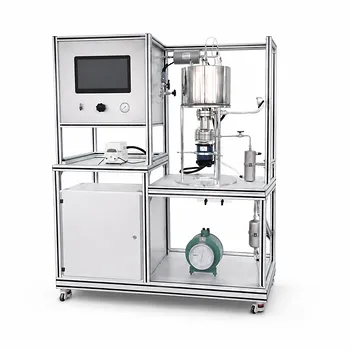
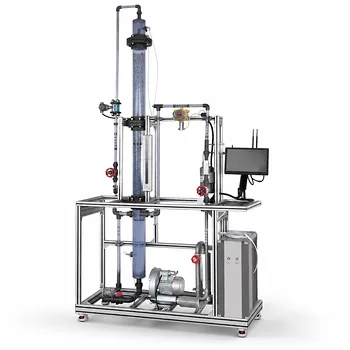
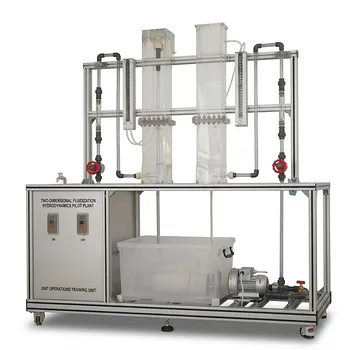
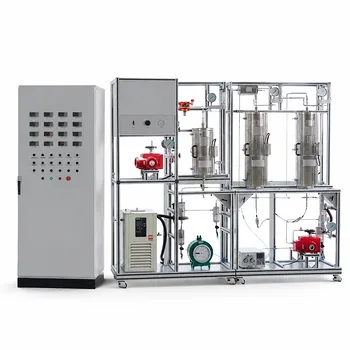
The decisive difference lies in how and when heat is removed. Multitubular fixed‑bed reactors weave continuous cooling directly into the reaction zone, while multibed adiabatic configurations interrupt the reaction path with discrete interstage cooling. In a pilot‑scale system, this means the multitubular design can guide the temperature along a smooth, near‑optimal descending curve, whereas multibed adiabatic setups create a characteristic sawtooth profile—rapid adiabatic temperature rise followed by a sharp quench.
Pilot plants that offer both configurations make this contrast tangible: multitubular reactors trade mechanical complexity for a precise, continuously managed temperature trajectory, while multibed adiabatic reactors trade some thermal elegance for simpler construction and the ability to isolate the impact of each catalyst bed.
How Multitubular Fixed‑Bed Reactors Shape the Temperature Profile
Continuous Heat Exchange Through the Tube Wall
The defining feature is a bundle of narrow tubes—often 20–50 mm inside diameter—packed with catalyst and surrounded by a circulating heat‑transfer fluid. This geometry provides a huge surface‑area‑to‑volume ratio, so heat released by the exothermic reaction is removed at every point along the tube, not just between stages.
Approximating the Optimal Descending Temperature Trajectory
For equilibrium‑limited exothermic reactions, the ideal temperature profile declines as conversion rises. By adjusting coolant flow or temperature (e.g., boiling water whose pressure controls its temperature), the multitubular reactor can closely track that descending optimum. The result is higher per‑pass conversion and better selectivity than a profile that overshoots the optimum.
Detecting and Suppressing Hot Spots in Pilot‑Scale Units
Even with continuous cooling, local overheating can occur near the feed inlet where rates are highest. Pilot‑scale multitubular reactors address this by inserting thermowells with multiple thermocouples along the tube axis, revealing the axial temperature distribution. Operators can then mitigate hot spots by diluting the inlet catalyst layer with inert solids, segmenting the cooling jacket, or adjusting the feed composition.
Coolant Selection and Control Philosophy
Pressurized hot water, boiling water, and high‑boiling hydrocarbons serve as shell‑side coolants. Automated loops that regulate coolant pressure (and therefore temperature) give the multitubular reactor its fast, distributed thermal response, making it the geometry of choice when the reaction is both highly exothermic and temperature‑sensitive.
How Multibed Adiabatic Reactors Shape the Temperature Profile
Adiabatic Beds with Interstage Intervention
In a multibed adiabatic reactor, each catalyst bed operates without any wall cooling—the temperature rises freely as the reaction progresses. Heat management is postponed to the space between beds, where a heat exchanger or a cold‑shot quench stream reduces the temperature before the next bed.
The Sawtooth Temperature Profile
This start‑stop cooling creates a trajectory that repeatedly shoots above the optimal temperature, then is dragged back down. On a conversion‑temperature diagram, the path zig‑zags between the equilibrium curve and the optimum rate curve. The profile is inherently suboptimal compared to a continuously cooled system, but it can still deliver acceptable conversion with careful bed sizing and interstage temperature selection.
Quench Methods: Heat Exchangers and Cold‑Shot Gas
Pilot plants routinely use two interstage cooling approaches. Indirect interbed heat exchangers (or cooled recycle loops) provide uniform temperature reduction, while direct cold‑shot injection—mixing cold feed or product gas between beds—offers a simpler, cheaper alternative. Both methods are demonstrated in pilot units for reactions such as ammonia synthesis, MTBE production, and benzene alkylation.
Learning Thermodynamic Constraints on the Pilot Floor
Operators studying SO₂ oxidation or ammonia synthesis can plot live x‑T diagrams, observing how each adiabatic segment approaches the equilibrium limit. This makes the multibed adiabatic pilot plant an exceptional teaching tool for the kinetic‑thermodynamic trade‑off, even if the absolute efficiency is lower than in a multitubular design.
Understanding the Trade‑offs
Radial Gradients in Multitubular Reactors
Narrow tubes suppress hot spots, but they also introduce radial temperature and concentration gradients that can complicate scale‑up. A thermowell only tells you the axial profile; it does not fully capture what is happening at the tube center versus the wall. Misinterpreting these gradients can lead to overestimation of catalyst life or selectivity.
Suboptimal Conversion and Catalyst Stress in Multibed Units
The sawtooth trajectory repeatedly exposes catalyst to peak temperatures that can accelerate sintering or coking. While individual beds may be simpler to load and monitor, the overall per‑pass conversion is often lower, demanding higher recycle ratios or larger total catalyst volumes.
Operational Complexity vs. Flexibility
Multitubular reactors demand sophisticated coolant systems, mechanical integrity of tube‑sheets, and careful startup/shutdown procedures. Multibed adiabatic reactors are mechanically simpler but require precise design of interstage quenching and bed inlet temperatures. For a pilot plant, the choice often hinges on whether the goal is to mimic an industrial continuous‑cooling process or to isolate the behavior of adiabatic catalyst stages.
Safety and Hot Spot Management
Both designs mitigate runaway, but through different mechanisms. Multitubular systems rely on rapid coolant response; multibed setups depend on interstage quench and conservative bed sizing. Pilot‑scale exploration teaches operators to identify the limiting safety lever in each architecture—coolant pressure control in one, quench gas flow in the other.
Matching the Configuration to Your Pilot‑Plant Objectives
- If your primary focus is studying the intrinsic kinetics and precise temperature optimisation: Start with a multitubular reactor. Its continuous cooling profile lets you map the optimal temperature‑conversion trajectory and investigate hot‑spot dynamics with high axial resolution.
- If your primary focus is demonstrating industrial adiabatic operation and interstage cooling strategies: Choose a multibed adiabatic setup. The sawtooth profile, combined with interbed quench or cold‑shot injection, teaches operators how to balance reaction rate against thermodynamic constraints across discrete stages.
- If your primary focus is teaching reactor safety and scale‑up principles: Maintain access to both configurations. Contrasting the two architectures equips students and researchers to evaluate how heat management design directly impacts conversion limits, catalyst longevity, and emergency response procedures.
Understanding these two profile‑management philosophies transforms a pilot plant from a simple test rig into a powerful decision‑making tool for real‑world reactor engineering.
Summary Table:
| Feature | Multitubular Fixed-Bed | Multibed Adiabatic |
|---|---|---|
| Cooling Method | Continuous cooling via tube walls | Discrete interstage quenching/cooling |
| Temperature Profile | Smooth, descending curve | Sawtooth (rapid rise & sharp quench) |
| System Complexity | High (complex jacket & tube bundle) | Medium (simpler beds, external quench) |
| Best For | Precision kinetics & hot-spot mapping | Simulating industrial equilibrium & safety |
Elevate Your Chemical Engineering Research & Training with LABPARK
Whether you are analyzing complex reaction kinetics or training the next generation of engineers, having the right experimental setup is crucial. LABPARK designs and manufactures high-quality Educational and Vocational Unit Operations Pilot Plants tailored for universities, research institutes, and enterprises.
Our customizable pilot plants span:
- Chemical Engineering (including advanced multitubular and multibed reactor systems)
- Bioprocess & Biotech
- Environmental & Water Treatment
Contact LABPARK today to discuss your laboratory requirements and receive a tailored solution!
Related Products
- Multi-Reactor Educational Pilot Plant for Reaction Engineering Unit Operations
- Multi Functional Catalytic Reaction and Reactor Evaluation Educational Unit Operations Pilot Plant
- Educational Unit Operations Pilot Plant for Intraparticle Diffusion Effective Factor Measurement
- Fixed Bed Gas Solid Catalytic Reaction Educational Pilot Plant
- Fixed-Bed Chemical Reaction and Gas Dust Tar Removal Unit Operations Pilot Plant
People Also Ask
- How does polyphosphate hydrolysis affect scale and corrosion in pilot plants? Essential Monitoring Guide
- How can pilot plants help students understand critical process parameters? Hands-On Extraction & Filtration
- What safety procedures must be established for pilot plant outages? Core Emergency Guide
- What role do customizable reactor pilot plants play in evaluating heat and catalyst performance? Scale-up Guide
- What is the operational significance of solids feed rate on emulsion phase dynamics in fluidized bed pilot plants?