The secret to tackling complex liquid-liquid separation challenges is a single, multi-tasking material. In pilot-scale unit operations, sulfonated PolyHIPE Polymer (PHP) materials function by combining an engineered micro-porous structure that adsorbs surfactants to break emulsions with a chemically active surface that acts as an ion exchanger, stripping dissolved metal ions and organic toxins from the fluid at the same time.
The core value of a multifunctional demulsifier-adsorber is right there in the name: it solves two problems at once. The physical architecture collapses stable emulsions by removing the stabilizing agents, while the chemical functionality polishes the separated phases, all within a single unit operation. This turns a material replacement into a lesson in process intensification.
The Dual Functionality of Sulfonated PolyHIPE Polymers
These polymers are not passive filters. They are active, interacting materials that fundamentally change the chemistry and physics of a liquid-liquid system.
Destabilizing Emulsions through Surfactant Adsorption
A stable emulsion, particularly a water-in-oil mixture, is held together by surface-active species—surfactants—that armor the droplets and prevent them from coalescing.
The micro-porous structure of the PolyHIPE provides an immense internal surface area. This structure selectively adsorbs those surfactants, physically pulling the stabilizing agents out of the emulsion.
Without its surfactant shell, a droplet becomes unstable. It will now readily merge with other droplets, quickly breaking the emulsion into two distinct, separable phases. The material acts like a magnet for the emulsifier, collapsing the mixture from the inside out.
Ion Exchange and Inorganic Toxin Removal
Once the phases begin to separate, the second function takes over. The polymer’s sulfonated, hydrophilic nature equips it with negatively charged sulfonic acid groups on its pore walls.
These groups act as active cation exchangers. Positively charged metal ions dissolved in the aqueous or organic phase—from sodium (Na) and magnesium (Mg) to heavy metals—are electrostatically attracted to the surface. They swap places with the hydrogen or sodium ions originally on the polymer, becoming chemically bound to the material.
Characterization using Energy Dispersive Analysis with X-rays (EDAX) confirms this. The polymer structure actively adsorbs a wide range of elements, including sodium, magnesium, aluminum, phosphorus, calcium, and silica.
This removes a spectrum of inorganic impurities simultaneously. The same material that broke the emulsion is now polishing the treated water or organic phase by reducing its overall metal loading, fulfilling what would traditionally require a separate ion-exchange column.
The Educational Power of a Single Unit Operation
Integrating these materials into a pilot plant is not just about process efficiency; it’s about creating a compact, high-density learning platform.
Studying Mass Transfer and Adsorption Kinetics
Because the material does two things at once, a single piece of equipment becomes a laboratory for multiple transport phenomena. Students and researchers can trace the rate-limiting step of an entire process in real time.
They can design experiments to decouple the physical adsorption of surfactants from the chemical ion exchange, generating breakthrough curves for different contaminants simultaneously. This naturally teaches the principles of complex mass transfer, diffusion into porous media, and equilibrium isotherms without needing separate experimental setups.
Demonstrating Real-World Water Treatment and LLE
The pilot plant mirrors a common industrial problem: produced water and refinery streams often contain both stable emulsions and dissolved toxic metals.
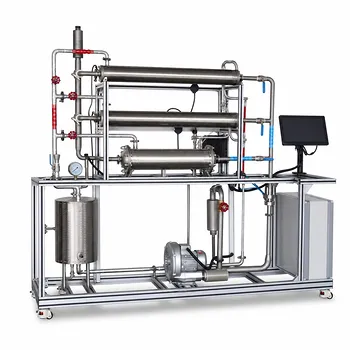
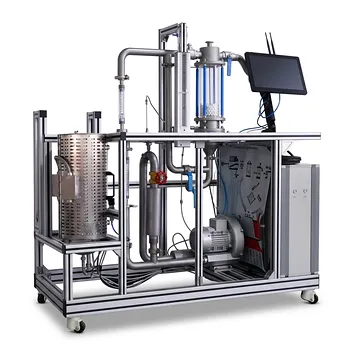
A single vessel packed with sulfonated PolyHIPE can demonstrate process intensification—doing in one step what normally requires a chemical demulsifier, a settler, and a guard bed of ion-exchange resin. It brings a real-world, cost-driven engineering principle right into the pilot plant.
Understanding the Trade-offs and Limitations
No material is a silver bullet. Objectivity demands we acknowledge where this approach adds complexity.
- Capacity and Fouling: The porous structure has a finite adsorption capacity. Surfactants and metals can eventually saturate the surface, and heavy organic foulants may block the pores, reducing the effective internal area over time.
- Regeneration Chemistry: Restoring the ion-exchange capacity requires a regeneration cycle with acid or brine, which generates a concentrated waste stream that must be managed. The demulsifying function may also require a solvent wash to remove trapped organics, adding operational steps.
- pH and Selectivity Sensitivity: The ion-exchange efficiency is highly pH-dependent. In strongly acidic or alkaline conditions, the material may degrade or lose its ability to target specific ions, requiring tight process control that a dedicated, single-purpose adsorbent might not need.
Making the Right Choice for Your Pilot Plant Goal
The decision to use a multifunctional material should be driven by what you need the pilot plant to teach or achieve.
- If your primary focus is demonstrating process intensification: Use this material to show how consolidating unit operations reduces equipment footprint and capital cost, but explicitly model the regeneration duty cycle.
- If your primary focus is on precise, decoupled kinetic studies: A single-function material might give you cleaner, easier-to-analyze data. However, a multifunctional system creates a richer, more challenging problem set for advanced modeling of competing mass transfer steps.
- If your primary focus is treating a real-world complex feed that contains both emulsions and heavy metals: The sulfonated PolyHIPE is an excellent starting point. Pair it with feed characterization like EDAX to correlate changes in the emulsion's stability with the specific metals being removed.
The true power of these polymers lies not just in cleaning a fluid, but in forcing you to think about separation sequences as interconnected networks rather than isolated steps. A single material can clean and clarify simultaneously, proving that the best process is often the one you design to happen all at once.
Summary Table:
| Functionality | Mechanism | Target Contaminants | Process Benefit |
|---|---|---|---|
| Demulsification | Surfactant adsorption via micro-porous structure | Emulsifying agents | Destabilizes & separates phases |
| Ion Exchange | Cation exchange via sulfonic acid groups | Heavy metals & inorganic toxins | Polishes output phases in one step |
Bring Process Intensification to Your Lab with LABPARK
Enhance your research and training capabilities with advanced hands-on systems. LABPARK provides premium Educational and Vocational Unit Operations Pilot Plants in chemical engineering, bioprocess & biotech, and environmental & water treatment.
We help universities, research institutes, and enterprises demonstrate complex mass transfer and real-world separation kinetics. Contact our engineering experts today to find the perfect pilot plant solution for your institution.
Related Products
- Rising and Falling Film Evaporation Educational Unit Operations Pilot Plant
- Polymerization Granulation and Pellet Processing Educational Unit Operations Pilot Plant
- 100L Continuous Loop Hydrogenation Educational Unit Operations Pilot Plant
- Electrolytic Hydrogen Production Educational Unit Operations Pilot Plant
- Carbon Dioxide PVT Curve Determination Educational Unit Operations Pilot Plant
People Also Ask
- How do educational unit operations pilot plants bridge theory and design? Bridge the Engineering Gap
- How do educational unit operations pilot plants address safety and waste management when scaling up?
- How is the heat transfer area calculated for an evaporation unit operations pilot plant during experimental design? Guide
- How to select educational evaporator pilot plants for thermal & scaling solutions? Complete Guide
- What are the structural characteristics & applications of rising-falling film evaporators in unit operations training?