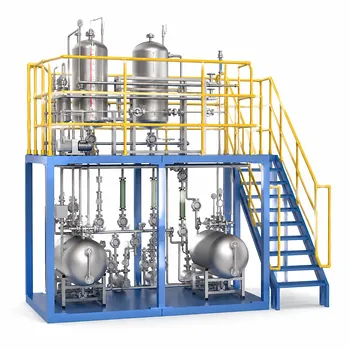
Modern process control unit operation pilot plants turn process safety and automation into hands-on practice. They combine industrial-style sensors, control valves, digital control architectures, monitoring software, and safety interlocks to measure and manage variables such as temperature, pressure, flow, and chemical composition. Students and researchers can then implement control strategies, simulate abnormal conditions, validate models, and practice safety responses in a controlled pilot-scale environment.
The central value of a modern pilot plant is its ability to connect theory with observable process behavior: users can see how sensors, controllers, equipment, operators, and safety systems work together during both normal operation and process deviations.
How Pilot Plants Build Practical Automation Skills
Industrial-style measurement and control
Pilot plants provide real-time measurements of key process variables, including temperature, pressure, flow rate, level, and composition. These measurements allow users to compare actual operating conditions with desired targets and understand how process changes propagate through the system.
Industrial-grade sensors, control valves, data-acquisition systems, and monitoring software make the training more representative of commercial processing environments than small, manually operated laboratory experiments.
Implementing control loops
Students can configure and evaluate control strategies such as feedback control, cascade control, and automated sequencing, depending on the plant design. They can observe how controller tuning affects overshoot, settling time, stability, and disturbance rejection.
This experience helps users understand that automation is not simply a matter of turning equipment on and off. Effective control requires selecting appropriate measurements, defining operating limits, tuning responses, and accounting for process dynamics.
Learning from real process responses
A pilot plant makes abstract control concepts visible. A change in cooling-water supply, feed rate, valve position, or heating duty can produce measurable changes in temperature, pressure, composition, or residence time.
Users can compare expected behavior with actual system performance and identify whether a deviation originates from the process, the instrumentation, the control logic, or the operating procedure.
How Pilot Plants Develop Process Safety Competence
Practicing hazard identification
Pilot plants support Process Hazard Analysis (PHA), Job Safety Analysis (JSA), and review of relevant Safety Data Sheets (SDS). Students can identify hazards associated with pressure, temperature, chemical reactions, utilities, equipment layout, and chemical exposure.
Because the equipment is operated at pilot scale under supervision, users can study credible failure scenarios without immediately facing the consequences of a full-scale industrial incident. The environment is controlled, but it still requires disciplined operating practices.
Simulating process deviations
Instructors and researchers can introduce or model deviations such as:
- Cooling-water failure
- Pressure buildup
- Valve blockage or incorrect positioning
- Loss of compressed air
- Abnormal temperature rise
- Utility interruption
- Excessive feed or dosing
These exercises show how the physical process responds and whether alarms, interlocks, relief devices, and emergency procedures work as intended.
Understanding layers of protection
Pilot plants can demonstrate multiple layers of protection, including alarms, safety interlocks, safety relief valves, rupture discs, and automated emergency shutdown systems. Users learn that process safety depends on coordinated prevention, detection, control, and mitigation—not on a single protective device.
The training also clarifies the difference between a normal control function and an independent safety function. A controller may maintain a temperature target, while a separate high-temperature trip may shut down the process if that target is exceeded substantially.
Developing emergency response habits
Automation does not eliminate the need for operators. Users must learn when to acknowledge an alarm, investigate a cause, place equipment in a safe state, activate an emergency shutdown, or escalate the event.
Repeated, supervised scenarios help develop the judgment needed to respond to abnormal situations rather than relying solely on memorized procedures.
How Pilot Plants Support Research and Model Validation
Studying dynamic and batch behavior
Dynamic vessels, batch reactors, distillation columns, and storage tanks allow users to study startup, shutdown, transitions, disturbances, and batch cycles. They can observe changes in temperature, pressure, conversion, composition, and column holdup over time.
This is essential because many industrial hazards and control challenges occur during transients rather than at steady state.
Validating mathematical models
Researchers can compare time-dependent mathematical models with measured pilot-plant data. Differences between the model and the physical system may reveal unmodeled heat losses, delays, mixing limitations, sensor dynamics, or equipment nonlinearities.
This provides a more credible basis for improving models, testing control algorithms, and evaluating scale-up assumptions.
Optimizing operating procedures
Pilot plants can be used to evaluate batch cycle times, startup sequences, energy use, control-loop performance, and operating schedules. Users can investigate how changes in one parameter affect product quality, safety margins, throughput, or utility consumption.
The result is a practical setting for testing improvements before applying them to larger and more expensive systems.
Connecting Automation with Process Quality
Monitoring conformance
A modern monitoring system can verify whether operating parameters remain within specified limits. Temperature, pressure, flow, and concentration measurements can be compared with process targets and critical quality requirements.
This teaches users to treat control performance and product quality as connected issues rather than separate subjects.
Measuring response and timing
Pilot-plant training can track response time, residence time, cycle time, and transition behavior. These measurements help users understand delays between a control action and the resulting process response.
Recognizing these delays is important for safe controller tuning and for avoiding aggressive actions that may cause instability or overshoot.
Evaluating utility reliability
Cooling water, steam, compressed air, electricity, and other utilities are part of the process-control system. Monitoring their availability and reliability demonstrates how a utility failure can become both a production problem and a safety problem.
Users can therefore evaluate not only equipment performance, but also the service level required to operate the process safely.
Applying process analytical technology
Inline sensors and automated data acquisition systems provide practical exposure to Process Analytical Technology (PAT). Users can monitor process variables in real time, examine interactions between parameters, and connect process conditions with critical quality attributes.
This supports the principle of continuous process verification, where process data contributes to quality assurance instead of relying only on final end-product testing.
Measuring repetition and cost
Training systems can also track repeated interventions, recalibrations, failed runs, and batch reruns. These measures show how poor control, unreliable instrumentation, or inadequate procedures increase operational effort.
Users can further consider the cost of quality, including failed material, routine testing, maintenance, calibration, and prevention activities.
Creating a Controlled Environment for Hazardous Operations
Enclosed and instrumented processing
Pilot plants can provide enclosed systems for studying hazardous reagents, volatile byproducts, gas absorption, exothermic reactions, and heat transfer. Integrated dosing pumps, scrubbers, pressure protection, and real-time monitoring reduce reliance on manual handling.
This allows users to study realistic process behavior while maintaining engineered containment and supervision.
Practicing environmental and water treatment
Environmental and water-treatment pilot plants extend training beyond chemical production. Users can investigate pollution control, remediation, treatment performance, and process monitoring without operating a full-scale facility.
These systems also reinforce the connection between process control, regulatory compliance, worker safety, and environmental protection.
Learning equipment and procedural limits
Users gain experience with pressure limits, temperature limits, chemical compatibility, operating envelopes, and safe handling procedures. The goal is not merely to operate the equipment, but to understand why those limits exist and what can happen when they are approached or exceeded.
Understanding the Trade-offs
Pilot scale does not reproduce every industrial condition
A pilot plant provides valuable physical behavior and operational realism, but it does not perfectly represent a commercial facility. Differences in scale, residence time, heat transfer, mixing, inventory, and process hazards may affect how results transfer to production.
Pilot data should therefore support—not replace—engineering analysis, scale-up studies, and formal safety reviews.
Automation can create false confidence
A highly automated system may give users the impression that the process is inherently safe. In reality, incorrect sensor readings, failed valves, poor alarm settings, communication failures, and programming errors can undermine protection.
Training should include instrument-failure scenarios and manual or fallback procedures where appropriate.
Controlled training is not risk-free
Pilot plants reduce exposure and limit consequences, but they still contain pressure, heat, chemicals, rotating equipment, and stored energy. Supervision, operating procedures, personal protective equipment, equipment inspections, and emergency planning remain essential.
The educational environment should be treated as a controlled industrial system, not as an environment where normal safety discipline can be relaxed.
More data requires better interpretation
Real-time monitoring can generate large volumes of data without automatically producing useful understanding. Users must learn data validation, sensor calibration, alarm prioritization, trend analysis, and the distinction between correlation and causation.
A technically advanced system is most valuable when the training explains how to interpret its information and act on it.
Making the Right Choice for Your Goal
Pilot plants are most effective when exercises combine normal operation, automation, process analysis, and abnormal-condition response.
- If your primary focus is automation training: Use real-time sensors, configurable control loops, industrial valves, data logging, and dynamic operating scenarios to evaluate stability and controller performance.
- If your primary focus is process safety: Include PHA and JSA activities, SDS review, utility-failure simulations, alarm response, interlocks, relief devices, and emergency shutdown exercises.
- If your primary focus is research: Use dynamic and batch modules to validate models, test control strategies, study transient behavior, and evaluate scale-up or process-optimization assumptions.
- If your primary focus is quality and efficiency: Monitor conformance, response time, utility reliability, repetition, energy use, and cost-of-quality indicators alongside critical process parameters.
- If your primary focus is hazardous or environmental processing: Select enclosed, instrumented systems with appropriate containment, gas scrubbing, dosing control, relief protection, and environmental-monitoring capabilities.
A well-designed process-control pilot plant gives learners and researchers the practical judgment to operate, automate, analyze, and safeguard complex processes before they encounter them at commercial scale.
Summary Table:
| Training and research focus | Key pilot-plant capabilities | Practical outcomes |
|---|---|---|
| Automation | Sensors, control valves, feedback and cascade loops, data logging | Controller tuning, stability analysis, and disturbance response |
| Process safety | Alarms, interlocks, relief devices, emergency shutdowns, failure scenarios | Hazard identification and confident abnormal-condition response |
| Research | Batch and dynamic modules, real-time measurements, model comparison | Model validation, control testing, and scale-up insight |
| Quality and efficiency | PAT, trend analysis, utility monitoring, cycle-time tracking | Process conformance, energy awareness, and improved operating procedures |
| Hazardous and environmental processing | Enclosed systems, dosing control, scrubbing, containment, water-treatment modules | Safer study of chemical, biotech, environmental, and water-treatment processes |
Prepare students, researchers, and process teams for real industrial challenges with LABPARK Educational and Vocational Unit Operations Pilot Plants. Our configurable systems support chemical engineering, bioprocess and biotech, and environmental and water-treatment training through hands-on automation, process safety, model validation, quality monitoring, and abnormal-condition exercises. Universities, research institutes, and enterprises can build practical expertise in operating limits, control strategies, safety interlocks, utility reliability, and process optimization in a supervised pilot-scale environment. Contact LABPARK to discuss your training or research goals and select a pilot plant configured for your process, safety, and automation requirements.
Related Products
- Multimodal Absorption and Desorption Pilot Plant for Unit Operations Training
- Multi Pump Fluid Transport Process Piping Unit Operations Training Pilot Plant
- Natural Product Extraction Unit Operations Training Pilot Plant
- Quantitative Dosing and Liquid Flow Control Educational Unit Operations Pilot Plant
- Fixed-Bed Chemical Reaction and Gas Dust Tar Removal Unit Operations Pilot Plant
People Also Ask
- How do predictive thermodynamic models integrate into pilot plants? Bridging Theory and Practice
- Which cross-validation strategy should be selected for pilot plant time-series & batch data? Avoid Data Leakage
- How do utility requirements influence pilot plant selection? Avoid Costly Lab Integration Mistakes
- How can process control schemes be configured to teach basic and advanced control?
- Why are Phase Equilibria & Enthalpy Vital in Separation Pilot Plants? Optimize Your Research