The modern pilot plant transforms filtration from a passive settling operation into an active, intensified process.
By replacing dead‑end cake filtration with cross‑flow hydrodynamics and adopting solid‑membrane media, these educational systems directly demonstrate how to restrict filter‑cake growth and achieve nanoscale separations. Students can observe, in real time, how fluid velocity parallel to the filter surface limits solid accumulation, while microfiltration, ultrafiltration, and nanofiltration modules showcase pore‑size‑based selectivity from 0.1 µm down to 0.1 nm. This hands‑on exposure connects theory to practice, revealing exactly why flux stays high and energy demand shrinks when filtration is re‑engineered for intensification.
Process intensification in filtration is about redesigning mass transport to prevent the formation of a dominant resistance layer. Pilot plants make this tangible: they let users run cross‑flow experiments where cake thickness plateaus and permeate flux remains elevated, and they allow direct comparison of classical depth media with membrane media that separate at the molecular level.
The Shift from Dead‑End to Cross‑Flow Filtration
Demonstrating Cake Growth Restriction
Traditional dead‑end filtration forces the entire feed flow perpendicular to the filter, rapidly building a compressible cake that throttles throughput.
In a modern pilot plant, the same slurry is instead pumped parallel to the filter surface. This cross‑flow creates shear that continuously scours the surface, preventing solids from packing into a thick, resistive layer.
Students see the cause‑and‑effect immediately.
As they increase the cross‑flow velocity, the cake growth decelerates and eventually plateaus at a thin, stable thickness. The permeate flux remains high because the dominant resistance shifts from the cake to the membrane itself—a far more predictable and controllable barrier.
Visualizing the Hydrodynamic Balance
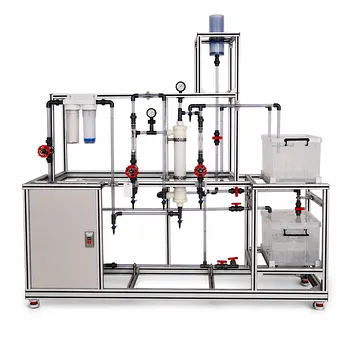
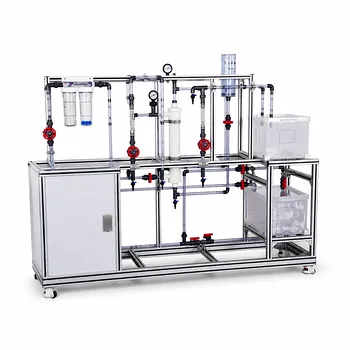
The pilot‑scale module is typically equipped with transparent housing or sight glasses, allowing visual observation of the particle‑deposition front.
Pressure transducers and flow meters then translate that visual input into quantitative data. Learners plot the relationship between transmembrane pressure (TMP) and flux, identifying the critical flux below which fouling is minimal and cake formation is effectively arrested.
They also discover the penalty of over‑shearing.
Excessive cross‑flow can emulsify droplets, degrade fragile solids, or cause unacceptable pumping costs. Thus the pilot plant becomes a living lab for balancing hydrodynamic lift, pressure drop, and product integrity—the very trade‑offs that define intensified design.
Membrane Media as a Fully Engineered Separation Layer
Teaching Pore‑Size Selectivity Across Scales
While cross‑flow handles the hydraulic challenge of cake control, the adoption of solid membrane media replaces the coarse, statistical retention of depth filters with precise, pore‑size‑based sieving.
Pilot plants demonstrate this by housing interchangeable modules: a 0.1 µm microfiltration (MF) membrane for bacteria and fine particles, a 0.01 µm ultrafiltration (UF) membrane for proteins, or a sub‑nanometer nanofiltration (NF) membrane for multivalent ions and small organics.
The same test slurry can be passed through each module in sequence.
Learners measure rejection rates and permeate quality, directly linking the nominal pore size to the actual molecular weight cut‑off. This progression from 0.1 µm down to 0.1 nm cements the concept that separation is no longer a compromise between throughput and clarity, but an engineered choice of media.
Mapping Pressure Drop to Membrane Performance
Every membrane module is instrumented to reveal the relationship between feed pressure, permeate flux, and real‑time selectivity.
Students can quickly see that a tighter membrane demands a higher driving force but delivers a lower‑salinity permeate—a classic intensification trade‑off where energy input is traded for separation quality.
They also witness irreversible fouling first‑hand.
Even with cross‑flow, dissolved organic matter can adsorb inside membrane pores, causing a gradual flux decline that hydraulic shear cannot reverse. This teaches the necessity of chemical cleaning protocols and pre‑treatment strategies, completing the picture of how membrane‑based intensification operates sustainably over time.
Bridging Process Intensification and Educational Design
Why Pilot Plants Are the Ultimate Intensification Workspace
The demonstration of cake‑restricted filtration and membrane selectivity isn’t an isolated exercise—it’s a microcosm of the broader process intensification (PI) philosophy.
By shrinking the mass‑transfer boundary layer and replacing bulky gravity settlers with hollow‑fiber cassettes, these pilot units show how filtration equipment itself can be miniaturized without sacrificing throughput.
Moreover, they illustrate the PI principle of function integration.
A single membrane module can simultaneously clarify, concentrate, and fractionate, eliminating the need for multiple sequential vessels. When students measure the elimination of an entire rotary drum filter and its auxiliary systems, the dramatic reduction in plant footprint becomes a tangible, numbers‑driven lesson.
Learning the Intensification Metrics
In a typical pilot‑plant session, the data automatically generates flux‑versus‑TMP curves and rejection‑versus‑pore‑size charts.
These curves allow a direct comparison: the traditional dead‑end setup exhibits a rapid flux drop at pressures above 0.2 bar, while the cross‑flow membrane setup maintains stable flux up to several bar.
Students also calculate energy per cubic meter of permeate, drawing a line directly from macroscopic operating conditions to the sustainability outcomes that PI promises.
The pilot plant becomes a platform where the abstract goal of “intensification” is reduced to a set of measurable, optimizable variables.
Understanding the Trade‑offs
Pilot‑scale demonstrations that restrict cake growth and utilize membrane media are inherently optimized for education, but they also highlight real‑world constraints that engineers must manage.
- Pumping Energy Demand: Maintaining high cross‑flow velocities requires recirculation pumps whose power consumption can offset the savings from a smaller filter area if not carefully selected.
- Membrane Fouling Beyond Cake: Even a perfectly restricted cake cannot prevent irreversible adsorption of organics, meaning cleaning‑in‑place (CIP) cycles and downtime are still part of the life‑cycle cost.
- Fragility of Membrane Media: Solid membranes are susceptible to scratching, chemical degradation, or pore collapse if exposed to unexpected pressure spikes or incompatible solvents—risks that are easy to demonstrate in a controlled pilot environment.
- Capital Cost vs. Operating Savings: The high‑precision modules and high‑shear pump loops represent a higher upfront capital cost, which is only justified when the value of continuous operation and reduced footprint outweighs it. The pilot plant lets students model this break‑even point for themselves.
Making the Right Choice for Your Goal
The way you leverage a filtration‑intensification pilot plant depends on whether you are teaching fundamentals, screening industrial membranes, or designing a miniaturized process.
- If your primary focus is teaching fundamental separation principles: Use the pilot plant’s interchangeable modules to run a pore‑size progression, and let students derive the critical flux for each. This turns abstract equations into a memorable, visual experience.
- If your primary focus is screening membranes for a specific product: Operate the cross‑flow loop with the actual process fluid, measure fouling rates and cleaning‑cycle recovery, and compare the life‑cycle flux of different membrane materials under identical hydrodynamic conditions.
- If your primary focus is demonstrating energy savings and waste reduction: Design a head‑to‑head experiment where the same separation is performed with a conventional rotary drum filter and with an intensified cross‑flow membrane system, then compare the solvent loss, thermal input (if the permeate must be evaporated), and system footprint.
- If your primary focus is training operators on real‑world troubleshooting: Deliberately induce a rapid fouling event—by starving the cross‑flow, spiking the solids, or exceeding the critical flux—and have the team diagnose the root cause from pressure‑drop signatures and turbidity data.
The modern pilot plant does not simply demonstrate that filtration can be intensified; it equips you with the diagnostic tools to see exactly where, why, and at what cost that intensification occurs.
Summary Table:
| Parameter | Traditional Dead-End Filtration | Intensified Cross-Flow Filtration |
|---|---|---|
| Flow Direction | Perpendicular to the filter surface | Parallel to the filter surface |
| Cake Growth | Rapid, thick, and highly resistive | Controlled, thin, and kept in dynamic balance |
| Permeate Flux | Drops quickly as cake thickness increases | Remains high and stable over long cycles |
| Primary Resistance | The accumulated solid filter cake | The engineered membrane media itself |
| System Footprint | Large (often requires multi-stage settling) | Compact and integrated (miniaturized footprint) |
Bring Process Intensification to Your Lab with LABPARK
Bridge the gap between theoretical transport phenomena and hands-on engineering reality. LABPARK provides state-of-the-art Educational and Vocational Unit Operations Pilot Plants in chemical engineering, bioprocess & biotech, and environmental & water treatment for universities, research institutes, and enterprises.
Our advanced pilot systems empower students and researchers to run real-time cross-flow experiments, analyze membrane fouling, and master the metrics of process intensification.
Ready to upgrade your laboratory capabilities? Contact us today to explore our customizable pilot plant solutions!
Related Products
- High-Gravity Emulsification and Mass Transfer Educational Pilot Plant
- Natural Product Extraction Unit Operations Training Pilot Plant
- Multi-Modal Distillation Unit Operations Training Pilot Plant
- Multi-Functional Special Distillation Educational Pilot Plant
- Constant Pressure Filtration Educational Unit Operations Pilot Plant
People Also Ask
- How to update chemometric calibration models in pilot plants? Best practices for process engineers.
- Why Compare Membrane-Reservoir Models with Pilot Plant Data? Ensure Successful Process Scale-Up
- How does column packing affect absorption intensification, and how is it evaluated experimentally?
- How should OSBL investments be estimated? Key Steps to Avoid Budget Overruns in Pilot Plant Projects
- How to estimate capital costs of custom pilot plant components? 2 Key Methods