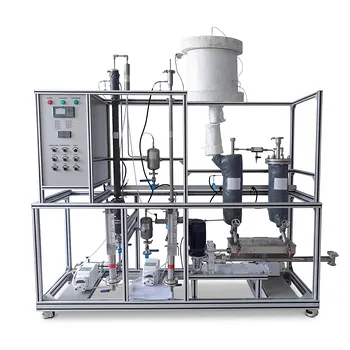
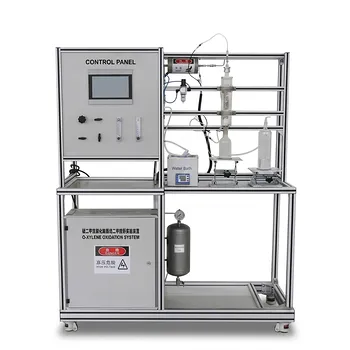
High-pressure catalytic reactor pilot plants simulate the industrial Haber process by creating a scaled-down, highly instrumented version of the core reaction—not a direct replica of a full-scale plant. This simulation focuses on replicating the fundamental thermodynamic and kinetic behavior, using controlled high temperatures and pressures, precise gas flow, and specialized catalyst beds. The goal is to enable safe, repeatable study of reaction yield, catalyst activity, and process dynamics without the extreme hazards and immense scale of actual ammonia production.
A Haber pilot plant isn’t trying to match the volume of industrial output; it’s designed to faithfully reproduce the chemical engineering principles—equilibrium limitations, mass and heat transfer, and catalytic behavior—that govern the process. By doing so at a manageable scale with rigorous safety systems, it becomes a powerful tool for research and engineering education.
Why Simulate the Haber Process at Pilot Scale?
The Haber process operates at the intersection of thermodynamic favorability (low temperature, high pressure) and kinetic practicality (high temperature), making it a quintessential case study in reaction engineering. A pilot plant provides a safe sandbox to explore this conflict.
Moving Beyond the Textbook
Industrial ammonia synthesis is an exothermic reaction that reduces volume, so equilibrium yield increases with pressure and decreases with temperature. But the reaction rate is impractically slow below 400°C. Pilot plants let researchers and students measure conversion, catalyst activity, and space velocity under precisely controlled conditions, turning theoretical trade-offs into tangible data.
A Laboratory for Real-World Phenomena
Industrial reactors face challenges like pressure drop across catalyst beds, heat exchanger fouling, and gas distribution. A well-designed pilot unit includes sensors and analytical tap points to quantify these effects. The simulation is not just about chemistry; it’s about unit operations and process safety.
The Core Architecture of a Haber Pilot Plant
These pilot systems are built on a skid or benchtop with an array of specialized components working in unison. Each element is chosen to mimic an industrial function while maintaining lab-level controllability.
The Reactor Vessel: Tubular and Fixed-Bed
The heart of the system is a pressurized tubular reactor containing a fixed bed of catalyst—typically an iron-based formulation similar to industrial systems. The reactant gases flow through the tube, which is housed inside a furnace. The design ensures plug-flow behavior and predictable residence time for accurate kinetic modeling.
Precision Gas Flow and Mixing
Industrial N₂ and H₂ feeds are simulated using mass flow controllers (MFCs) that blend the two gases in a precise 1:3 molar ratio. Any variation in feed composition would skew conversion data, so these controllers maintain setpoints with high accuracy. A mixing station downstream ensures homogeneity before the gas touches the catalyst.
Temperature Control and Multi-Zone Furnaces
Reaction kinetics are exquisitely sensitive to temperature. Pilot plants deploy PID-controlled multi-zone furnaces wrapped around the reactor. Each zone is independently controlled to maintain a precise axial temperature profile, often peaking near the catalyst bed outlet to mimic the industrial hot spot. This allows study of how temperature shifts influence yield and catalyst deactivation.
Analytical Tap Points
To track conversion, the system includes analytical tap points that withdraw a small slipstream of the reactor effluent. This is sent to a gas chromatograph or an NDIR analyzer to measure ammonia concentration in real time. Without this, you’d be blind to performance—these tap points are the window into the reaction’s internal state.
The Critical Battle Against Hydrogen Embrittlement
Perhaps the most dangerous hidden challenge in Haber simulation is not the pressure or temperature alone—it’s the interaction between hydrogen gas and standard construction materials.
A Metallurgical Threat at the Molecular Level
Under high pressure and temperature, hydrogen molecules dissociate on metal surfaces and diffuse into the steel lattice. This atomic hydrogen can accumulate at grain boundaries, causing a loss of ductility and eventual brittle fracture. In a pilot plant with high-purity H₂, this is not a theoretical concern—it’s a primary design constraint.
Material Selection for Piping and Vessels
To prevent catastrophic gas leaks, all wetted components—reactor tubes, flanges, valves, and piping—must be fabricated from specialized high-strength, low-alloy steels or austenitic stainless steels with proven resistance to hydrogen embrittlement. This is a direct material translation from industrial practice to the laboratory, ensuring that the pilot plant doesn’t just simulate chemistry but also replicates critical process safety engineering.
Safety Systems: The Non-Negotiable Foundation
A Haber pilot plant operates with flammable gas (H₂) at extreme pressures. Safety systems are not add-ons; they are integrated into the operational logic from the first design sketch.
Overpressure Protection and Relief
Automated high-pressure relief systems are mandatory. These include rupture discs and spring-loaded relief valves set to vent at a pressure below the vessel’s design limit. They provide passive, fail-safe protection against a runaway reaction or a control system failure.
Leak Detection and Automated Shutdown
Fixed-point hydrogen gas detectors are placed at critical locations. If a leak is sensed, the control system triggers an automated emergency shut-off: gas feed valves slam closed, the reactor heater is de-energized, and an inert purge gas automatically flushes the system. Many pilot plants also incorporate blast shields or operate inside a ventilated enclosure, mirroring the safety culture of full-scale plants.
What You Actually Study: From Kinetics to Catalyst Activation
Once the plant is running safely, the real work begins. The simulation allows deep investigation into the performance factors that dictate industrial profitability.
Replicating Reaction Kinetics and Equilibrium Limitations
By varying bed temperature (e.g., 400–530°C) and reactor pressure (up to 30 MPa), researchers can map conversion against equilibrium predictions. The pilot plant demonstrates that while high pressure pushes NH₃ concentration upward, the kinetic boost from higher temperature eventually hits a diminishing return as equilibrium shifts. This is the central teaching moment of the Haber process.
Practical Engineering Skills
The pilot plant also trains future engineers in catalyst activation (reduction of the iron oxide precursor with H₂), measurement of space velocity (how fast gas flows through the catalyst bed per unit catalyst volume), and evaluation of pressure drop across the packed bed. These are the exact operational metrics a plant engineer monitors to detect catalyst aging or bed channeling.
Understanding the Trade-offs in Pilot Plant Design
A pilot plant is a compromise. It must be faithful enough to the industrial reality to be useful, yet practical enough to be safe and affordable.
Pressure and Temperature Scaling: Safety vs. Fidelity
Educational pilot plants often operate at lower pressures (e.g., 15–30 MPa vs. 100+ MPa industrial) and somewhat moderated temperatures. This reduces hydrogen embrittlement risk and vessel wall thickness requirements. The core thermodynamic principle—the pressure-yield relationship—is still clearly observed, but the absolute conversion values are lower. The trade-off is accepted because the learning objectives are met without needing a vessel that would require a special bunker.
Cost and Complexity: Is a Full-Scale Replica Necessary?
A true high-fidelity replica of a 200-atm industrial converter would cost orders of magnitude more and introduce safety challenges that outweigh the educational benefit. A well-designed pilot plant replicates the phenomena, not the physical size. It prioritizes instrument access, visual observation, and operational flexibility—factors that are far more valuable for research and training than chasing an exact pressure number.
Making the Right Choice for Your Goal
The specific design of a Haber pilot plant should align tightly with your primary objective. Here’s how to think about what you need:
- If your primary focus is undergraduate chemical engineering education: A micro-reactor system operating at moderate pressures (10–30 bar) with a simple catalyst bed and online analysis will beautifully demonstrate equilibrium and kinetics, while keeping safety manageable.
- If your primary focus is catalyst research and development: You’ll need a high-pressure system capable of 20–30 MPa with precise multi-zone temperature control and the ability to run for extended periods to study deactivation and activation protocols.
- If your primary focus is process safety training: Prioritize a pilot plant that fully integrates hydrogen embrittlement-resistant materials, multiple layers of overpressure protection, leak detection, and automated shutdown logic—the engineering of the safety systems is the lesson.
A well-conceived high-pressure catalytic reactor pilot plant turns an abstract industrial marvel into a tangible, safe, and illuminating engineering experiment that prepares the next generation for the realities of the plant floor and the research lab.
Summary Table:
| Parameter / Feature | Industrial Haber Process | Pilot Plant Simulation |
|---|---|---|
| Primary Objective | Maximize ammonia production volume | Study kinetics, catalysts, and process safety |
| Reactor Type | Large-scale multi-bed converter | Pressurized tubular fixed-bed reactor |
| Operating Pressure | High (often 100+ MPa) | Moderated (typically 1.5–3.0 MPa for safety) |
| Gas Feed Control | Industrial-scale recycling systems | Precision Mass Flow Controllers (MFCs) |
| Safety Focus | Large-scale containment & mitigation | Automated shutdown, relief valves, leak detection |
| Material Criticality | High-strength alloys for hydrogen resistance | Identical focus on preventing hydrogen embrittlement |
Bring Industrial-Scale Chemical Engineering into Your Lab
To effectively teach or research complex reactions like the Haber process, you need equipment that balances real-world chemical fidelity with rigorous safety design.
LABPARK provides state-of-the-art Educational and Vocational Unit Operations Pilot Plants in chemical engineering, bioprocess & biotech, and environmental & water treatment. Tailored for universities, research institutes, and enterprises, our systems offer:
- Uncompromised Safety: Integrated gas detection, automated shutdown, and hydrogen-resistant metallurgy.
- Precision Control: Advanced multi-zone heating and mass flow control for accurate kinetic modeling.
- Hands-on Learning: True-to-life unit operations that prepare students and researchers for industry challenges.
Ready to elevate your laboratory capabilities? Contact LABPARK today to find the perfect pilot plant solution for your institution.
Related Products
- Methanol Synthesis and Catalyst Performance Evaluation Educational Unit Operations Pilot Plant
- Carbon Dioxide Hydrogen Methanol Synthesis Educational Unit Operations Pilot Plant
- Multi Functional Catalytic Reaction and Reactor Evaluation Educational Unit Operations Pilot Plant
- Fixed Bed Gas Solid Catalytic Reaction Educational Pilot Plant
- Ethylbenzene Dehydrogenation Educational Unit Operations Pilot Plant
People Also Ask
- Why is a purge system necessary when operating a gas recirculation loop in a methanol synthesis pilot plant? (Guide)
- How do temp & pressure affect methanol synthesis pilot plants? Optimize equilibrium and catalyst performance.
- Why do modern methanol pilot plants operate at lower pressures? Catalyst & Feed Requirements Explained
- What are the operational requirements for catalyst activation? Safe Methanol Pilot Plant Operation
- Why Compare Predicted and Experimental Excess Enthalpy? Key to Accurate Pilot Plant Scale-up