In chemical engineering pilot plants, data integrity is non-negotiable. Errors like Increment Extraction Error (IEE) and Increment Preparation Error (IPE) directly undermine sampling accuracy by introducing systematic bias into the analytical data. IEE distorts the physical sample by violating the center-of-gravity rule during extraction. IPE corrupts the sample after extraction through unintended alterations like contamination, spillage, or moisture changes. Left unchecked, these errors produce measurements that are precisely wrong, leading engineers to faulty process control decisions and incorrect conclusions about reaction kinetics, separation efficiency, or product quality.
IEE and IPE are not random noise—they are hard-coded biases that cannot be fixed by better instruments or more measurements. Because the Total Sampling Error in a typical pilot plant is 20 to 100 times larger than the analytical error, failing to eliminate these Incorrect Sampling Errors (ISE) components makes the entire measurement chain unreliable, no matter how sophisticated the instrumentation.
The Foundation: Why Sampling Accuracy Defines a Pilot Plant’s Purpose
A pilot plant’s job is to generate trustworthy data for scale-up, process optimization, and safety assessments. That data is only as credible as the sample it comes from.
The Silent Dominance of Total Sampling Error
The Theory of Sampling (TOS) reveals a brutal truth: Total Sampling Error (TSE) dwarfs Total Analytical Error (TAE) by a factor of 20 to 100. This means the act of taking and preparing a sample is vastly more error-prone than running a laboratory assay or a process analyzer scan. Obsessing over instrument calibration while neglecting sampling fundamentals is a fatal mistake.
Accuracy vs. Precision: The Target You Must Hit
Accuracy reflects how close a measurement is to the true process value—systematic errors ruin it. Precision only describes reproducibility. IEE and IPE are systematic error generators. They can make a sensor or lab analysis deliver highly repeatable (precise) but completely incorrect (inaccurate) values, such as a consistent 15% under-reporting of a key reactant. In pilot plants, this disguises yield losses or masks dangerous hotspots.
The Increment Extraction Error (IEE): The Flawed Grab
IEE is all about physical misrepresentation during the moment of sample collection. It occurs when the sampling device fails to follow the center-of-gravity rule.
What the Center-of-Gravity Rule Demands
Every particle whose center of mass lies within the defined increment boundaries must be collected, and no particle whose center lies outside should be included. In a slurry pipe or a moving belt of granules, the cutter must move smoothly through the entire cross-section. If the cutter deflects large particles, leaves behind heavier fragments, or scoops an incomplete portion, IEE is created. This error favors certain particle sizes, densities, or velocities, systematically skewing the composition of the collected sample.
How IEE Sabotages Process Understanding
Imagine a fluidized bed reactor where catalyst attrition fines are present. A sampling probe that preferentially captures fines due to poor extraction geometry will report a false particle size distribution. The engineer sees “good fluidization” on paper, while the bed is actually clogging. This misled view triggers wrong adjustments to gas velocities or purge rates—damaging catalyst life and product consistency.
The Increment Preparation Error (IPE): The Quiet Corrupter
IPE happens after the sample is collected—during transport, splitting, drying, or storage. It is a sequence of uncontrolled chemical or physical changes that alter the sample’s properties.
The Many Faces of Post-Extraction Damage
- Moisture absorption or loss can shift the weight of a hygroscopic powder, making the measured moisture content meaningless.
- Spillage and cross-contamination from one sample to the next create phantom components in an analysis.
- Degradation (e.g., polymerization of monomers, oxidation of sensitive intermediate) occurs if the sample container isn’t inert or cooled, transforming the composition before it reaches the lab.
- Segregation during transport can stratify particles by size, so any subsample drawn later is biased.
Why IPE Breeds Overconfident False Signals
A sample contaminated with a trace of cleaning solvent can spike a gas chromatograph output. Engineers then chase a fake impurity, modifying distillation columns or reaction conditions based on a ghost signal. IPE errors are especially dangerous because they can be invisible to standard quality checks if only precision is monitored and no reference material is run through the same preparation steps.
How IEE and IPE Combine to Derail Process Control
These errors don’t operate in isolation. They form part of the Incorrect Sampling Error (ISE), alongside Increment Delimitation Error (IDE), and their combined effect can completely mask true process dynamics.
The Cascade from a Biased Sample to a Bad Decision
A pilot plant studying a new crystallization process draws a sample with IEE (fines are excluded) and then suffers IPE (solvent evaporates during transport). The resulting lab data suggests the crystal size is larger and the mother liquor is more concentrated than it really is. The engineer, believing supersaturation is dropping too fast, reduces cooling rate. In reality, nucleation is already underway, and the batch later crashes into a lump of agglomerates—ruining the experiment.
The Irreducible RMSEP Trap
Multivariate process models (like near-infrared calibrations) rely on representative samples. IEE and IPE inject bias that cannot be averaged out by taking more sensor scans or performing a higher number of replicated analyses. The Root Mean Square Error of Prediction (RMSEP) plateaus at an unacceptably high value because the error is embedded in the sampling procedure, not in the measurement noise. The only fix is to redesign the sampling system, not the analyzer.
Understanding the Trade-offs and Common Pitfalls
Eliminating IEE and IPE often demands money, maintenance, and process access—all of which come with trade-offs.
The Cost of Over-Rigorous Sampling vs. The Cost of Bad Data
Installing a full-stream cross-cut sampler with an enclosed, inert transport system is more expensive and complex than a simple dip valve. However, a “cheap” sampling system that generates biased data causes far greater financial loss through failed scale-ups, wasted batches of raw materials, and extended pilot plant campaigns. Pilot plant teams must weigh capital expenditure against the enormous cost of unreliable process development data.
The Illusion of “Good Enough” by Averaging
A common pitfall is believing that compositing many biased increments will cancel out the error. If each increment suffers from the same IEE (for example, always rejecting the coarsest particles), the composite will still be systematically biased. Averaging does not eliminate systematic error; it only makes the wrong answer more repeatable. Variographic analysis of the process can reveal this nugget effect and prove that the TSE is exceeding acceptable limits, which is a signal to stop analysis and fix the sampling bias first.
Making the Right Choice for Your Data Integrity
Ensuring sampling accuracy means tackling both IEE and IPE as non-negotiable parts of the sampling protocol. Your specific focus will dictate the priority.
- If your primary focus is verifying a reaction kinetic model: Validate that your sampling probe strictly obeys the center-of-gravity rule (eliminate IEE) because a skewed concentration profile will introduce a constant offset into your rate constants, making model parameters meaningless.
- If your primary focus is tracking trace impurities or degradation products: Invest in inert, sealed, and cooled sample handling systems to crush IPE, as even parts-per-million contamination or loss of unstable intermediates will give a false picture of product purity and stability.
- If your primary focus is optimizing particle size distribution or solid-liquid separation: First ensure the extraction method captures all size fractions equally (address IEE), then guarantee that no segregation, breakage, or agglomeration occurs during transport (address IPE), or else the entire particle characterization effort is built on a lie.
Every effort you spend on eliminating these fundamental sampling errors directly upgrades the value of your pilot plant data—turning each experiment from a potential misdirection into a solid foundation for successful scale-up.
Summary Table:
| Error Type | Occurrence Phase | Primary Cause | Main Impact on Data |
|---|---|---|---|
| Increment Extraction Error (IEE) | During sample collection | Violation of the center-of-gravity rule | Skews physical representation and particle size distribution |
| Increment Preparation Error (IPE) | Post-extraction (transport, storage, splitting) | Contamination, spillage, evaporation, or chemical degradation | Corrupts chemical composition and introduces false signals |
Ensure Data Integrity in Your Pilot Plant Scaling
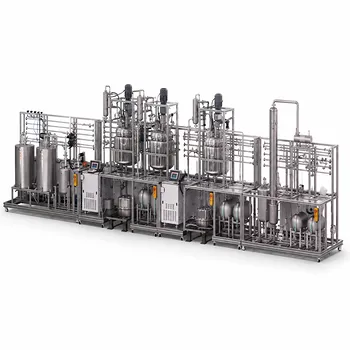
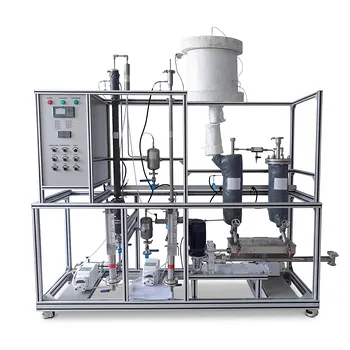
Don't let systematic sampling errors derail your research and scale-up decisions. LABPARK provides state-of-the-art Educational and Vocational Unit Operations Pilot Plants in chemical engineering, bioprocess & biotech, and environmental & water treatment.
Designed specifically for universities, research institutes, and enterprises, our pilot plants are engineered to support precise process control and minimize errors like IEE and IPE, delivering the trustworthy data you need.
Contact LABPARK today to discover how our pilot plants can enhance your research accuracy and accelerate your process development!
Related Products
- Fixed Bed Gas Solid Catalytic Reaction Educational Pilot Plant
- Multi Pump Fluid Transport Process Piping Unit Operations Training Pilot Plant
- Carbon Dioxide Hydrogen Methanol Synthesis Educational Unit Operations Pilot Plant
- Ethyl Acetate Synthesis Unit Operations Pilot Plant for Practical Training
- Natural Product Extraction Unit Operations Training Pilot Plant
People Also Ask
- How do reactor pilot plants safely study gas-solid reactions? Master kinetics with thermal & flow control.
- How does the Mears criterion evaluate transport resistance? Key Guide to Intrinsic Kinetics
- Fluidized vs. Fixed Bed Reactors: Comparing Heat & Complexity in Pilot Plants
- Why is a multibed configuration necessary for exothermic reactions? Optimize your pilot plant trajectory.
- How is the friction factor determined for fixed-bed pilot plants? Select the best pressure drop correlation.