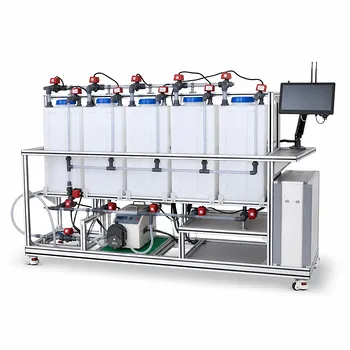
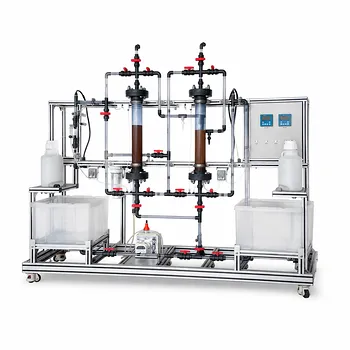
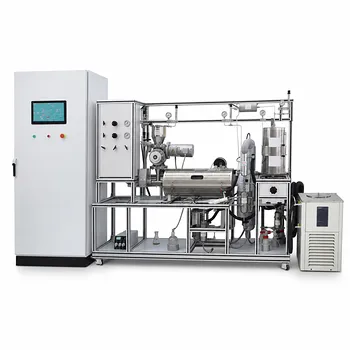
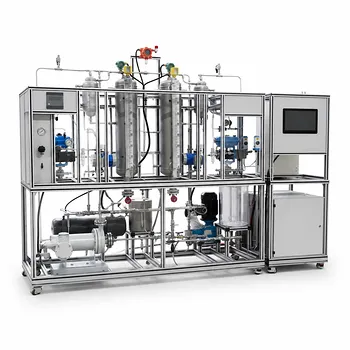
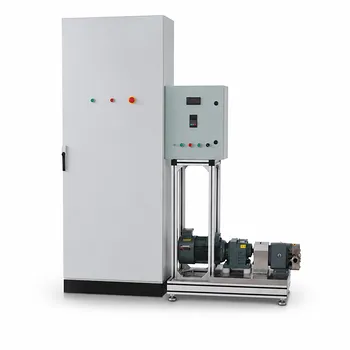
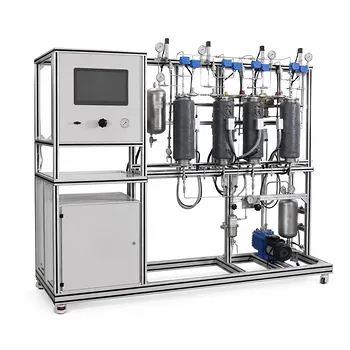
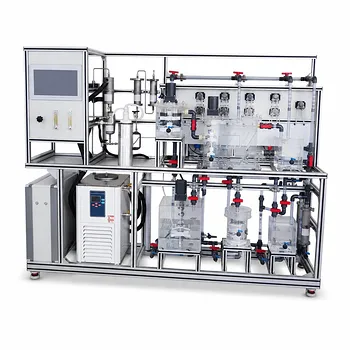
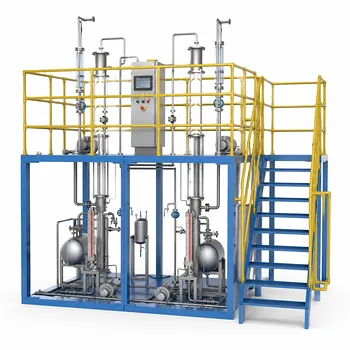
The fundamental value lies in their ability to validate theory under real-world stress conditions. Environmental and water treatment unit operations pilot plants bridge the critical gap between abstract textbook formulas and the unpredictable behavior of contaminated water. They provide a hands-on, process-engineering environment where students don't just learn that a process works, but how to make it work when variables spiral out of control. This direct interaction transforms passive knowledge of purification technology into active, diagnostic skill for advanced water recycling.
Before a student can design a full-scale municipal recycling plant, they must first see a pump clog, a membrane foul, and a breakthrough curve deviate from the ideal. These pilot plants compress decades of field experience into a single academic semester, turning theoretical chemistry into actionable wisdom by forcing students to measure real energy inputs, optimize chemical doses, and solve physical failures in real-time.
Bridging the Gap from Theory to Field Reality
The deep need in water treatment education isn't just understanding the chemistry of a pollutant. It is understanding how to reliably remove it at scale without consuming excessive energy or bankrupting a municipal budget. Pilot plants serve as the translator for this transition.
The Classroom Model vs. The Real System
In a laboratory beaker, adsorption follows a clean, predictable isotherm. In a packed bed column within a pilot plant, that same process is complicated by channeling, pressure drops, and mass transfer limitations.
A student turning a valve to control flow through an ion exchange resin instantly learns that residence time is not just a number on paper. It is a physical constraint that dictates whether the effluent meets discharge regulations. The pilot plant exposes the hidden complexities that static calculations ignore.
Integrating Multi-Stage Treatment Trains
Modern non-fresh water reuse rarely relies on a single technology. A typical system requires a sequence, such as chemical coagulation, followed by sedimentation, and finally membrane polishing.
Pilot plants allow learners to physically connect these unit operations, linking a sedimentation basin directly to an ultrafiltration (UF) module. When the upstream settling process malfunctions, the student sees immediate, catastrophic fouling in the downstream membrane. This teaches systems thinking, which is vital for designing integrated municipal reclamation processes.
Building the Core Skill Set Through Diagnostics
Operating a pilot plant requires maintaining a delicate dynamic equilibrium. It is this instability that educates operators better than a perfectly stable system ever could.
Understanding Membrane Filtration Regimes
Textbooks clearly define Reverse Osmosis (RO), Nanofiltration (NF), and Ultrafiltration (UF) based on pore size and osmotic pressure. However, the distinction becomes intuitive only when a student watches trans-membrane pressure (TMP) rise and flux decline in real time.
By running high-pressure RO simulations for brackish water reuse alongside low-pressure UF for oil-water separation training, students internalize where each technology fits in the market. They learn that choosing a membrane is an economic trade-off between water quality, energy cost, and fouling propensity, not just a pore size calculation.
Data-Driven Process Optimization
Sustainable engineering requires minimizing waste. Pilot plants equipped with sensors allow students to perform simplified Lifecycle Assessments (LCA) based on real measurements, not assumptions.
A student can measure the kilowatt-hours consumed to treat a cubic meter of wastewater and the volume of chemical sludge generated. This hands-on data collection transforms environmental compliance from a regulatory checkbox into a quantifiable design goal. It teaches that the "best" treatment is often the one that balances purification efficiency with minimal environmental footprint.
Evaluating Novel Purification Technologies
The pilot scale is where promising lab materials either succeed or fail commercially. When testing advanced treatments, like nanomaterial-based filters for heavy metal removal, the pilot plant is the proving ground.
Students circulate contaminated water through these innovative filters, measuring not just initial contaminant removal rates, but also long-term lifespan and backwash efficiency. This direct comparison between traditional granular media and a novel nanostructured membrane provides a sobering, evidence-based perspective on technological hype versus industrial reality.
Understanding the Trade-offs and Real-World Constraints
A perfectly designed theoretical system can be rendered useless by a poor cost profile or an undiagnosed maintenance issue. Pilot plants openly display these vulnerabilities.
The Inevitability of Membrane Fouling
No filtration lecture is complete until a membrane clogs. Pilot plants intentionally demonstrate that fouling is not an anomaly—it is the central operational reality of advanced recycling.
Students learn to diagnose fouling types (organic, inorganic scaling, or biofouling) by analyzing the data signature of the declining flux. The critical lesson isn't how to prevent fouling entirely, but how to design effective cleaning-in-place (CIP) protocols and pre-treatment strategies to manage it economically.
The Economics of Regeneration and Waste Streams
Ion exchange resins don't work forever, and spent activated carbon must go somewhere. Pilot plant operation forces students to confront the cost and logistics of regeneration cycles.
Running a breakthrough curve on an adsorption column shows that a cheaper sorbent with a shorter lifespan might generate more solid waste than a costly one with high capacity. This teaches that water recycling always produces a concentrated waste stream, forcing an analysis of the total carbon footprint of the purification process itself.
Operational Safety and Mechanical Aptitude
Advanced oxidation uses harsh chemistry, and pressure-driven RO systems operate at high stakes. The pilot plant environment ingrains the mechanical safety habits that are invisible in a simulation.
Students learn the sound of a cavitating pump and the danger of a relief valve failure. This vocational muscle memory—understanding the physical plumbing, fittings, and material compatibility—is what distinguishes a competent field engineer from a theoretician when processing complex industrial wastewater.
How to Apply This to Your Learning Objective
The configuration of a pilot plant must match the specific educational outcome. A system designed for general chemistry demonstration will not teach the nuances of high-purity water production.
- If your primary focus is vocational training for municipal plant operators: Prioritize pilot plants with robust mechanical components, including clear sedimentation basins, surface aerators, and back-washable multimedia filters. The goal is operational maintenance and process control.
- If your primary focus is process engineering and energy minimization: Select pilot plants featuring dense sensor arrays and interchangeable membrane modules (RO/NF/UF). The key is collecting real-time data to plot pump energy curves and calculate specific flux to benchmark separation efficiency.
- If your primary focus is environmental compliance and sustainability: Insist on pilot plants with integrated adsorption columns and ion exchange modules that allow for mass balance analysis. Measuring spent regenerant volumes and sludge toxicity is essential for understanding Lifecycle Assessment (LCA) under ISO 14040 standards.
- If your primary focus is researching next-generation materials: Seek a system that allows for the simple swapping of test columns or membrane cells. This enables a direct, side-by-side comparison between a standard polyamide membrane and a novel nanomaterial-enhanced filter under identical hydraulic conditions.
A pilot plant that mimics the chaotic complexity of real water streams doesn't just teach the definition of advanced recycling—it creates the adaptable, diagnostic mindset required to solve the world's escalating water scarcity problems.
Summary Table:
| Educational Focus | Key Pilot Plant Features | Target Learning Outcomes |
|---|---|---|
| Operator Training | Sedimentation basins, surface aerators, back-washable filters | Process control, system maintenance, and safety |
| Process Engineering | Dense sensor arrays, interchangeable RO/NF/UF membranes | Energy optimization, flux calculation, and data analysis |
| Environmental Compliance | Integrated adsorption columns, ion exchange modules | Mass balance calculations and Lifecycle Assessment (LCA) |
| Materials Research | Easily swappable test columns and membrane cells | Benchmarking novel nanomaterials vs. standard media |
Elevate Your Engineering Curriculum with LABPARK
Prepare the next generation of engineers, operators, and researchers for real-world environmental challenges. LABPARK provides premium Educational and Vocational Unit Operations Pilot Plants in chemical engineering, bioprocess & biotech, and environmental & water treatment for universities, research institutes, and enterprises.
Our pilot plants bridge the gap between classroom theory and industrial reality, allowing students to master membrane filtration, system diagnostics, and process optimization hands-on.
Ready to upgrade your laboratory or training facility? Contact LABPARK today to find the ideal pilot plant solution for your educational goals.
Related Products
- Electrochemical Water Treatment Educational Unit Operations Pilot Plant
- Ion Exchange Water Purification Educational Pilot Plant for Engineering Unit Operations
- Multi-Functional Membrane Separation Educational Pilot Plant for Unit Operations Lab
- Dual-Mode Rectification Pilot Plant for Practical Training Unit Operations
- Solid Waste Pyrolysis and Refining Educational Pilot Plant for Unit Operations
People Also Ask
- What design features do educational electrochemical pilot plants utilize to manage gas liberation and water loss?
- How can unit operations pilot plants show lead-acid concentration vs state of charge? Real-time monitoring guide.
- How do educational electrochemical pilot plants scale up electrolysis? Master industrial engineering.
- How to Estimate Sulfate in Water Treatment Pilot Plant Deposits: Gravimetric Guide
- How can foaming be managed during steam generation experiments in water treatment unit operations pilot plants? Tips