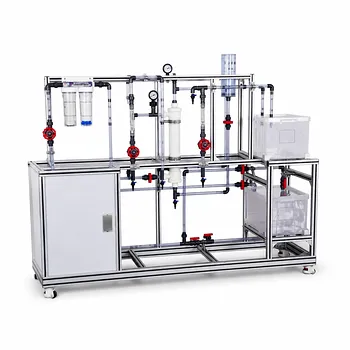
The leap from nanomaterial innovation to real-world water treatment isn’t made in a beaker—it’s made in a pilot plant.
Environmental and water treatment pilot plants provide the scalable, hands-on platform needed to study advanced nanomaterial-based filtration systems. They allow researchers to circulate contaminated water through nanostructured membranes or adsorption media and directly measure the removal rates of heavy metals, microorganisms, and organic pollutants. This process yields reliable data on filtration efficiency, membrane lifespan, energy demand, and scalability—the very metrics that determine whether a laboratory breakthrough becomes a practical water purification technology.
The defining value of environmental pilot plants is their ability to stress-test nanomaterial filters under continuous-flow, real-world conditions. They supply the critical performance data—on removal, fouling, regeneration, and safety—that bridges the chasm between a laboratory-scale promise and a dependable, industrialized water treatment solution.
From Lab-Scale Promise to Process-Ready Proof
Theoretical studies and batch experiments cannot replicate the dynamic challenges of a flowing, mixed matrix of contaminants. Pilot plants close this gap by forcing nanotechnologies to prove themselves in operational settings.
Testing Under Continuous-Flow Conditions
Nanomaterials like carbon nanotubes and graphene oxide show exceptional pollutant capture in beakers. But their real-world viability depends on how they behave when water flows continuously over hours and days. Pilot plants emulate this by feeding polluted water through packed adsorption columns or membrane modules at controlled flow rates. Researchers can then observe real-time changes in removal efficiency, track saturation over time, and identify the exact point when performance drops—something a simple batch test cannot reveal.
Comparing Nanomaterials Against Traditional Methods
A pilot plant is a side-by-side testing ground. The same contaminated feed water can be routed through a conventional filter and a nanomaterial-enhanced filter simultaneously. This direct comparison quantifies the additional value of the nanotechnology: perhaps a higher removal rate for a specific heavy metal or the ability to capture antibiotics that escape traditional activated carbon. The data is unbiased and directly relevant to operators who must justify investment in new materials.
The Critical Metrics Only Pilot Plants Can Reveal
A successful nanofilter is not just about high removal; it must also last, require minimal energy, and be economically regenerable. Pilot plants make these metrics measurable.
Filtration Efficiency and Contaminant Removal Rates
Under controlled conditions, pilot plants log inlet and outlet concentrations for target pollutants. This directly quantifies the removal capacity of nanostructured membranes or nanoparticle-embedded adsorbents. For example, a pilot-scale nanofiltration unit can demonstrate >99% rejection of divalent salts or organic micropollutants, providing the hard numbers needed for process design.
Membrane Fouling and Longevity
Fouling is the silent killer of membrane systems. Organic matter, microorganisms, or inorganic scale coat the nanomaterial surface, degrading performance. Pilot plants expose the filter to realistic feed waters over extended periods, allowing researchers to measure flux decline, document fouling layer formation, and test cleaning protocols. This data defines operational lifespans and maintenance schedules.
Pressure Drop and Energy Demand
Every filtration process consumes energy. Nanofilters, especially tight nanofiltration (NF) membranes, may require higher driving pressures than traditional media. By monitoring feed pressure, flow rate, and power draw, pilot plants calculate the specific energy consumption. This is a pivotal economic metric that determines whether the nanotechnology will be sustainable at municipal or industrial scale.
Regeneration Efficiency and Breakthrough Curves
Materials like carbon nanotubes or functionalized nanoparticles often can be regenerated. Pilot plants map breakthrough curves—plotting effluent concentration versus time or volume treated—to pinpoint when the bed is exhausted. Then, they test regeneration cycles with chemicals or heat, measuring how much adsorption capacity is restored. This demonstrates the true cost per cubic meter of treated water over many cycles.
Simulating the Complexity of Real Contaminated Water
Real water contains cocktails of pollutants, not just single compounds. Pilot plants recreate that complexity, showing how nanomaterials handle multifaceted challenges.
Heavy Metal Stabilization with Reactive Nanoparticles
When using reactive materials like zero-valent iron (nZVI), groundwater remediation involves much more than simple filtration. Pilot plants can simulate underground conditions, injecting nZVI slurries to observe oxidation-reduction reactions that immobilize heavy metals like chromium or arsenic. Subsequent filtration then captures the stabilized metal-nanoparticle complexes, and the integrated data validates the entire treatment chain.
Removing Low-Concentration Organics
Industrial wastewater often carries trace organic compounds—pharmaceuticals, pesticides—that conventional treatments miss. Pilot-scale adsorption columns packed with graphene oxide or carbon nanotubes can target these elusive contaminants. The large surface area and tailored surface chemistry of the nanomaterials amplify capture efficiency, and pilot data demonstrates their uniqueness at low concentrations, where every percentage point of removal counts.
Desalination and Brackish Water Treatment
NF membrane pilot plants are purpose-built to simulate seawater or brackish water desalination. They reveal how nanoscale pores reject salts while allowing water to pass, and they directly compare the energy consumption of NF against reverse osmosis (RO). This informs decisions about where nanomaterials can truly reduce treatment costs without sacrificing permeate quality.
Integrating Nanomaterials into Full Treatment Trains
Filtration rarely works in isolation. Modern water reuse requires a sequence of unit operations. Pilot plants allow nanomaterial-based stages to be tested within a complete, multi-barrier system.
Pilot plants can combine sedimentation, chemical oxidation, adsorption columns, and membrane filtration in series. A nanomaterial-enhanced adsorption column might polish effluent from a biological reactor, while a downstream nanofiltration membrane provides a final polish. By running such a train, researchers evaluate not just individual component performance but also how the nanomaterial interacts with preceding and subsequent steps—for instance, whether oxidation byproducts foul the nanomembrane.
Understanding the Inherent Risks: Leaching and Disposal
No responsible evaluation of nanotechnology is complete without studying its own potential to become a pollutant. Pilot plants are indispensable for this safety dimension.
Health and Environmental Risks of Nanomaterials
The very properties that make nanoparticles effective—small size, high reactivity—also create toxicological concerns. If nanoparticles leach into treated water, they may pose ecological or human health risks. A pilot plant can be configured to deliberately track nanoparticle release under various stress conditions, such as high flow rates or aggressive cleaning cycles.
Developing Capture and Neutralization Protocols
To ensure compliance, researchers use pilot plants to test dedicated separation processes for spent nanomaterials. Membrane filtration, sedimentation, and advanced oxidation can be evaluated for their ability to capture and neutralize nanoparticles at the end of their life. This work establishes standardized safety protocols and provides regulators with the evidence that nanomaterials can be handled responsibly at scale.
How to Structure Your Pilot Plant Research for Maximum Impact
Your decision on how to use a pilot plant should mirror your primary objective—whether it is performance validation, scale-up feasibility, or safety assurance. Define the goal first, then design the experiment.
- If your primary focus is demonstrating contaminant removal: Run the nanomaterial filter with a real or highly simulated feed stream and measure removal rates for multiple target pollutants under varying operational conditions. Present the data in a way that directly compares to benchmark technologies.
- If your primary focus is scaling up for industrial or municipal use: Emphasize long-duration fouling studies, pressure drop logging, and regeneration cycle efficiency. Your pilot plant data should answer the questions: “How often must I replace the media?” and “What is the lifetime cost per cubic meter?”
- If your primary focus is ensuring safe implementation: Configure the pilot plant to monitor nanoparticle leaching and test downstream capture methods. Build a mass balance around the system to prove that the technology does not shift the problem from chemical pollution to nanoparticle pollution.
A pilot plant is not just a larger experiment; it is the proving ground where nanomaterials earn their place in the future of water treatment. Use it to generate the robust, multi-dimensional evidence that turns a promising material into a deployable, trusted technology.
Summary Table:
| Evaluation Metric | What it Measures | Importance in Scale-Up |
|---|---|---|
| Removal Rates | Inlet vs. outlet pollutant concentrations | Validates real-world purification efficiency |
| Membrane Fouling | Flux decline and cleanability over time | Establishes filter lifespan and maintenance |
| Pressure Drop | Feed pressure and energy consumption | Determines operational viability and cost |
| Leaching & Safety | Nanoparticle release under stress conditions | Ensures environmental safety and regulatory compliance |
Scale Up Your Nanomaterial Water Treatment Research with LABPARK
Bridging the gap between laboratory breakthroughs and industrialized water treatment requires reliable, scalable testing platforms. LABPARK provides premium Educational and Vocational Unit Operations Pilot Plants in chemical engineering, bioprocess & biotech, and environmental & water treatment.
Designed for universities, research institutes, and enterprises, our pilot plants deliver the precise control, real-time monitoring, and durability you need to stress-test advanced nanomaterial filtration systems under continuous-flow conditions.
Ready to accelerate your process development?
Contact LABPARK today to request a quote and discover how our pilot plants can enhance your research efficiency.
Related Products
- Ultrafiltration Membrane Separation Educational Pilot Plant
- Hot Filtration Educational Unit Operations Pilot Plant Laboratory System
- Multifunctional Membrane Separation Educational Pilot Plant with Ultrafiltration, Nanofiltration, Reverse Osmosis
- Constant Pressure Filtration Educational Unit Operations Pilot Plant
- Multi-Functional Membrane Separation Educational Pilot Plant for Unit Operations Lab
People Also Ask
- How do PEI, PVDF, and PSU membranes compare in pilot plants? Find the best fit.
- Pervaporation vs. Vapor Permeation: Handling Suspended Solids in Membrane Pilot Plants
- Isotropic vs. Anisotropic Membranes: How to Choose the Best Pilot Plant Modules
- Why Use a Membrane Separation Pilot Plant vs. Lab Testing? Avoid Costly Scale-Up Failures
- How do membrane pilot plants demonstrate synthetic vs biological membrane advantages?