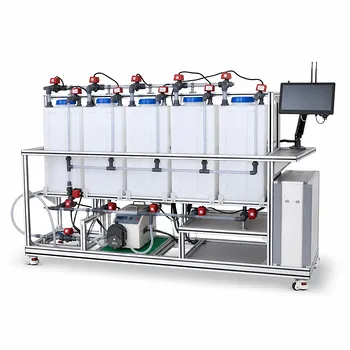
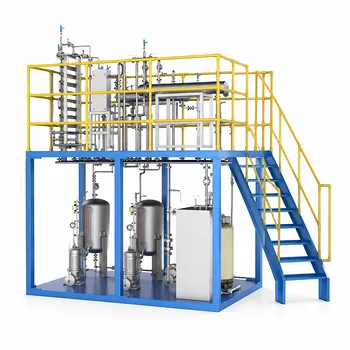
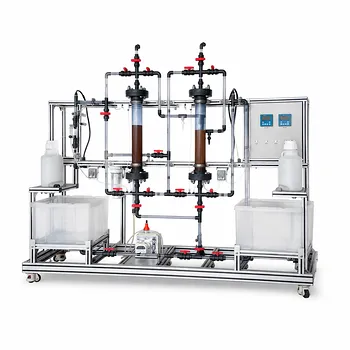
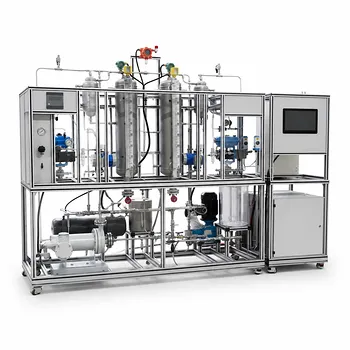
Electrochemical pilot plants bridge the critical gap between theory and practice by allowing you to physically control and measure the operating conditions that dictate how far a reaction travels into a porous electrode. By varying flow rates, temperature, and applied current while monitoring voltage losses, researchers can directly map the reaction penetration depth and reveal the true, often non-uniform, current distribution within an electrode's thickness. This hands-on experimentation is essential because real-world porous electrodes rarely behave like idealized flat plates, and these pilot plants provide the empirical data needed to validate the models that guide industrial scale-up.
The central insight is that an electrode’s effectiveness is limited by how deeply the electrochemical reaction can penetrate before encountering prohibitive resistance. Pilot plants transform this abstract concept into a measurable, tunable experimental system, enabling researchers to see exactly how operating conditions and material properties cause polarization gradients that restrict material utilization. This allows them to directly measure reaction penetration depth and map the current distribution, turning theoretical models into reliable scale-up tools.
Understanding Reaction Penetration Depth and Current Distribution
The Challenge of Porous Electrode Utilization
If a porous electrode is thicker than the reaction penetration depth, the material deep inside remains unused. This unused mass adds cost, weight, and volume without contributing to performance. The penetration depth is not a fixed material property—it shifts with how the electrode is operated.
The current distribution is the spatial map of where the reaction is actively occurring. In an ideal world, current would be uniform across the entire pore network, but in reality, it is highly skewed toward the side nearest the counter electrode. Understanding this gradient is fundamental to avoiding wasted material and poor power performance.
Key Governing Factors
Three primary factors determine how far the reaction zone extends. The first is electrolyte conductivity, which dictates how easily ions travel through the liquid-filled pores. The second is matrix conductivity, the electronic resistance of the solid electrode framework. The third is electrode kinetics, the inherent speed of the charge-transfer reaction itself.
Any resistance—whether ionic or electronic—creates a voltage loss that grows with distance from the current collector or separator. This polarization gradient starves the reaction of driving force deeper inside the electrode. Pilot plants make it possible to decouple and study the influence of each factor.
How Pilot Plants Enable Direct Observation
Manipulating Flow, Temperature, and Current Density
Electrochemical pilot plants designed for research give you direct knobs to turn. You can systematically change the electrolyte flow rate, which alters the convective transport of reactants and can mitigate concentration depletion within the pores. You can adjust the temperature, which directly influences electrolyte conductivity and reaction kinetics. And you can set the applied current density, which is the primary driver of polarization.
By observing how the overall voltage response changes across these conditions, researchers can infer the shifting current distribution. For example, a sudden increase in overpotential at higher current densities often signals that the reaction is becoming concentrated only at the pore mouths, shrinking the effective penetration depth.
Mapping Polarization to Reveal Current Distribution
The voltage penalty you measure is a direct fingerprint of the inaccessible electrode area. In a pilot-scale system, you can instrument the cell to measure potential at different points, or use reference electrodes to track the potential drop across the electrolyte and the matrix separately. This allows you to construct a polarization curve that is not just for the whole cell, but for specific regions of the electrode.
When you combine these measurements with variations in separator resistance—estimated from electrolyte conductivity—you can quantify the mass and voltage penalties that arise from a non-optimal current distribution. The pilot plant transforms the abstract concept of “penetration depth” into a tangible, measurable voltage loss that can be minimized.
Bridging Theory and Industrial Scale-up
Validating Mathematical Models
A model is only as good as the data that proves it. Electrochemical pilot plants generate the experimental data needed to validate computational models of porous electrodes. When you can test a model’s prediction against actual penetration depth measurements under varied current densities, you gain confidence in its use for designing larger cells.
Without this validation, a model might wrongly assume uniform current distribution, leading to an industrial electrode that is either needlessly thick or pathologically underperforming. The pilot plant closes this loop by exposing where the model’s assumptions break down.
Optimizing Electrode Thickness
The ultimate goal is to match the physical thickness to the usable reaction depth. Through pilot plant experiments, you can identify the thickness beyond which additional material yields negligible performance gain. This directly informs the scale-up rule: there is an optimum thickness, and it changes with operating current density.
The data also reveals how changes in grid weight and interconnecting bus dimensions impact electronic conductance. By seeing the resulting mass and voltage penalties firsthand, engineers can make informed trade-offs between energy capacity and power delivery in the scaled-up design.
Understanding the Trade-offs
Controlled vs. Realistic Conditions
Pilot plants often simplify fluid dynamics or thermal management to isolate variables, which may not perfectly represent the chaotic conditions of a full-scale industrial reactor. The trade-off is between gaining a fundamental understanding of penetration depth and replicating every real-world imperfection. Researchers must carefully extrapolate findings from a clean, instrumented environment to a production setting where fouling, flow maldistribution, and temperature gradients are common.
Measurement Limitations
Directly measuring current distribution inside a porous structure is invasive. Techniques like embedded reference electrodes can disturb the local fields, while non-invasive imaging may have resolution limits. The pilot plant data is powerful, but it often requires interpreting indirect signals like overall polarization, which demands a robust theoretical framework to deconvolute. If this framework is flawed, the inferred penetration depth can be misleading.
Making the Right Choice for Your Research Goals
How you use a pilot plant depends on whether your primary need is fundamental model validation or pre-engineering an industrial design.
- If your primary focus is fundamental understanding and model validation: Prioritize experimental flexibility with a pilot plant that allows you to independently vary flow, temperature, and current while measuring separate potential drops. Focus on isolating the contributions of electrolyte and matrix conductivity to current distribution.
- If your primary focus is optimizing electrode thickness for a specific industrial cell design: Use the pilot plant to simulate the targeted operating current density and electrolyte conditions as closely as possible. Systematically test varying electrode thicknesses while measuring capacity utilization and polarization to pinpoint the economic break-even point where additional material yields no further usable energy.
- If your primary focus is studying transport-limited reactions: Operate the pilot plant at varied flow rates and use online analytical sensors to correlate reactant concentration profiles with the measured polarization. This links the local concentration changes described by the Nernst equation directly to the penetration depth.
An electrochemical pilot plant does not just tell you that current distribution matters—it shows you exactly how it shifts under your control, turning guesswork into a precise engineering decision for the design of efficient, scalable porous electrodes.
Summary Table:
| Key Factor | Impact on Current Distribution | Pilot Plant Experimental Control |
|---|---|---|
| Electrolyte Conductivity | Dictates ionic transport ease through pores | Vary flow rates and monitor potential drops |
| Matrix Conductivity | Solid electronic resistance of electrode | Test different thickness & grid configurations |
| Electrode Kinetics | Speed of charge-transfer reaction | Control temperature and applied current density |
Accelerate Your Electrochemical & Chemical Engineering Research with LABPARK
Transitioning from theoretical models to industrial-scale performance requires reliable empirical data. LABPARK provides state-of-the-art Educational and Vocational Unit Operations Pilot Plants in chemical engineering, bioprocess & biotech, and environmental & water treatment. Designed specifically for universities, research institutes, and enterprises, our pilot systems empower you to accurately study reaction kinetics, optimize electrode designs, and scale up your processes with confidence.
Ready to elevate your laboratory's research capabilities? Contact LABPARK today to discuss your pilot plant requirements with our specialists!
Related Products
- Electrochemical Water Treatment Educational Unit Operations Pilot Plant
- Rising and Falling Film Evaporation Educational Unit Operations Pilot Plant
- Dual-Mode Rectification Pilot Plant for Practical Training Unit Operations
- Multi-Reactor Educational Pilot Plant for Reaction Engineering Unit Operations
- Electrolyte Distillation Purification and Formulation Educational Pilot Plant
People Also Ask
- What design features do educational electrochemical pilot plants utilize to manage gas liberation and water loss?
- How can unit operations pilot plants show lead-acid concentration vs state of charge? Real-time monitoring guide.
- How do educational electrochemical pilot plants scale up electrolysis? Master industrial engineering.
- How to Estimate Sulfate in Water Treatment Pilot Plant Deposits: Gravimetric Guide
- How can foaming be managed during steam generation experiments in water treatment unit operations pilot plants? Tips