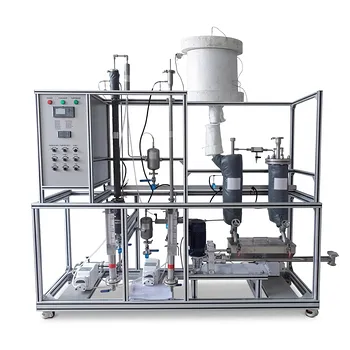
Educational hydrocracking reactors and catalytic unit operations pilot plants facilitate material-balance modeling by replacing an impractical list of individual reaction equations with measurable overall balances. By measuring feed and product flow rates and compositions, students and researchers can apply carbon and hydrogen balances across the reactor, determine hydrocarbon conversion and hydrogen consumption, and close the balance without identifying every cracking, isomerization, hydrogenation, and side-reaction pathway.
When reaction networks are too complex to model species by species, elemental balances provide a rigorous, experimentally grounded alternative. Pilot plants make this approach practical by connecting measured stream data with reactor performance calculations and process-simulation models.
Why Complex Hydrocracking Reactions Are Difficult to Model
Multiple Reaction Pathways Occur Simultaneously
Hydrocracking over zeolite catalysts at elevated temperature and pressure can involve several reactions at once. Hydrocarbon cracking may occur alongside hydrogenation, isomerization, and the formation of multiple product families.
A complete species balance would require detailed knowledge of every reaction stoichiometry, intermediate, and product distribution. In an educational or early-stage pilot study, that level of detail may be unavailable or unnecessary.
Individual Reaction Rates Are Not Always Required
The primary objective may be to determine overall conversion, hydrogen consumption, or elemental closure rather than to estimate every kinetic parameter. Elemental balances capture the net transformation of material even when the internal reaction network remains unresolved.
This is similar to accounting for money entering and leaving a business without recording every internal transaction. The overall balance can still be accurate if the relevant inputs and outputs are measured reliably.
How Pilot Plants Support Material-Balance Modeling
They Provide Controlled Feed and Product Streams
A catalytic pilot plant provides a defined feed stream and a measurable reactor outlet. Flow controllers and operating procedures help establish the quantities of hydrocarbon feed and hydrogen entering the system.
Outlet analysis then identifies the remaining reactants and major product components. These measurements create the data needed to calculate the overall material transformation.
They Enable Carbon and Hydrogen Balances
For hydrocracking experiments, carbon atoms entering in the hydrocarbon feed must be accounted for in the hydrocarbon products and any carbon-containing byproducts. Hydrogen atoms are distributed among unreacted hydrogen, hydrocarbon products, and hydrogen incorporated into the reacted material.
A simplified carbon balance can be expressed as:
[ \text{Carbon in feed}=\text{Carbon in outlet products}+\text{Carbon in other measured streams} ]
The corresponding hydrogen balance provides a basis for estimating net hydrogen uptake. Together, these balances describe the overall reaction without requiring a separate equation for every molecular pathway.
They Allow Hydrogen Consumption to Be Determined
Once feed and product compositions are measured, the difference between hydrogen entering and hydrogen leaving can be calculated. This supports determination of a molar hydrogen consumption ratio, such as hydrogen consumed per mole of hydrocarbon reacted.
That ratio is an experimentally derived process result. It reflects the combined effect of the actual reaction network under the selected temperature, pressure, catalyst, and feed conditions.
How the Approach Simplifies the Modeling Problem
It Reduces the Number of Unknowns
Detailed reaction modeling can introduce many unknown reaction extents, product concentrations, and kinetic parameters. Elemental balances reduce the problem to conserved quantities and directly measured stream properties.
This makes the degree-of-freedom analysis more manageable. Students can determine whether the available measurements are sufficient to solve for conversion or consumption rates before attempting calculations.
It Separates Measurement from Mechanistic Assumptions
A species-level model depends heavily on assumptions about which reactions occur and in what proportions. An elemental balance depends primarily on conservation laws and measured compositions.
This does not eliminate the need for chemical understanding. It establishes a reliable overall model before more detailed mechanistic or kinetic models are introduced.
It Supports Overall Performance Indicators
The same stream data can be used to calculate several practical reactor metrics:
- Hydrocarbon conversion
- Hydrogen consumption
- Product yield
- Carbon balance closure
- Selectivity toward measured product groups
- Effects of temperature, pressure, and catalyst conditions
These indicators provide a useful description of reactor performance even when individual products or intermediates cannot be fully resolved.
What Measurements Make the Balance Useful
Feed and Outlet Flow Rates
Mass flow controllers or calibrated flow measurements establish the quantity of material entering and leaving the reactor. Without reliable flow data, composition measurements alone cannot produce a complete material balance.
The measurements should be taken under defined operating conditions so that transient startup or shutdown behavior is not confused with steady operation.
Stream Composition
Standard stream-composition measurements provide the species information needed to perform carbon and hydrogen accounting. Depending on the pilot plant, analytical instruments such as online gas chromatography may be used to measure outlet components.
The analytical method must be consistent between feed and product streams. Missing product families can create an apparent balance error even when the reactor is operating correctly.
Temperature and Pressure
Temperature and pressure do not directly replace the material balance, but they define the conditions under which the measured reaction occurs. Recording them allows results from different runs to be compared and helps connect conversion or hydrogen uptake to operating conditions.
Temperature profiles can also indicate whether the reactor is close to isothermal operation or experiencing significant heat generation and removal effects.
Connecting the Pilot Plant to Dynamic and Flowsheet Models
Steady-State Balances Describe Continuous Operation
For a continuously operated catalytic reactor, the basic overall balance compares feed and outlet rates after the system reaches stable operation. The pilot plant supplies the physical stream data, while the balance equations translate those data into conversion and consumption values.
This gives students a practical interpretation of the algebraic equations used in process models.
Dynamic Balances Describe Changing Conditions
During startup, heating, catalyst conditioning, or shutdown, flow and composition may change with time. Dynamic material balances are then needed because accumulation inside the reactor and associated equipment cannot be ignored.
Sensor data allow users to compare measured transient behavior with numerical models. This extends the learning process from simple steady-state accounting to time-dependent process behavior.
Flowsheeting Extends the Analysis
Process simulators can represent the pilot plant as connected unit operations and solve the associated mass and energy balances. Measured feed and outlet data can be used to validate the simulated stream conditions.
This creates a feedback loop between experiment and model: the simulator identifies expected behavior, while the pilot plant reveals how closely the model represents the physical process.
Understanding the Trade-offs
Elemental Balances Do Not Identify Every Product
Carbon and hydrogen balances determine overall conservation and net consumption, but they cannot distinguish all individual hydrocarbon species. Two different reaction networks may produce similar elemental totals.
Detailed product analysis is required when molecular selectivity, intermediate formation, catalyst mechanism, or product quality must be understood.
Balance Accuracy Depends on Measurement Quality
Flow-controller errors, sampling problems, calibration drift, condensation, and unmeasured products can prevent the balance from closing. An apparently incorrect reaction model may actually reflect incomplete or inconsistent measurements.
Balance closure should therefore be treated as a diagnostic indicator, not merely as a final calculation.
Hydrogen Uptake Requires Clear System Boundaries
Hydrogen consumption must be calculated using consistent boundaries around the reactor and associated equipment. Dissolved hydrogen, purge streams, leaks, sampling losses, or changes in holdup can distort the result if they are excluded from the accounting.
The reported molar ratio should state which streams were measured and whether the result represents reactor consumption or a broader process-level consumption.
Simplification Can Hide Important Energy Effects
An elemental material balance does not describe heat generation, heat removal, or temperature excursions. For strongly exothermic or poorly controlled operation, energy balances are required alongside material balances.
Temperature measurements and coolant data can support evaluation of heat-transfer behavior and help identify operating conditions that may create thermal-management problems.
Making the Right Choice for Your Goal
The appropriate modeling level depends on what you need to learn or predict.
- If your primary focus is overall reactor performance: Use measured feed and outlet flow rates with carbon and hydrogen balances to determine conversion and net hydrogen consumption.
- If your primary focus is educational understanding: Begin with elemental balances and degree-of-freedom analysis before introducing detailed reaction kinetics or species-level models.
- If your primary focus is product distribution: Combine the overall balances with detailed outlet analysis capable of distinguishing individual hydrocarbons and product families.
- If your primary focus is process simulation or scale-up: Validate a flowsheet model against pilot-plant stream, temperature, and pressure data, then identify which assumptions require a more detailed reactor model.
Pilot plants make complex reactions modelable by turning conservation laws and measured streams into reliable overall process information.
Summary Table:
| Key aspect | How pilot plants help | Result |
|---|---|---|
| Feed and outlet data | Measure flow rates and stream compositions | Reliable overall balances |
| Carbon balance | Track carbon from feed to products and byproducts | Conversion and balance closure |
| Hydrogen balance | Compare hydrogen entering and leaving the system | Net hydrogen consumption |
| Operating conditions | Record temperature, pressure, and catalyst conditions | Comparable experimental results |
| Dynamic operation | Monitor startup, conditioning, and shutdown changes | Time-dependent model validation |
| Flowsheet integration | Connect measured data with process simulators | Better process modeling and scale-up |
| Main limitation | Elemental balances do not identify every molecule | Detailed analysis is needed for selectivity and mechanisms |
Ready to turn complex reactions into practical, measurable learning? Contact LABPARK to discuss educational and vocational unit operations pilot plants tailored to your needs. LABPARK supports universities, research institutes, and enterprises with pilot plants for chemical engineering, bioprocess and biotechnology, and environmental and water treatment applications. Our systems help teams collect reliable process data, teach material and energy balances, validate simulations, evaluate operating conditions, and build confidence before scale-up.
Related Products
- Methane Cracking Educational Unit Operations Pilot Plant
- 100L Continuous Loop Hydrogenation Educational Unit Operations Pilot Plant
- Crude Benzene Hydrogenation Educational Unit Operations Pilot Plant
- Multi-Reactor Educational Pilot Plant for Reaction Engineering Unit Operations
- Electrolytic Hydrogen Production Educational Unit Operations Pilot Plant
People Also Ask
- How do ethane vs naphtha cracking influence teaching pilot plant analytical configurations? Key Design Guide
- How can flow-NMR be integrated with pilot plant reactors to monitor kinetics? A Complete Guide
- How do cracking temperature and residence time affect olefin yield? Pilot Plant Guide
- How do reactor pilot plants define QbD design space? Master chemical process scale-up.
- Why is it important to distinguish between mass and mole concentration units? Master Material Balances