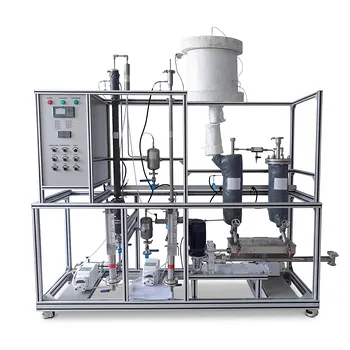
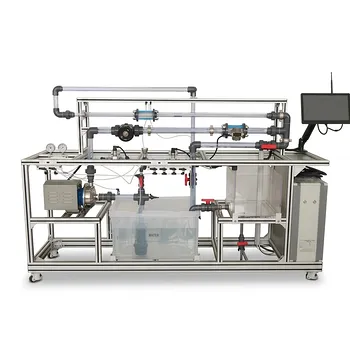
Continuous rectification is a steady-state parade, while batch rectification is a transient, fading performance. In continuous operation, the raw feed is introduced nonstop at a central feed plate, which splits the column into two distinct zones: a rectifying section above to purify the volatile component, and a stripping section below to recover the heavier one. Batch mode, conversely, dumps the entire charge into the reboiler at the start; the column then operates with only a rectifying section as the kettle’s composition constantly changes and depletes over time. To demonstrate both in a single pilot plant, you must build modular piping, multiple feed points, and switchable feed and heating strategies so students can physically transition from one flow regime to the other and observe how the product composition profile behaves completely differently.
The core challenge isn’t just the equipment—it’s that batch and continuous distillation teach fundamentally different engineering mindsets. A well-configured pilot plant uses flexible feed locations, reconfigurable piping, and dual instrumentation to let learners experience both the dynamic, time-dependent control of batch and the steady-state material balances of continuous operation.
The Fundamental Flow Differences Between Batch and Continuous Rectification
Continuous Operation: A Divided Column at Steady State
Continuous rectification is a constant-flow process. The raw feed enters at a dedicated feed plate, which acts as the column's anatomical waist. Above this plate, the rectifying section concentrates the more volatile component into the overhead product. Below it, the stripping section scrubs the descending liquid to recover the heavy component in the bottoms.
This setup creates a steady-state condition. Once the column reaches equilibrium, temperatures, compositions, and flow rates at every point become constant. Material and energy balances are time-invariant. This makes continuous operation ideal for demonstrating fundamental chemical engineering principles like McCabe-Thiele stepping, reflux ratio optimization, and large-scale industrial throughput.
Batch Operation: A Single-Section Column Under Transient Conditions
Batch rectification throws that steady-state out the window. The entire starting mixture is charged into the reboiler at the bottom. Because there is no external feed, the column has only a rectifying section—there is no stripping section. The kettle’s liquid composition is not constant; it becomes progressively leaner in the light component as the distillation proceeds.
Consequently, the process is inherently unsteady-state. The overhead product composition will drift unless the operator constantly adjusts the reflux ratio or heat input. This transience offers a powerful teaching opportunity. Students must practice time-dependent control strategies, profile temperature changes, and decide when to cut fractions—exactly the skills needed for high-value, small-volume separations in pharmaceuticals and specialty chemicals.
Configuring a Unit Operations Pilot Plant for Dual-Mode Operation
The Core Design Principle: Modular Piping and Multiple Feed Points
A dual-mode pilot plant is, above all, a routing puzzle. The column must have feed nozzles at several heights, not just one. One nozzle sits at the traditional midpoint for continuous operation. Others are positioned lower or higher for research flexibility. For batch mode, you need a direct, valved connection from the reboiler to the base of the column, completely bypassing the feed pump and intermediate stages.
The piping is built with quick-coupling connections or a manifold system. This modularity allows you to physically reconfigure the flow path in minutes. A student team can run a continuous distillation in the morning, then shut down, swap a few spool pieces, and be in full batch-rectification training by the afternoon.
Switching from Batch to Continuous: The Role of Feed Pumps and Vessels
In batch mode, the feed pump is idle. You charge the reboiler with the pre-mixed stock, apply heat, and let the column operate solely as an enricher. To switch to continuous operation, you activate a feed pump that draws from a separate feed tank and injects the mixture at the designated feed plate. Simultaneously, you engage the bottoms pump to continuously remove the heavy product, maintaining level in the reboiler—which now acts as a reboiler and stripping section sump, not just a batch kettle.
The pilot plant must also provide dedicated collection vessels. Continuous mode requires separate receivers for distillate and bottoms that can be emptied without process interruption. Batch mode uses a single distillate receiver with fraction-cut valves so operators can collect narrow boiling-point slices as the still-head temperature climbs.
Monitoring the Evolution of Composition: Instrumentation Differences
Continuous operations rely on steady-state sensors: constant-reading thermocouples at each tray, inline refractometers or density meters that track unchanging compositions. The data tells you if equilibrium is lost.
Batch operations demand time-series logging. The same thermocouples become a historical record of the distillation curve. Students watch the top-tray temperature remain flat for a long period (pure light component boiling off) then drift upward as the heavy component breaks through. A pilot plant must therefore have a data acquisition system that can toggle between “steady-state screen” and “trend-plotting mode” for each configuration.
Understanding the Trade-offs
Why Batch Wins on Versatility, But Continuous on Industrial Realism
A single batch column can separate a multi-component mixture into several narrow cuts. A continuous column doing the same would need multiple columns in series. Therefore, batch systems drastically reduce laboratory footprint and capital cost for teaching diverse separations. They are also easier to clean and sterilize between runs, a critical advantage for bioprocess training.
Continuous pilot plants, however, are the real factory mimics. They run 24/7 at high utilization, imparting deep knowledge of process control loops, heat integration, and disturbance rejection. Students who will enter commodity chemical plants need hands-on time with a live, steady-state column that mirrors the 90–95% onstream factors of industry.
The Hidden Cost of Flexibility: System Complexity and Cleanout
A pilot plant that can do both is naturally more complex. More valves, more connections, more dead legs. This creates additional leak points and cleaning challenges. If a batch run leaves high-boiling residues in the reboiler, switching immediately to a continuous feed can contaminate the stripping section. Procedures must be rigorous, teaching not just distillation theory but also operational discipline and changeover protocols—which itself is a valuable lesson for chemical engineering students.
Making the Right Choice for Your Educational Goal
Your configuration should be driven by the learning outcomes you need to measure. Match the mode to the core skill.
- If your primary focus is dynamic process control and fraction-cutting skills: Prioritize a batch column with a high-reflux-ratio capability, automated fraction collectors, and detailed temperature logging. Teach students to read the distillation curve in real time.
- If your primary focus is steady-state material and energy balances and industrial-scale operations: Build a continuous column with a dedicated feed pump, bottoms removal system, and multi-point temperature control. Let students lock in a reflux ratio and watch the column hold a constant profile for hours.
- If your primary focus is demonstrating the impact of residence time on heat-sensitive materials: Integrate a vacuum pump and vacuum-rated seals into your versatile column. Run a batch vacuum distillation first to show gentle separation, then switch to a continuous vacuum setup with a static mixer and rapid separator to show how minimal contact time boosts yield by avoiding thermal degradation.
- If your core goal is a comprehensive vocational training module: Invest in a fully reconfigurable pilot plant that pairs a batch stirred vessel with a continuous distillation column downstream. Run semi-continuous scenarios where one reactant feeds continuously while the batch reacts, then separate products in a steady-state column. This teaches the fluid transition between worlds that modern chemical plants increasingly demand.
The most powerful pilot plant is not the one that does everything, but the one that physically reconfigures to make an abstract concept like “steady-state versus transient operation” something a student can touch, trace, and troubleshoot.
Summary Table:
| Feature | Continuous Rectification | Batch Rectification |
|---|---|---|
| System State | Steady-state (constant composition/temperature) | Transient / Unsteady-state (changing composition) |
| Column Structure | Divided into Rectifying and Stripping sections | Contains only a Rectifying section |
| Feed Strategy | Continuous, constant feed at a midpoint plate | Single initial charge directly into the reboiler |
| Product Output | Nonstop distillate and bottoms removal | Fraction-cutting over time as light components deplete |
| Instrumentation | Steady-state sensors for constant profiles | Time-series logging to track distillation curves |
Upgrade Your Engineering Lab with LABPARK
Are you looking to give your students or researchers hands-on experience with both continuous and batch distillation? LABPARK provides state-of-the-art Educational and Vocational Unit Operations Pilot Plants in chemical engineering, bioprocess & biotech, and environmental & water treatment for universities, research institutes, and enterprises.
Our modular and highly configurable pilot plants make abstract thermodynamic concepts tangible. Contact us today to discover how we can customize a dual-mode training system for your institution!
Related Products
- Dual-Mode Rectification Pilot Plant for Practical Training Unit Operations
- Steam Methane Reforming Hydrogen Production and Purification Educational Pilot Plant
- Electrolyte Distillation Purification and Formulation Educational Pilot Plant
- Ion Exchange Water Purification Educational Pilot Plant for Engineering Unit Operations
- High-Gravity Emulsification and Mass Transfer Educational Pilot Plant
People Also Ask
- How does polyphosphate hydrolysis affect scale and corrosion in pilot plants? Essential Monitoring Guide
- How do predictive thermodynamic models integrate into pilot plants? Bridging Theory and Practice
- Which cross-validation strategy should be selected for pilot plant time-series & batch data? Avoid Data Leakage
- How can process control schemes be configured to teach basic and advanced control?
- Why Use Center Points in Process Analyzer Calibration? Key Benefits Explained