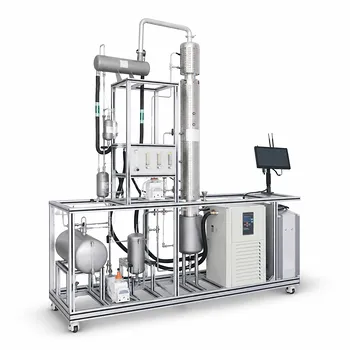
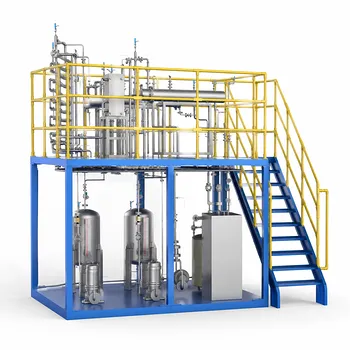
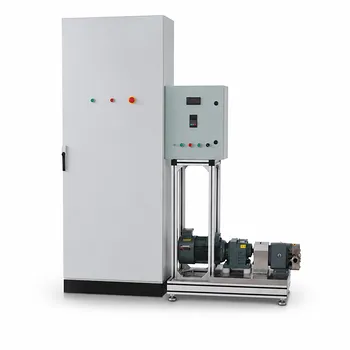
Chemistry is an undeniably experimental science—a discipline where molecular theory only becomes truth once it’s been tested, measured, and observed. Chemical engineering unit operations pilot plants fulfill this mandate by giving university students a rare, hands-on environment where abstract reaction kinetics, thermodynamic equilibria, and transport phenomena become tangible, scalable realities. Rather than merely reading about an integrated process, students manipulate real temperatures, pressures, and flow rates on pilot-scale distillation, absorption, or reactor systems to collect data that directly verifies theoretical predictions.
The central value of a pilot plant in chemistry education is that it closes the gap between textbook formulas and industrial truth. By moving beyond benchtop glassware, students confront the non-linear complexities of mass transfer, heat exchange, and process control that define real chemical systems, transforming experimental learning from a simple verification exercise into a deep investigation of how chemistry behaves when scale, safety, and economics matter.
From Glassware to Gigafactories: Why Scale Transforms the Experimental Mindset
The Invisible Limitations of Benchtop Chemistry
A standard undergraduate lab teaches reaction fundamentals using beakers, flasks, and test tubes. Heat transfer is fast, mixing is simple, and side reactions rarely dominate. These idealized conditions provide a clean introduction to stoichiometry and yield, but they mask the physical phenomena that dominate real production.
At bench scale, fluid dynamics are irrelevant; surface area to volume ratios are enormous, making temperature control trivial. Students never see how a poor choice of impeller design in a 50-liter reactor can create stagnant zones that skew kinetic measurements. A pilot plant makes these once-invisible transport limitations immediately observable, forcing the student to think not just about molecules but about momentum, energy, and mass transfer as interdependent variables.
A Modular Laboratory for Whole-Process Thinking
A well-designed chemical engineering pilot plant does more than enlarge a single reaction. It typically strings together modular unit operations—raw material preparation, a continuous stirred-tank reactor (CSTR), a separation column, a recycle loop, and a waste treatment stage. By manipulating temperature in the reactor and then directly measuring downstream product purity in the distillation column, students experience the chain of causality that defines a complete industrial process.
This holistic, modular design turns the pilot plant into an experimental platform where a single change—such as increasing the space velocity of a gas-phase reaction—triggers a cascade of measurable effects across unit operations. That direct feedback loop is impossible in a collection of isolated beakers; it teaches students to think in integrated systems, a fundamental experimental skill for chemists and chemical engineers alike.
Experimental Verification of Theory: Kinetics and Thermodynamics in Action
Capturing Kinetic Order on a Pilot-Scale Reactor
Theoretical chemistry courses derive integrated rate laws elegantly, but a pilot-scale CSTR or batch reactor lets students test those derivations with industrial noise. A student can sample reactant concentration over time, then apply the first-order test: a linear relationship when plotting $\lg(A)$ versus time reveals the rate constant $k$ as the slope. For a second-order reaction, a linear plot of $1/(B)$ versus time confirms kinetics.
Performing this analysis on a reactor with non-ideal mixing, sensor lag, and realistic heat transfer challenges adds a layer of experimental rigor that a small glass flask never provides. The student learns that data fitting is not a mathematical formality—it is a diagnostic tool that reveals whether a pilot-scale system obeys the ideal assumptions taught in lecture.
Observing Equilibria Shift with Le Chatelier’s Principle
Equilibrium reactions come alive when a student introduces a controlled disturbance to a running pilot-scale system. The plant’s inline sensors for temperature, pressure, and concentration allow a class to watch a new equilibrium establish itself in near real-time after, say, a sudden increase in pressure for a gas-phase reaction. This concrete demonstration of Le Chatelier’s principle bridges the mental gap between a static textbook diagram and a dynamic industrial operation.
Simultaneously, the student performs the necessary energy balances to confirm that the heat released or absorbed matches predictions. By comparing theoretical equilibrium constants with measured reactor output, they internalize that thermodynamics sets the boundary, but process dynamics determine how you get there.
Integrating Theory to Optimize Real Yield
Pilot plants let students close the experimental loop by turning raw data into actionable decisions. They calculate conversion, selectivity, and yield from their own operating log sheets, then physically adjust parameters—reactor temperature, feed ratio, residence time—to optimize the process. This iterative, hypothesis-driven experimentation mirrors the scientific method at an industrial tempo, reinforcing that chemistry is a living discipline where theory serves as a guide, not a dogma.
Bridging the Gap to Industry: Process Safety and Control as Experimental Variables
Safety as a Measurable Parameter
Chemistry education cannot afford to treat process safety as a footnote. A pilot plant inherently contains hazards—higher pressures, exothermic runaways, flammable solvents—that demand rigorous risk assessment before any experiment begins. Students learn to perform hazard and operability (HAZOP) analyses, specify relief systems, and interpret control interlocks not as bureaucratic hurdles but as integral experimental constraints.
This safety-conscious design changes their experimental mindset: they understand that every manipulation of a process variable carries a safety implication, preparing them for the reality that industrial chemistry is a negotiation between reactivity and containment.
Inline Instrumentation and the Art of Process Control
Another fundamental experimental skill is the ability to monitor a process in real time and adjust it accordingly. Pilot plants are equipped with temperature probes, pressure transducers, flow meters, and analytical devices that feed data directly to a control system. Students learn to distinguish between a sensor drift and an actual process upset, a form of hypothesis testing that sharpens their analytical instincts.
By tuning a PID controller to maintain a setpoint or by manually intervening to correct a fluctuating column pressure, they appreciate that control is not an add-on but a central experimental variable. The plant becomes an instrument, not just a scaled-up pot.
Understanding the Trade-offs: When Pilot Plants Fall Short
The High Cost of Physical Scale
Operating a pilot plant requires significant capital, maintenance, and safety infrastructure. Not every university can afford multiple units, and the consumable costs—solvents, utilities, replacement gaskets—can outstrip typical department budgets. This reality means that experimental repetitions are constrained, which limits the statistical power of student datasets and can falsely emphasize getting a "right answer" over exploring edge cases.
The Risk of Masking Fundamental Science with Operational Noise
Pilot-scale experiments introduce mechanical complexity—pump failures, sensor calibration errors, phase entrainment—that can overwhelm the underlying chemistry lesson. A student might spend an entire lab session troubleshooting a blocked feed line rather than analyzing kinetic data. Without careful curriculum design, the operational burden can obscure the experimental objective.
Scale Doesn’t Always Translate Linearly
Some phenomena, like microkinetic effects or highly sensitive organometallic catalysis, do not mimic well even at pilot scale. The equations that govern fluidized bed hydrodynamics at 10,000 liters may break down at 100 liters. Educators must therefore carefully select experiments where the scaled-down physics are representative, or supplement with computational modeling to explain discrepancies—an important lesson in itself, but one that can dilute the hands-on value if over-relied upon.
Making the Right Choice for Your Curriculum’s Experimental Core
How you integrate a unit operations pilot plant depends on whether your primary goal is to deepen conceptual understanding or to produce industry-ready graduates. The following recommendations can help you align the plant’s capabilities with your educational mission.
- If your primary focus is reinforcing theoretical chemistry concepts: Use the pilot plant for a select set of canonical experiments—kinetics with a CSTR, distillation mass balances, equilibrium shifts—where the data directly test equations from the lecture hall. Minimize equipment changes to keep student attention on the chemistry, not the machinery.
- If your primary focus is developing experimental problem-solving skills: Intentionally introduce controlled disturbances (feed composition swings, heat exchanger fouling) and ask students to diagnose the root cause using only their process data. Let them iterate operator settings and defend their decisions based on thermodynamic and kinetic principles.
- If your primary focus is career readiness for the chemical industry: Design full-process projects that span multiple unit operations, require HAZOP documentation, and enforce batch records. Grade students on safety adherence, material efficiency, and data integrity as much as on final product yield.
- If your primary focus is resource-constrained training: Invest in a single versatile pilot unit (a jacketed reactor with a small distillation column) that can rapidly switch between experiments. Supplement with virtual simulations for the integrated process train to keep the experimental thinking alive without overextending budgets.
By treating the pilot plant as a sophisticated experimental tool rather than a mere demonstration device, universities can honor chemistry’s experimental soul. It is this translation from symbolic equation to concrete observation that forges the chemist and engineer—equipping them not just with facts, but with the evidence-tested judgment that an experimental science demands.
Summary Table:
| Aspect | Benchtop Chemistry | Pilot Plant Experience |
|---|---|---|
| Scale & Fluid Dynamics | Idealized mixing; trivial heat transfer | Real-world mass/heat transfer & fluid dynamics |
| System Complexity | Isolated, single-step glassware setups | Integrated, multi-stage modular unit operations |
| Data & Kinetics | Clean, noise-free calculation exercises | Real-world data fitting with process noise |
| Safety & Control | Minimal risk; manual adjustments | Active HAZOP, inline sensors, & PID control loops |
Elevate Your Practical Education with LABPARK
Bridge the gap between theoretical chemistry and industrial reality. LABPARK provides premium Educational and Vocational Unit Operations Pilot Plants in chemical engineering, bioprocess & biotech, and environmental & water treatment.
Designed specifically for universities, research institutes, and enterprises, our training systems empower students to master real-world process dynamics, safety protocols, and system control.
Ready to transform your laboratory curriculum? Contact LABPARK today to design the ideal pilot plant solution for your institution.
Related Products
- Carbon Dioxide Hydrogen Methanol Synthesis Educational Unit Operations Pilot Plant
- Multi Pump Fluid Transport Process Piping Unit Operations Training Pilot Plant
- Multi-Reactor Educational Pilot Plant for Reaction Engineering Unit Operations
- Ethyl Acetate Synthesis Unit Operations Pilot Plant for Practical Training
- Multi-Modal Distillation Unit Operations Training Pilot Plant
People Also Ask
- How do temp & pressure affect methanol synthesis pilot plants? Optimize equilibrium and catalyst performance.
- Why is a purge system necessary when operating a gas recirculation loop in a methanol synthesis pilot plant? (Guide)
- Why do modern methanol pilot plants operate at lower pressures? Catalyst & Feed Requirements Explained
- What are the operational requirements for catalyst activation? Safe Methanol Pilot Plant Operation
- Why is the chemical plant startup schedule crucial? De-risk scale-up with pilot plants.