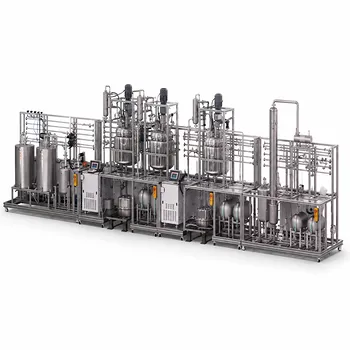
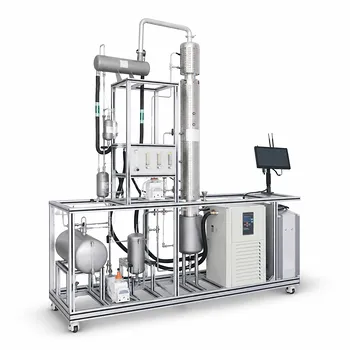
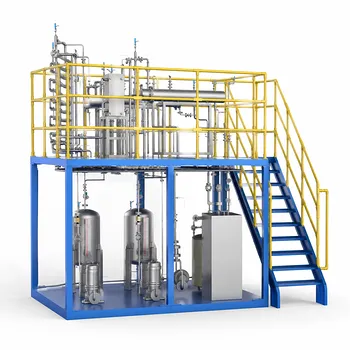
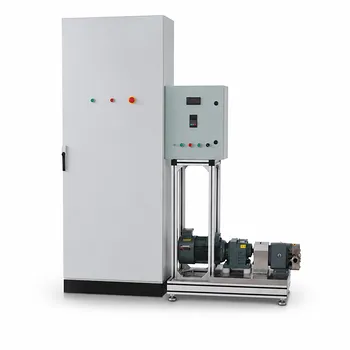
A pilot plant's greatest lesson isn't just how a reactor works—it's the stark revelation that a brilliant reaction is worthless without an efficient separation train. In a unit operations pilot plant, students physically run a chemical reaction, measure conversion and selectivity at the reactor outlet, and then follow the stream into a distillation column or filter. They see firsthand that poor reactor selectivity creates a flood of byproducts that must be separated using energy, time, and equipment. This visceral experience teaches them that overall process yield is not a reactor metric; it’s the product of reaction efficiency and downstream separation effectiveness, a lesson no textbook can fully convey.
The core insight pilot plants provide is the inescapable coupling between reactor performance and the entire separation sequence. Low reactor selectivity doesn't just waste raw materials—it imposes a heavy burden on every downstream unit, shrinking the final product recovery and inflating operating costs. Students learn that optimizing an industrial process means treating the reactor and its purification train as a single, integrated system.
From Equations to Physical Reality: What Pilot Plants Add
Why Classroom Definitions Aren't Enough
Most students first encounter conversion, selectivity, and yield as neat calculations. Conversion is moles reacted divided by moles fed; selectivity compares desired to undesired product; and reactor yield relates actual product formed to the maximum possible.
These definitions are unambiguous on paper. In a pilot plant, however, the numbers come alive with real measurements, imperfect sensors, and unexpected side reactions. Suddenly, a high “conversion” can look excellent in isolation while the reactor effluent contains a messy mixture of byproducts. The pilot plant forces students to confront the difference between reactor yield (the chemical efficiency inside the vessel) and overall process yield (the purified, usable product that actually leaves the plant).
The Moment of Truth: Material Balances
When students draw samples from reactor outlets and separation unit inlets, they perform a complete material balance. They see that if reactor selectivity drops from, say, 95% to 85%, the stream entering the distillation column suddenly contains twice as many impurities.
The pilot plant makes this quantitative. Students calculate exactly how many kilograms of byproduct must be boiled off, condensed, or filtrated. The direct link between a lower selectivity number and a larger energy bill, a slower separation, or a reduced final product recovery becomes concrete. This hands-on exercise is the bridge from stoichiometric theory to industrial process economics.
The Hidden Consequences of Low Reactor Selectivity
Tracing the Byproduct Trail
In a typical pilot plant exercise, students might run an alkylation reaction where the target product is ethylbenzene, but the side reaction forms diethylbenzene. By adjusting the reactor temperature or residence time, they can intentionally create conditions with poorer selectivity.
The real learning begins downstream. The distillation column designed to purify ethylbenzene struggles to separate the heavier diethylbenzene, requiring a higher reflux ratio. Students watch the overall process yield decline—not because the reactor formed less product, but because separation losses in the column increased. The pilot plant makes it impossible to ignore that byproducts steal yield in the purification steps, not just in the reactor.
How Separation Efficiency Multiplies Reactor Performance
A reactor with 80% selectivity sounds acceptable until students realize that a downstream separation unit operating at 90% recovery will deliver an overall yield of only 72% (0.80 × 0.90). The pilot plant proves that final process yield is a multiplicative function of both reaction and separation efficiencies.
Students can change a filter membrane, raise the distillation column pressure, or extend extraction time and immediately see the overall yield improve—even though the reactor selectivity remained unchanged. This teaches a fundamental principle: sometimes the cheapest way to increase plant output is not to improve the reactor but to upgrade the separation train.
The Bottleneck Beyond Chemistry: Process Cycle Time
In multi-step batch pilot plants that integrate reactors, Nutsche filters, and dryers, low reactor selectivity can also create a scheduling bottleneck. If poor selectivity generates a sticky byproduct that doubles the filtration time, that unit operation becomes the slowest step in the production cycle.
Students quickly spot this by tracking equipment idle times during consecutive batches. They see that adding a second filter or optimizing the reaction selectivity could dramatically reduce cycle time and increase overall plant throughput. The lesson: selectivity does not just affect product purity; it can strangle the entire manufacturing rhythm.
Understanding the Critical Trade-offs
The Selectivity-Conversion Tango
Many pilot plant experiments let students push the reactor to higher conversion by increasing temperature or catalyst loading. They often observe a painful trade-off: conversion rises, but selectivity falls as over-reactions accelerate.
A reactor running at 98% conversion with 75% selectivity may produce a lower final yield than one run at 85% conversion with 95% selectivity, simply because the enormous separation load in the first scenario destroys product recovery. The pilot plant makes this trade-off tangible, teaching students that chasing one metric blindly can cripple the overall process economically.
When High Reactor Yield Masks Downstream Disasters
It’s tempting to celebrate a reactor that produces a 92% theoretical yield. But if that reactor effluent contains a difficult-to-separate impurity that forces a 70% recovery in the crystallizer, the overall process yield plummets.
Students see this happen when they test a fast, exothermic reaction that creates a hard-to-filter precipitate. The pilot plant reveals that reactor perfection is meaningless if the downstream unit operations cannot handle the physical properties of the product stream. Process integration is everything.
Common Pitfall: Optimizing the Reactor Alone
One of the most critical lessons from pilot plants is the danger of sub-optimization. A student might spend hours tweaking the reactor temperature to gain 2% extra selectivity, only to find that the energy required for heating increased downstream utility costs by 10%.
Because pilot plants measure utilities like steam, electricity, and cooling water, students learn to evaluate the total cost of production, not just reaction efficiency. They discover that a lower-selectivity route with an easy, cheap separation can sometimes yield a more profitable process than a high-selectivity route requiring an expensive distillation.
How to Apply These Insights to Your Design Goals
Pilot plant experiences shape how engineers think about process development. Here’s how to translate these lessons into actionable principles.
- If your primary focus is maximizing final product recovery: Always start by characterizing the separation efficiency of your downstream train. Then work backwards to determine the minimum required reactor selectivity. Never specify the reactor without modeling the full separation sequence.
- If your primary focus is minimizing operating costs: Use pilot plant data to compare the energy penalty of poor selectivity against the capital cost of a more selective reactor or a better separation unit. Often, the lowest-cost solution involves a balanced trade-off, not a perfect reactor.
- If your primary focus is scaling up safely and efficiently: Replicate the pilot plant’s cause-and-effect mapping. Identify which reactor parameters most strongly influence selectivity, and then test how those selectivity shifts cascade through your pilot-scale distillation or extraction to predict overall yield at commercial scale.
- If your primary focus is process robustness: Deliberately vary reactor conditions in your pilot plant to understand the sensitivity of downstream unit operations. A process that tolerates a range of reactor selectivities without catastrophic yield loss will be far easier to operate in a real plant with raw material fluctuations.
Pilot plants transform selectivity and conversion from abstract numbers into the language of profit, energy, and plant rhythm. Once you’ve seen a distillation column flood because the reactor selectivity dropped too far, you never design a reaction step the same way again.
Summary Table:
| Metric | Classroom Definition (Theory) | Pilot Plant Reality & Downstream Impact |
|---|---|---|
| Conversion | Ratio of reactants consumed in the reactor. | High conversion can mask byproduct generation if selectivity is poor. |
| Selectivity | Ratio of desired product to undesired byproducts. | Low selectivity doubles separation loads, spikes energy bills, and slows throughput. |
| Process Yield | Theoretical product recovery calculation. | The actual purified product output; a product of reactor and separation efficiencies. |
Bring Real-World Process Dynamics to Your Lab
Bridging the gap between chemical theory and industrial reality requires hands-on experience. LABPARK provides state-of-the-art Educational and Vocational Unit Operations Pilot Plants in chemical engineering, bioprocess & biotech, and environmental & water treatment. Designed specifically for universities, research institutes, and enterprises, our pilot plants empower students and researchers to master the critical links between reaction, separation, and overall process yield.
Ready to elevate your training and research capabilities? Contact LABPARK today to find the perfect pilot plant system for your institution!
Related Products
- Carbon Dioxide Hydrogen Methanol Synthesis Educational Unit Operations Pilot Plant
- Multi Pump Fluid Transport Process Piping Unit Operations Training Pilot Plant
- Multi-Reactor Educational Pilot Plant for Reaction Engineering Unit Operations
- Ethyl Acetate Synthesis Unit Operations Pilot Plant for Practical Training
- Multi-Modal Distillation Unit Operations Training Pilot Plant
People Also Ask
- How do temp & pressure affect methanol synthesis pilot plants? Optimize equilibrium and catalyst performance.
- Why is a purge system necessary when operating a gas recirculation loop in a methanol synthesis pilot plant? (Guide)
- Why do modern methanol pilot plants operate at lower pressures? Catalyst & Feed Requirements Explained
- What are the operational requirements for catalyst activation? Safe Methanol Pilot Plant Operation
- Why is the chemical plant startup schedule crucial? De-risk scale-up with pilot plants.