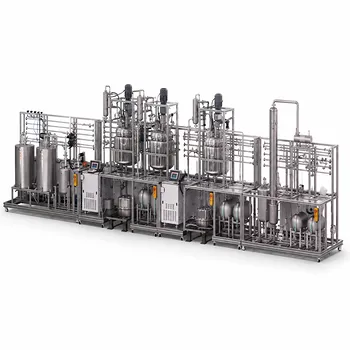
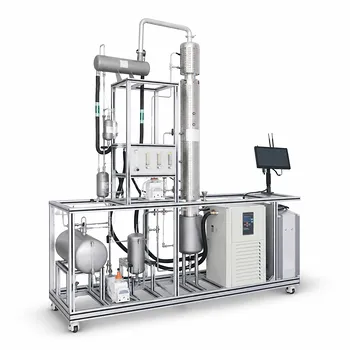
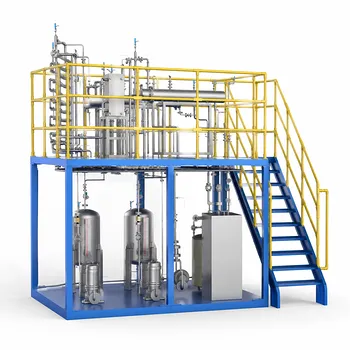
The bridge between a simulated reactor and a real one is built on the physical recycle loop. Unit operations pilot plants help researchers and students validate process simulation models by recreating the exact recycle conditions that cause those models to drift away from reality. Under continuous recycle, by-products and impurities accumulate in ways that purely computational flowsheets often miss. By operating a physical pilot plant in this mode, you can measure the actual reactor yield, collect empirical mass and energy balances, and feed that hard data back into your digital model to correct its assumptions—ensuring your yield predictions finally match what you would get on the plant floor.
Process simulation software frequently overpredicts reactor yields because it fails to capture the progressive decay caused by impurity build‑up in recycle streams. A unit operations pilot plant with a physical recycle loop fills that blind spot by delivering measured yields and stream compositions under true continuous operation, giving you the empirical leverage you need to tune your model and confirm economic viability.
The Blind Spot of Pure Simulation
Simulation tools are brilliant at solving ideal material balances and equilibrium relationships, but they operate in a world without walls. Real reactors, especially when recycle loops are present, accumulate trace components that slowly erode yield and selectivity.
Why Simulated Recycle Yields Often Look Too Good
A digital process model typically assumes perfect separation and complete knowledge of reaction kinetics. It might predict a 95% reactor yield on paper, but it rarely accounts for the slow, creeping influence of unreacted impurities that circulate back into the reactor feed.
These impurities can act as catalyst poisons, shift equilibrium, or simply dilute the reactants, dropping the real yield significantly. Because the model’s recycle stream is mathematically pure, it misses this degradation entirely.
The Accumulation Problem in a Nutshell
What goes around, comes around—and it can hurt. In a continuous reaction‑separation‑recycle system, any by‑product that is not perfectly removed by the downstream separator will loop back, increasing its concentration with every pass.
Over time, this feedback loop creates a steady‑state impurity level far higher than the simulation ever predicted. The actual reactor then operates in a completely different chemical environment, producing a yield that can be 10–20% lower than the modelled value. This is exactly why you cannot trust a simulated recycle yield without physical validation.
What a Pilot Plant with a Physical Recycle Loop Actually Measures
Educational and vocational pilot plants bring the recycle problem into the tangible world. They let you witness the accumulation, measure its impact, and collect the data that your digital model craves.
Continuous Recycle Operation as the Key
A pilot plant configured for recycle operation runs the entire process—raw material feed, reactor, separation unit, and recycle line—without interruption. This mirrors the exact dynamic that causes yield deviations at industrial scale.
By physically pumping the separation bottoms or unreacted feed back to the reactor inlet, the pilot unit forces all the real‑world constraints—fluid maldistribution, minor leaks, heat loss, and incomplete separation—to participate in the mass balance. The reactor yield you measure is no longer a theoretical prediction; it is the true steady‑state performance under recycle.
Extracting True Mass Balances and Yield Data
Once the pilot plant settles into a steady recycle loop, researchers draw samples from every key point: reactor inlet, reactor outlet, recycle stream, and product take‑off. They then calculate the overall reactor yield based on actual conversions and the purity of the final product stream.
This empirical mass balance reveals exactly how much of the fresh feed becomes desirable product versus by‑product or waste. You get a hard number that reflects accumulation, side reactions, and separation limitations—all combined. That number becomes the gold standard against which you must calibrate your process simulation.
From Raw Data to a Validated Model
Validation is not about dismissing the simulation; it is about sharpening it. The data from a recycle‑mode pilot plant gives you the knobs to turn your digital model into an accurate mirror of reality.
Calibrating Reactor Parameters Against Empirical Reality
When the measured yield differs from the simulated yield, the discrepancy tells you which model parameters need adjustment. Perhaps the reaction kinetics need a deactivation term, or the separation efficiency must be reduced to account for real‑world tray weeping or packing inefficiency.
By systematically comparing pilot‑plant data with simulation outputs, students and researchers can update rate constants, mass transfer coefficients, or impurity‑induced inhibition factors. The goal is to make the model reproduce the actual yield—not to force the plant to match the model. This iterative loop of experiment and parameter refinement is the essence of modern process design.
Confirming Economic Viability Before Scale‑Up
A process that fails the recycle test fails the business case. Once the pilot plant gives you a trustworthy reactor yield under realistic recycle conditions, you can run the simulation again with the calibrated model to forecast full‑scale production costs, raw material efficiencies, and waste disposal volumes.
This validated prediction becomes the foundation for go/no‑go investment decisions. Without it, you are scaling up based on a hopeful digital fantasy—and the real‑world yield shortfall could destroy profitability. Pilot‑scale validation under recycle converts an unverified model into a reliable scaling road map.
Understanding the Trade‑offs
Pilot‑plant validation is immensely powerful, but it is not free. You must weigh its benefits against its cost and complexity, and you must interpret the data with a critical eye.
When Pilot Plants Are Overkill (and When They’re Not)
Industry rules of thumb are clear: reactors, extraction units, and solids‑handling systems almost always require pilot‑scale testing because their scale‑up behaviour is complex and non‑linear. Conversely, single‑phase fluid flow or standard distillation columns typically scale well from first principles.
If your process involves a reactor with a significant recycle loop—especially one where by‑product accumulation is suspected—skipping the pilot plant is gambling. The primary reference confirms that initial simulation yields often differ from real operation precisely because of recycle‑stream impurities, making physical validation non‑negotiable for economic viability assessments.
The Risks of Misinterpreting Pilot Data
A pilot plant is a scale‑down, not a miniature version of a full‑scale plant. Wall effects, smaller heat‑loss ratios, and different mixing patterns can skew the results if you treat the data as literal scale‑up multipliers.
Additionally, measuring only the overall reactor yield without tracking the composition of the recycle stream itself leaves you with an incomplete picture. If you feed an incomplete dataset into your model calibration, you may inadvertently bake in a new error. The safest validation approach uses complete stream analyses and a clear understanding of the dimensionless parameters that govern the process.
Making the Right Choice for Your Validation Goal
Your specific objective determines how aggressively you should use a pilot plant with recycle capability.
- If your primary focus is teaching fundamental engineering: Use a pilot plant with a physical recycle loop to let students observe impurity accumulation in real time, calculate declining yields, and see the direct consequences of separation inefficiency—this transforms abstract simulation errors into unforgettable lessons.
- If your primary focus is process development and research: Invest in pilot‑scale recycle runs to generate the hard mass‑balance data needed to calibrate kinetic and thermodynamic parameters; this is the only reliable way to move from an optimistic simulation to a truly predictive model.
- If your primary focus is de‑risking scale‑up and securing investment: Make validated reactor yields under recycle the centrepiece of your stage‑gate review; the numbers from a physical pilot plant give you the credibility to claim economic viability and the confidence to order a commercial reactor.
When you anchor a simulation model to the stubborn physical truth of a pilot‑plant recycle loop, you stop guessing and start engineering.
Summary Table:
| Feature / Parameter | Process Simulation Model (Unvalidated) | Physical Pilot Plant (Recycle Loop) |
|---|---|---|
| Impurity Tracking | Assumes mathematical purity; misses accumulation | Captures real-world trace impurity buildup |
| Reactor Yields | Often overpredicted (idealized) | Measured steady-state (realistic) |
| Parameter Tuning | Based on theoretical kinetics | Calibrated with empirical mass balances |
| Economic Viability | High risk of scale-up yield shortfall | Validated economic road map for scale-up |
Bridge the Gap Between Simulation and Reality with LABPARK
Don't let idealized digital simulations risk your process scale-up success. LABPARK provides premium Educational and Vocational Unit Operations Pilot Plants in chemical engineering, bioprocess & biotech, and environmental & water treatment.
Designed specifically for universities, research institutes, and enterprises, our physical pilot units with functional recycle loops empower your students and researchers to capture real-world mass balances, accurately calibrate process models, and ensure economic viability before scale-up.
Ready to elevate your research and training capabilities? Contact LABPARK today to discuss your custom pilot plant requirements!
Related Products
- Multi-Reactor Educational Pilot Plant for Reaction Engineering Unit Operations
- Carbon Dioxide Hydrogen Methanol Synthesis Educational Unit Operations Pilot Plant
- Multi Pump Fluid Transport Process Piping Unit Operations Training Pilot Plant
- Ethyl Acetate Synthesis Unit Operations Pilot Plant for Practical Training
- Multi-Modal Distillation Unit Operations Training Pilot Plant
People Also Ask
- What role do educational pilot plants play in scaling green chemistry? Bridging the Lab-to-Industry Gap
- How do educational pilot plants teach scale-up? Bridge the gap to commercial manufacturing.
- How do educational unit operations pilot plants address safety and waste management when scaling up?
- How do educational unit operations pilot plants bridge theory and design? Bridge the Engineering Gap
- Why Compare Predicted and Experimental Excess Enthalpy? Key to Accurate Pilot Plant Scale-up