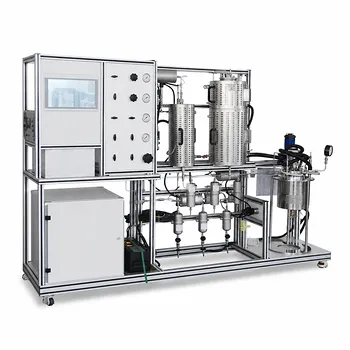
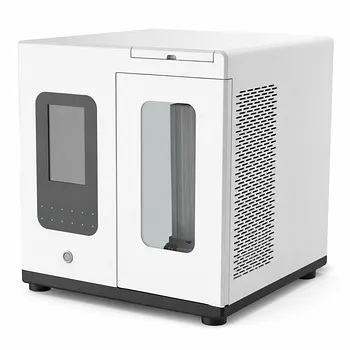
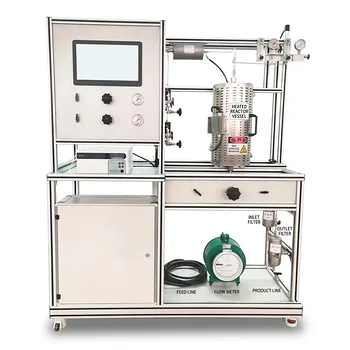
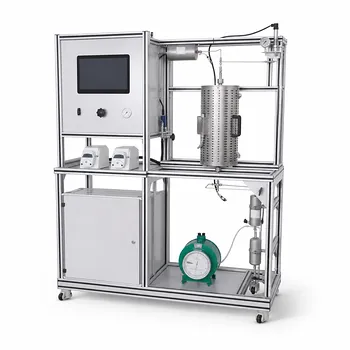
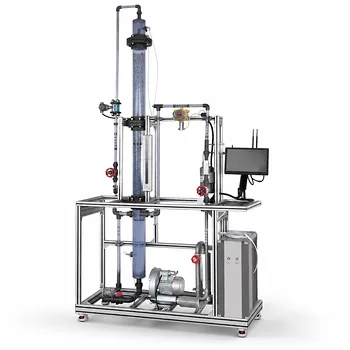
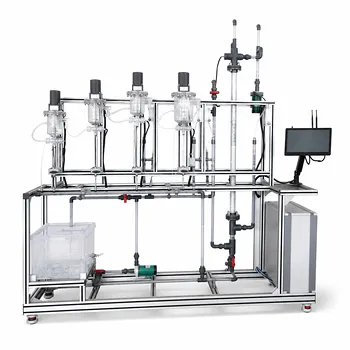
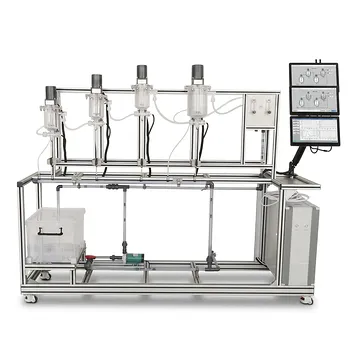
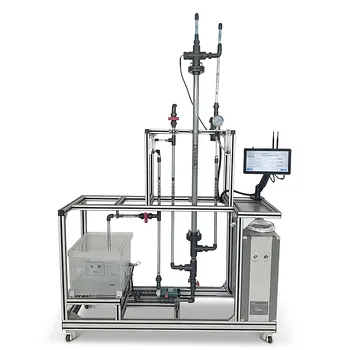
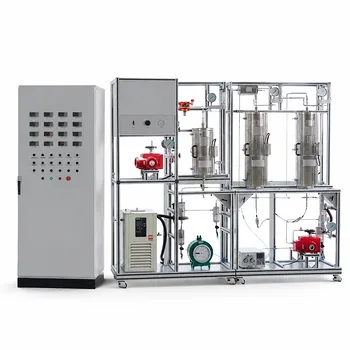
Fluidized bed training pilot plants make the heat transfer advantage instantly visible.
When running a highly exothermic reaction, the fluidized bed unit will show a remarkably flat temperature profile—measured at multiple points along the bed—while the shell-and-tube heat exchanger reactor reveals a sharp temperature spike near the inlet. You don’t need to calculate a thing; the data logger plots tell the story. Students learn that the fluidized solids themselves act as a massive, turbulent thermal buffer, delivering heat transfer coefficients that routinely reach 200 W/(m²·°C), something a stationary fluid in a heat exchanger tube simply cannot match.
The core insight: in a fluidized bed, the violently mixing solid particles equalize temperature within seconds and bring reaction heat directly to internal cooling coils, delivering a near-isothermal environment. A shell-and-tube reactor, by contrast, forces the reacting fluid to flow through a narrow channel where heat generation and removal race against each other, inevitably creating dangerous “hotspots.” Pilot plants turn this abstract theory into a measured, side-by-side reality.
How Pilot Plants Make Heat Transfer Visible
Chemical engineering training plants are built to expose the inner thermal life of a reactor. Thermowells are placed strategically, cooling utility flows are metered, and every temperature is logged. This turns invisible transport phenomena into a dataset you can discuss around a control panel.
The Fluidized Bed’s Secret: Solids as a Thermal Flywheel
In a fluidized bed pilot plant, the “bed” is a dense swarm of catalyst particles lifted by the reactant gas. Each particle acts as a tiny heat carrier. Because the solids are in chaotic, continuous circulation, they constantly collide with the cooling tubes immersed in the bed. This solid-to-wall contact is far more effective than gas-to-wall heat transfer alone. The result is a high overall heat transfer coefficient—typically around 200 W/(m²·°C)—and a bed temperature that varies by less than a few degrees.
Students see this directly: the temperature profile graph across the bed is essentially a horizontal line. They can map how internal cooling tube bundles (carrying thermal oil or water) absorb the reaction heat evenly, preventing any single region from overheating.
Measuring Uniformity at the Pilot Scale
Training units are instrumented to let you probe the bed at multiple axial and radial positions. The data confirms that even when the exothermic reaction rate peaks, the solids’ rapid mixing obliterates any temperature gradient. This demonstration cements the concept of “isothermal conditions” more powerfully than any textbook equation.
The Heat Exchanger Reactor: A Battle Against Hotspots
Switch to the shell-and-tube heat exchanger reactor on the same skid, and the thermal behavior changes entirely. The primary reference notes that for homogeneous highly exothermic reactions, the reaction rate is non-linear with temperature. A slight rise in temperature accelerates the reaction, which releases more heat, which raises the temperature further. In a narrow tube, this feedback loop focuses on a single region.
Visualizing Temperature Runaway
A pilot plant will show a distinct temperature peak a short distance from the tube inlet. That peak—the hotspot—can be tens of degrees higher than the cooling jacket temperature. Students watching the trend in real time see how a small reduction in coolant flow or a small increase in feed concentration pushes that hotspot temperature higher, rapidly. The demonstration imparts an instinctive understanding of thermal runaway potential.
The Control Challenge
Unlike the fluidized bed where cooling is almost self-regulating through solids mixing, the shell-and-tube reactor demands precise manipulation of utility coolant flow or temperature. The pilot plant control room forces students to become active thermal managers: adjusting the coolant inlet temperature, throttling the flow, and watching the hotspot respond with a non-linear lag. This hands-on struggle highlights the innate complexity that the fluidized bed sidesteps.
The Comparative Advantage in Training
Placing both reactors on a single training skid or running them sequentially in the same lab term creates a powerful pedagogical contrast. It’s not just about the data; it’s about the design logic.
Quantifying Heat Transfer Coefficients
By measuring the heat removed and the driving force (the temperature difference between the reacting mixture and the coolant), students calculate the overall heat transfer coefficient for each system. The fluidized bed’s value will be several times higher than that of the tube-side flow in the heat exchanger reactor, even when the latter uses high velocities. The hands-on calculation locks in the fundamental advantage.
From Pilot Data to Industrial Scale
Training pilot plants enable the safe exploration of “what-if” scenarios—increasing feed rate, simulating catalyst deactivation, or pushing toward runaway conditions without real danger. These experiments build the engineering judgment needed to select, scale, and safeguard industrial reactors. Seeing the flat temperature profile of a fluidized bed while running a reaction that would run away in a tubular exchanger makes the choice intuitive for many high-volume oxidation or hydrogenation processes.
Understanding the Trade-offs
Heat transfer brilliance is not free. The supplementary references and practical experience remind you that fluidized beds introduce their own engineering demands. Being objective means acknowledging these without undercutting the thermal advantage.
Complexity vs. Control
A fluidized bed pilot plant is mechanically more complex. It requires a steady supply of small, attrition-resistant particles (typically under 300 μm), gas-solid separation equipment like cyclones or filters to prevent catalyst loss, and careful management of fluidization velocity to avoid slugging or channeling. The operator trades a simpler temperature control problem for a more involved solids-handling problem.
Catalyst Attrition and Mechanical Stress
The continuous particle collisions wear down the catalyst, generating fines that can clog downstream filters or escape the system. Demonstrating this on a pilot plant—by collecting cyclone catch and measuring particle size distribution over time—teaches students about the hidden operating cost of attrition. This doesn’t negate the heat transfer advantage but defines the boundary where a fixed-bed or a moving-bed design might become more attractive despite poorer heat management.
Making the Right Choice for Your Reaction
Design decisions flow from what you prioritize. Use the insight gained from a pilot plant comparison to guide your reactor selection.
- If your primary focus is avoiding hotspots and achieving isothermal control: The fluidized bed reactor is the clear choice, as the pilot plant demonstration will confirm uniform temperature profiles and high heat transfer coefficients.
- If your primary focus is mechanical simplicity and you can manage the cooling load with a conservative safety margin: A shell-and-tube heat exchanger reactor may still work, but you must design for active anti-runaway control, just as the pilot plant training forces you to do manually.
- If your primary focus is high solids conversion with plug-flow behavior: Recognize that fluidized beds’ complete mixing can limit conversion per pass. A moving-bed reactor might be worth exploring, but you’ll reintroduce the hotspot challenge that you saw the fluidized bed so elegantly solve.
The pilot plant’s greatest gift is the unified picture it gives you: temperature uniformity is not just a performance metric—it’s the key to process safety, catalyst lifetime, and product selectivity. Once you’ve watched a fluidized bed swallow a reaction’s heat spike without flinching while a tubular exchanger struggles, the thermodynamic choice becomes almost instinctive.
Summary Table:
| Feature | Fluidized Bed Reactor | Shell-and-Tube Reactor |
|---|---|---|
| Temperature Profile | Near-isothermal (flat profile) | Sharp temperature spike (hotspots) |
| Heat Transfer Coeff. | High (~200 W/(m²·°C)) | Lower, fluid velocity-dependent |
| Thermal Control | High thermal buffer, self-regulating | Prone to non-linear thermal runaway |
| Complexity | High (solids handling & attrition) | Low (mechanically simpler) |
Bring textbook thermodynamics to life with LABPARK. We provide premium Educational and Vocational Unit Operations Pilot Plants in chemical engineering, bioprocess & biotech, and environmental & water treatment. Designed specifically for universities, research institutes, and enterprises, our pilot plants empower students and researchers to safely analyze heat transfer dynamics, visualize thermal runaways, and master reactor control.
Ready to upgrade your laboratory capabilities? Contact us today to find the perfect training system for your institution!
Related Products
- Fluidized Bed Gas Solid Catalytic Reaction Educational Pilot Plant
- Multi-Reactor Educational Pilot Plant for Reaction Engineering Unit Operations
- Multi Functional Catalytic Reaction and Reactor Evaluation Educational Unit Operations Pilot Plant
- Two-Dimensional Fluidization Hydrodynamics Educational Pilot Plant for Unit Operations Training
- Multi-Functional Drying Educational Unit Operations Pilot Plant
People Also Ask
- Why is the bed height-to-diameter ratio (L/dt) critical? Fluidized bed pilot plant selection guide.
- How is the minimum fluidization velocity (U_mf) determined and utilized? A Unit Operations Guide
- How does the Mears criterion evaluate transport resistance? Key Guide to Intrinsic Kinetics
- How do reactor pilot plants safely study gas-solid reactions? Master kinetics with thermal & flow control.
- How do pilot plants demonstrate fluidized-bed reactor advantages over fixed-bed? Find Out Now