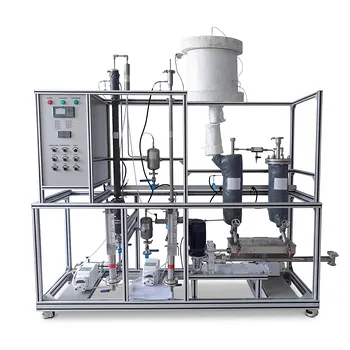
The simple act of loading a differently shaped catalyst pellet into a reactor transforms a textbook equation into a direct, measurable experience. Chemical engineering pilot plants enable students to analyze the relationship between space velocity, catalyst geometry, and mass transfer limitations by providing the controlled environment to isolate each variable. By manipulating gas flow rates to set a desired space velocity ((SV = V_0/V_c)) and physically inserting catalyst bodies like Raschig rings, wheels, or multi-hole pellets, students can measure the resulting conversion and pressure drop. This hands-on approach makes abstract diffusion–reaction theory visible, allowing them to quantify exactly when internal pore diffusion—not surface kinetics—becomes the rate‑limiting barrier.
Pilot plants turn catalyst pellets into diagnostic probes. By fixing space velocity and swapping one geometry for another, students can directly observe the transition from kinetic control to diffusion control, using tools like the Wheeler–Weisz modulus to pinpoint the internal mass transfer bottleneck—something no lecture slide can fully convey.
Understanding the Experimental Toolkit
Pilot‑scale catalytic reactors give students a physical sandbox where the interplay of flow, geometry, and transport is no longer hidden inside opaque equations. The instrumentation built into these units transforms two simple, user‑adjustable parameters into a rich dataset for analyzing reaction regimes.
Space Velocity as a Macroscopic Indicator
Space velocity is the student’s first lever. On a pilot plant equipped with mass flow controllers, the feed gas flow rate (V_0) is set precisely, and the catalyst volume (V_c) inside the reactor tube is known. The ratio (SV = V_0/V_c) (commonly in the range 1000–2000 h⁻¹ for industrial reforming) then defines the nominal residence time of the gas. When students increase SV at a fixed temperature, the drop in conversion instantly signals that the reacting molecules simply don’t spend enough time near active sites—a direct, visual reinforcement of residence time theory.
Catalyst Geometry: More Than Just Shape
The primary reference explicitly describes loading different catalyst shapes—Raschig rings, wheels, multi‑hole pellets—and observing the effect on pressure drop and reaction rate. In the pilot plant, these shapes do not just alter the bed’s hydraulic behavior; they change the characteristic diffusion length inside the porous particle. A solid sphere has a long diffusion path, while a thin‑walled multi‑hole structure drastically shortens it. By measuring the pressure drop across the bed and the overall conversion for each geometry at the same SV, students learn that a lower pressure drop is often paid for by a slower apparent reaction rate—and that the culprit is internal mass transfer.
Unmasking Internal Mass Transfer Limitations
Once students have controlled the gross operating parameters, pilot plant data allow them to move from “it seems slower” to a rigorous, dimensionless diagnosis of the diffusion‑reaction interplay.
The Wheeler–Weisz Modulus as a Diagnostic
The supplementary references show how pilot plant experiments can feed directly into transport calculations. By measuring the observed macro‑kinetic reaction rate (r_A) (from product analysis or real‑time gas sensors), and knowing the catalyst particle’s characteristic dimension (L) (the half‑thickness or radius), the effective diffusivity (D_e), and the surface concentration (c_{AS}), students calculate the Wheeler–Weisz modulus: [ M_w = \frac{r_A L^2}{c_{AS} D_e} ] The result is a direct read on the severity of internal diffusion limitations: if (M_w < 0.15), the pore diffusion resistance is negligible (effectiveness factor (\eta \approx 1)); if (M_w > 7), strong internal concentration gradients dominate.
From Theory to Experiment: Observing the Kinetic‑to‑Diffusion Transition
The pilot plant turns this calculation into a tangible discovery. A student can run the same reaction at the same space velocity but replace a large spherical pellet with a small extrudate. Since (L) shrinks, (M_w) drops, conversion rises, and the effectiveness factor moves closer to unity—without altering the intrinsic kinetics. Alternatively, by raising the reactor temperature, (r_A) increases, (M_w) climbs, and the student sees the reaction slide into the diffusion‑controlled regime where further heating gives diminishing returns. This direct manipulation and measurement of the transition is precisely what bridges the gap between textbook idealizations and real industrial behavior.
Understanding the Trade‑offs
Even a well‑instrumented pilot plant can mislead a student who overlooks its limits. Acknowledging these pitfalls builds the critical thinking needed for scale‑up.
- Assumptions in the modulus calculation: The Wheeler–Weisz approach typically assumes a uniform, isothermal catalyst particle. Pilot plant beds can develop temperature gradients that distort the apparent reaction rate, making the diagnosed diffusion resistance look larger or smaller than it truly is.
- Ignoring external film resistance: If the gas flow is not sufficiently turbulent, a stagnant film around the pellet can mask the internal diffusion effect. Students must always cross‑check by varying the linear velocity at a constant SV to confirm that external mass transfer is not the true bottleneck.
- Shape‑specific effective diffusivity: Multi‑hole pellets and Raschig rings can create tortuous, non‑uniform diffusion paths. Using a single characteristic length (L) for complex geometries requires careful judgment, and pilot plant data should be paired with micro‑CT imaging or detailed pore structure analysis for full clarity.
How to Apply This to Your Goal
The value of the pilot plant experiment depends entirely on what you are trying to teach or troubleshoot. Use the same hardware differently based on your learning objective.
- If your primary focus is appreciating catalyst shaping in reactor design: Load the reactor with three distinct pellet geometries at a constant SV. Compare pressure drop, conversion, and calculated (M_w) to show that mechanical integrity and low pressure drop often come at the cost of severe internal diffusion penalties.
- If your primary focus is diagnosing mass transfer bottlenecks: Fix the pellet shape but systematically vary particle size (grind and sieve the catalyst). Plot (M_w) against conversion to demonstrate the critical particle size where the reaction transitions from kinetic to diffusion control.
- If your primary focus is scale‑up intuition: Run experiments at two different space velocities with the same geometry and observe that the measured effectiveness factor is not a constant—it shifts with conversion and flow conditions, teaching that a catalyst that works in the lab may fail in a tall industrial bed.
These experiments, anchored in real‑time data and direct observation, convert pilot plants from mere demos into a deep‑learning environment where space velocity, geometry, and mass transfer stop being isolated formula inputs and become a single, interconnected system.
Summary Table:
| Key Parameter | Physical Action in Pilot Plant | Educational Insight / Formula |
|---|---|---|
| Space Velocity (SV) | Vary gas flow rates over fixed catalyst volume | Demonstrates residence time theory and conversion trends. |
| Catalyst Geometry | Swap shapes (Raschig rings, wheels, spheres) | Relates shape to pressure drop and characteristic diffusion length. |
| Internal Mass Transfer | Measure reaction rates at different temps/particle sizes | Diagnoses diffusion limitations using Wheeler–Weisz modulus. |
Empower the Next Generation of Chemical Engineers
Bring textbook equations to life in your laboratory. LABPARK provides state-of-the-art Educational and Vocational Unit Operations Pilot Plants in chemical engineering, bioprocess & biotech, and environmental & water treatment. Designed specifically for universities, research institutes, and enterprises, our pilot plants enable hands-on analysis of complex reaction kinetics, mass transfer limitations, and fluid dynamics.
Ready to upgrade your laboratory training equipment? Contact LABPARK today to discuss your custom pilot plant requirements!
Related Products
- Fixed Bed Gas Solid Catalytic Reaction Educational Pilot Plant
- Multi Pump Fluid Transport Process Piping Unit Operations Training Pilot Plant
- Carbon Dioxide Hydrogen Methanol Synthesis Educational Unit Operations Pilot Plant
- Ethyl Acetate Synthesis Unit Operations Pilot Plant for Practical Training
- Natural Product Extraction Unit Operations Training Pilot Plant
People Also Ask
- How do reactor pilot plants safely study gas-solid reactions? Master kinetics with thermal & flow control.
- How does the Mears criterion evaluate transport resistance? Key Guide to Intrinsic Kinetics
- Why is a multibed configuration necessary for exothermic reactions? Optimize your pilot plant trajectory.
- Fluidized vs. Fixed Bed Reactors: Comparing Heat & Complexity in Pilot Plants
- How is the friction factor determined for fixed-bed pilot plants? Select the best pressure drop correlation.