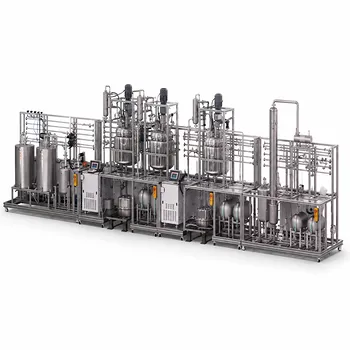
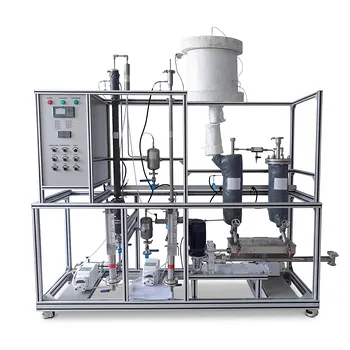
Here's the foundational truth about parallel reactions and temperature: selectivity is not fixed—it's a controllable variable, and pilot plants give you the precise dial to turn. In a chemical engineering pilot plant, jacketed reactors with PID-controlled heating and cooling systems allow operators to enforce precise, often dynamic, temperature profiles. For parallel reactions where the desired and undesired pathways have different activation energies ((E_1 \neq E_2)), the ability to hold a reactor at a specific temperature or to shift it over time is the primary lever for steering the reaction away from waste and toward the target product. This transforms a theoretical optimization problem into a physical, reproducible, and scalable manufacturing strategy.
The core challenge is that temperature dictates which parallel reaction pathway is kinetically favored. A pilot plant's value lies not just in setting a temperature, but in using high-fidelity control and real-time analytics to systematically find—and then hold—the thermal sweet spot that maximizes the yield of your desired product while minimizing the formation of unwanted side products.
The Kinetics of Selectivity: Why Temperature is the Ultimate Steering Wheel
Activation Energy Defines the Temperature Response
Every reaction has an activation energy ((E_a))—the energy barrier molecules must overcome to transform. In parallel reactions, a single reactant can follow path 1 (desired) or path 2 (undesired). The relative rates of these paths are governed by the Arrhenius equation, and the selectivity is proportional to the ratio of their rate constants, which is (\exp[-(E_1 - E_2)/RT]).
If the desired reaction has a higher activation energy ((E_1 > E_2)), the exponential term grows with temperature. A hotter reactor disproportionately accelerates the desired path, tipping selectivity in your favor. Conversely, if the desired reaction has a lower activation energy ((E_1 < E_2)), the exponential term shrinks as temperature rises. In that case, high temperatures betray you by favoring the side reaction, and you must operate under cooler conditions to preserve selectivity.
Moving Beyond a Single Setpoint: The Need for Strategy
Textbook problems often simplify to a single optimum temperature. In reality, as the reaction progresses and reactant concentration falls, the ideal temperature can shift. This is where pilot plants become indispensable. They let you move from a static "best guess" to a dynamic, evidence-based temperature trajectory.
How Pilot Plants Turn Theory into Tangible Selectivity Control
PID-Controlled Jacketed Reactors: The Precision Core
The heart of the system is the ability to impose a thermal boundary condition with minimal drift. Chemical engineering pilot plants use jacketed vessels with electric heating elements or circulated coolant, managed by proportional-integral-derivative (PID) controllers. These controllers continuously compare the measured reactor temperature to a setpoint and adjust heating/cooling power to cancel errors. This precision is what makes kinetic studies possible—without it, small fluctuations would scramble the subtle rate differences you are trying to exploit, making selectivity data unreliable.
Real-Time Monitoring and the Feedback Loop
Precision hardware is only half the story. Pilot plants are instrumented with high-accuracy resistance temperature detectors (RTDs) or thermocouples, often coupled with inline analytical tools like gas chromatographs or spectroscopic probes. This generates a live stream of temperature and composition data. Researchers can watch the instant-by-instant formation of the desired product and the byproduct, directly visualizing how a deliberate temperature change shifts the selectivity. This closes the loop: you set a temperature profile, observe the kinetic outcome, and refine the model in real-time—something impossible to do by manual sampling alone.
Honing the Strategy: Implementing Optimal Temperature Profiles
When to Turn Up the Heat ((E_1 > E_2))
If the desired product pathway has the higher activation energy, the pilot plant allows you to exploit this ruthlessly. You can verify that selectivity indeed climbs as you raise the reactor to a high, stable temperature. The plant's safety systems and heat transfer simulations then become critical: you can push the temperature as far as material and safety limits allow, while the PID controllers prevent a runaway excursion. This experimental confirmation of the Arrhenius selectivity equation gives you the confidence to scale up a high-temperature, high-selectivity process.
When to Start Cool and Ramp Up ((E_1 < E_2))
If the desired reaction has the lower activation energy, a single temperature is a compromise you don't have to accept. The pilot plant enables a temperature profiling strategy. You initially set the jacket to a low temperature to ensure the desired path dominates, keeping the side reaction suppressed despite its higher activation energy. As the reactant is consumed and the risk of losing selectivity to the undesired path diminishes, you program the controller to ramp the temperature upward. This boost accelerates the remaining desired reaction, driving conversion to completion without sacrificing the early-run selectivity. The pilot plant proves that this sequential thermal shift works and allows you to measure the exact gain in overall yield compared to a fixed intermediate temperature.
Understanding the Trade-offs: The Speed-Selectivity Dilemma
Optimizing for selectivity alone is not a commercial goal; you need a viable production rate. This is where the pilot plant reveals the true challenge. A low temperature that maximizes selectivity for a low-(E_a) desired reaction can also make the overall conversion painfully slow. The optimum economic solution is often the temperature trajectory that maximizes the space-time yield—the amount of product made per unit reactor volume per unit time.
Pilot plants make this trade-off tangible. You can run multiple batch campaigns or use a continuous stirred-tank reactor (CSTR) train to map out the frontier of selectivity versus space-time yield. You can directly observe the consequences of pushing too hard for selectivity (a reactor that takes forever to finish) to pushing too hard for speed (a waste stream that destroys your economics). This experimental mapping grounds the theoretical activation energy numbers in business reality.
Making the Right Choice for Your Process Goal
The pilot plant's ultimate role is to translate a kinetic understanding of activation energies into a concrete, operable process that you can scale. The right thermal strategy depends entirely on your specific reaction pair.
- If your primary focus is maximizing selectivity when the desired reaction has a higher activation energy: Leverage the plant's precision to push to a high, stable temperature. Verify experimentally that selectivity increases, and use the safety systems to define the upper thermal limit for scale-up.
- If your primary focus is maximizing selectivity when the desired reaction has a lower activation energy: Program the plant to execute a low-start, ramping temperature trajectory. Prove that this profile yields more total product than any single fixed temperature, then document the ramp rate and endpoints for technology transfer.
- If your primary focus is balancing selectivity with production rate: Use the pilot plant to map the full selectivity vs. conversion space. Identify the temperature trajectory that sits on the optimal economic trade-off curve, not just the chemistry textbook optimum.
Kinetics provides the map, but the pilot plant is the vehicle that drives you to the true optimum, turning a calculated selectivity curve into a verified, scalable, and profitable process.
Summary Table:
| Kinetics Scenario | Thermal Strategy | Main Goal |
|---|---|---|
| Desired $E_a >$ Undesired $E_a$ | Maintain high, stable temperature | Accelerate the desired pathway |
| Desired $E_a <$ Undesired $E_a$ | Start low, then ramp temperature | Suppress side reactions, drive completion |
| Speed vs. Selectivity | Map space-time yield trajectories | Balance reaction rate with process economics |
Ready to bridge the gap between kinetic theory and industrial reality? LABPARK provides advanced Educational and Vocational Unit Operations Pilot Plants in chemical engineering, bioprocess & biotech, and environmental & water treatment. Engineered for universities, research institutes, and enterprises, our systems deliver the precise temperature control and real-time monitoring needed to optimize reaction pathways. Contact LABPARK today to discuss your research and training requirements!
Related Products
- Fixed Bed Gas Solid Catalytic Reaction Educational Pilot Plant
- Multi Pump Fluid Transport Process Piping Unit Operations Training Pilot Plant
- Carbon Dioxide Hydrogen Methanol Synthesis Educational Unit Operations Pilot Plant
- Ethyl Acetate Synthesis Unit Operations Pilot Plant for Practical Training
- Natural Product Extraction Unit Operations Training Pilot Plant
People Also Ask
- How do reactor pilot plants safely study gas-solid reactions? Master kinetics with thermal & flow control.
- How does the Mears criterion evaluate transport resistance? Key Guide to Intrinsic Kinetics
- Why is a multibed configuration necessary for exothermic reactions? Optimize your pilot plant trajectory.
- Fluidized vs. Fixed Bed Reactors: Comparing Heat & Complexity in Pilot Plants
- How is the friction factor determined for fixed-bed pilot plants? Select the best pressure drop correlation.