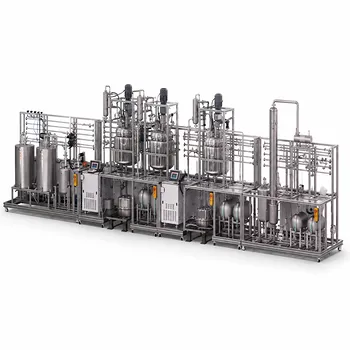
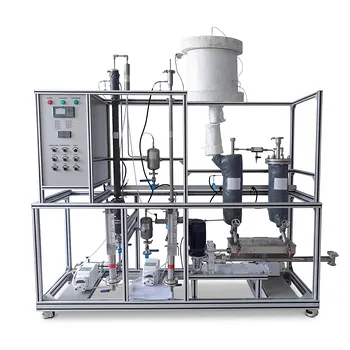
The answer lies in shifting the role of the pilot plant from a simple intermediate size step to a high-fidelity model calibration instrument. In a traditional empirical scale-up, you physically increase reactor volume in order-of-magnitude jumps, hoping the chemistry behaves identically. In the mathematical modeling approach, a unit operations pilot plant does not mimic final production directly. Instead, it serves as a critical bridge, generating the precise empirical data needed to calibrate and validate kinetic, thermal, and fluid dynamic equations. Once validated, this predictive model—not the pilot plant—determines the full-scale design.
The fundamental difference is that empirical scale-up uses physical size jumps to manage unknown physics, while the modeling approach uses a pilot plant to gain definitive control over that physics. The pilot plant’s primary output is not a small batch of chemicals, but validated equations. It transforms scale-up from a slow, capital-intensive gamble into a deterministic, engineered prediction by verifying critical parameters like flow dynamics and backmixing before a single cubic meter of industrial reactor is built.
The Exhaustion of the Empirical Method
The traditional step-by-step approach is rooted in a logical but inefficient fear of the unknown. It treats scale-up as a process of cautious replication, but this method often breaks down under the weight of its own assumptions.
The Unpredictable Physics of Size
Reactions that proceed smoothly with a few grams in a lab flask often behave erratically at larger volumes. This is not due to a change in chemistry, but to the dominance of physical transport phenomena.
Heat and mass transfer rates shift dramatically with scale. A small vessel enjoys uniform temperature and rapid mixing, but a large reactor can develop hot spots, stagnant zones, and concentration gradients. These "scale-up effects" make the reaction path unpredictable, leading to lower yields, runaway reactions, or the formation of dangerous impurities that were never seen on the bench.
The Crippling Economics of Sequential Builds
The empirical method’s solution to these unknowns is brute force—building multiple pilot facilities. You might build a 1-liter reactor, then a 10-liter, then a 100-liter, and so on.
Each step requires capital, time, and operator training. This sequential construction is incredibly slow, delaying time-to-market by years. If a problem is only discovered at the 1000-liter stage, the entire process could be scrapped, wasting the entire investment from all previous stages.
The Pilot Plant as a Computational Instrument
The mathematical modeling approach fundamentally redefines the pilot plant’s purpose. It is no longer a small production unit but a sophisticated data-generation tool designed to solve the equations that define your process.
The Cycle of Model, Test, and Calibrate
The process begins not in the lab, but in the mind. Engineers first build a mathematical model from initial trial values for reactor dimensions, temperature, pressure, and feed rates. This model comprises stagewise, nonisothermal equations for material, equilibrium, and enthalpy balances.
Next, they design a targeted experiment in the pilot plant. The goal is not to make product, but to measure the self-adjusting parameters in those equations—hydrodynamics, mass transfer rates, and the true kinetic constants. By feeding this empirical data back into the model, the software can iteratively compute the fluxes and concentrations, creating a perfect digital twin of the reactor’s behavior.
Pilot Plants as Validation Engines
This is the crucial bridge the primary reference describes. A unit operations pilot plant is instrumented with precise sensors and data acquisition systems to capture what a theoretical model cannot predict on its own.
It provides real-world data on material inputs, cycle times, and, most importantly, non-ideal flow dynamics like backmixing. Run a tracer study in a pilot-scale column, and you can calibrate your dispersion model. Measure temperature profiles during a reaction, and you can validate your heat transfer coefficient correlations. This empirical verification ensures your equipment-sizing calculations are accurate, guaranteeing vessels are large enough to prevent overfilling yet maintain the minimum operating volume for mixing and heat transfer.
De-risking Through Controlled Failure
Validating a model does not mean just proving it right; it means exploring where it breaks. Pilot plants allow you to safely introduce process upsets and test multivariate designs that would be catastrophic at full scale.
You can deliberately test failure modes—like loss of cooling or an agitator failure—and collect data to validate your risk assessments. By proving the model can predict stable operation and the boundaries of safe operation, you move to commercial manufacturing with substantiated prior knowledge, not just theoretical hope.
Understanding the Trade-offs
The modeling approach is powerful, but it is not a magic wand. Its success depends on the quality of its inputs and the realistic understanding of its constraints.
The High Cost of Precision
A pilot plant used for mathematical modeling is significantly more expensive to build than one used for simple empirical testing. It requires high-fidelity sensors, online analyzers, and rugged data acquisition systems to capture the rich, time-dependent data a model needs. This demands a team skilled in both chemical engineering fundamentals and computational methods, a higher operational cost than simply running an oversized lab experiment.
The Trap of an Unvalidated Assumption
A model is only as good as the physics it contains. If your pilot plant cannot replicate the specific mixing regime or mass transfer limitation of the full-scale unit, the data will be misleading.
You cannot determine a commercial reactor's performance solely on generic kinetics. If you fail to check for a previously unknown precipitation that fouls a sensor in the pilot plant, your model will be blind to it. The model predicts what you tell it to predict; the pilot plant’s greatest value is revealing what you forgot to ask.
Making the Strategic Choice for Your Goal
Your decision to lean on mathematical modeling versus a more empirical approach should be driven by your process’s complexity and your business’s risk tolerance.
- If your primary focus is accelerating time-to-market for a well-characterized reaction: The modeling approach is non-negotiable. Use a highly instrumented pilot plant to validate your kinetic and transport model, allowing you to bypass intermediate scale-up stages entirely and leap directly to a pre-commercial demonstration unit.
- If your primary focus is scaling a novel reaction with completely unknown mechanisms: Do not abandon the model, but adjust your expectations. Use the pilot plant first to perform a set of empirical screening runs, identifying the critical scale-up effects. Then, use that data to build your initial model, knowing it will require more extensive pilot-scale calibration.
- If your primary focus is minimizing total project capital at risk: Invest heavily in the pilot plant’s instrumentation, not its size. The capital saved by avoiding a single failed industrial-scale batch—or a redundant 10x scale-up step—will pay for an elite, model-driven pilot-plant program many times over.
The modern pilot plant is no longer just a "mini-factory" producing sample batches; it is the CPU of your scale-up program, and the mathematical model is its code. Validate the code with real-world data, and you can reliably predict the performance of any reactor you design.
Summary Table:
| Feature | Empirical Step-by-Step Scale-up | Mathematical Modeling Approach |
|---|---|---|
| Core Purpose | Physically replicate size jumps | Calibrate predictive equations |
| Process Steps | Multiple physical builds (e.g., 1L -> 10L -> 100L) | Direct jump via validated digital twin |
| Primary Output | Small batches of chemical product | Validated kinetic and transport models |
| Capital Risk | High (failures found late in large builds) | Low (critical physics resolved early) |
| Equipment Focus | Standard reactor vessels | Highly instrumented, sensor-rich pilot plants |
Scale Up Smartly with LABPARK Pilot Plants
To transition from empirical guesswork to precise mathematical modeling, you need high-fidelity, real-world data. LABPARK provides advanced Educational and Vocational Unit Operations Pilot Plants in chemical engineering, bioprocess & biotech, and environmental & water treatment.
Whether you are a university training the next generation of engineers, a research institute proving novel concepts, or an enterprise de-risking commercial scale-up, our pilot systems deliver the exact sensor data and reliability you need.
Get in touch with LABPARK today to discover the ideal pilot plant solution for your facility!
Related Products
- Fixed Bed Gas Solid Catalytic Reaction Educational Pilot Plant
- Multi Pump Fluid Transport Process Piping Unit Operations Training Pilot Plant
- Carbon Dioxide Hydrogen Methanol Synthesis Educational Unit Operations Pilot Plant
- Ethyl Acetate Synthesis Unit Operations Pilot Plant for Practical Training
- Natural Product Extraction Unit Operations Training Pilot Plant
People Also Ask
- How do reactor pilot plants safely study gas-solid reactions? Master kinetics with thermal & flow control.
- How does the Mears criterion evaluate transport resistance? Key Guide to Intrinsic Kinetics
- Why is a multibed configuration necessary for exothermic reactions? Optimize your pilot plant trajectory.
- Fluidized vs. Fixed Bed Reactors: Comparing Heat & Complexity in Pilot Plants
- What are the differences between pseudohomogeneous and heterogeneous models in pilot plants?