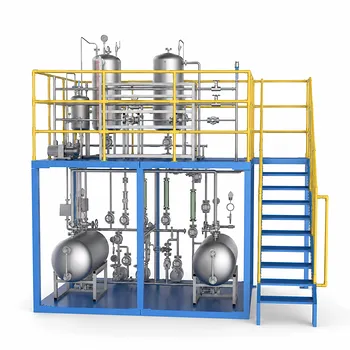
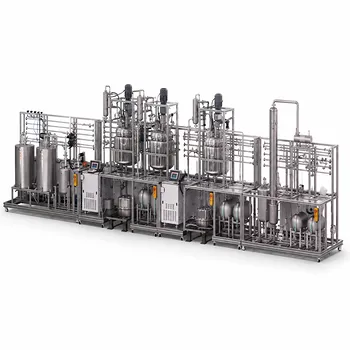
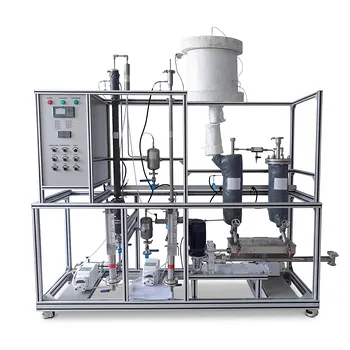
They make the invisible, visible. A chemical engineering pilot plant demonstrates the process control of recycle loops and purge streams by integrating a physical recycle line with a variable purge valve and monitoring the consequences in real-time. Students or operators deliberately manipulate the purge-to-recycle ratio and observe, via inline sensors, how inert components either accumulate to a dangerous new steady state or are kept in check, directly linking the control action to reactor stability and material balance.
While textbooks present the purge as a mathematical fraction in a mass balance equation, the pilot plant reveals its true nature as a dynamic, critical control handle. It physically demonstrates the unavoidable trade-off between conserving valuable reactants and maintaining reaction kinetics by preventing inert buildup—a balance that is the heart of continuous reactor operation.
The Core Problem: Why Purge at All?
Before controlling a loop, you must understand the failure mode it prevents. The pilot plant's primary lesson is that continuous recycling creates a trap for inert components.
The Inert Accumulation Trap
In a perfect world, you would recycle 100% of unreacted material. However, in real processes, the feed stream always contains small amounts of non-reactive components (e.g., argon or nitrogen in an oxygen feed). A recycle loop continuously returns these inerts to the reactor while the product stream removes only the desired components.
This creates a concentration effect. Inerts have no exit path except through the reactor with the product, but their concentration in the reactor can build to levels far exceeding what's in the fresh feed. The pilot plant makes this dangerous, invisible process tangible.
How Accumulation Degrades Performance
As inert concentration rises, it directly impacts reaction kinetics. Inerts dilute the reactants, dropping their partial pressures. For a gas-phase reaction, this can drastically slow the reaction rate. The pilot plant demonstrates this as a direct cause-and-effect: do not open the purge valve enough, and you will see the reactor's output of desired product fall, even with constant feed. This transforms a theoretical yield calculation into an observed performance penalty.
The Demonstration: From Control Panel to Chemical Principle
The power of the pilot plant is in its physicality. The control panel is not just a simulation; it adjusts real valves on a live process loop.
The Critical Control Handle: A Variable Purge Valve
The primary reference describes the key element directly: a control panel with a variable purge valve. An operator starts with the system at a steady state with a balanced purge. The lesson begins when they partially close this valve.
Immediately, the recycle flow rate remains high, conserving reactants. But the pilot plant is instrumented to show the delayed consequence. Over time, inline sensors (such as gas chromatographs or thermal conductivity detectors) show the concentration of the tracer inert component climbing. The operator sees the process slowly destabilize, not from a sudden failure, but from a creeping shift in composition.
Observing the New Steady State and "Line Out"
This is a critical learning outcome that static calculations cannot teach. A batch of knowledge work cannot replicate the feeling of waiting for a process to "line out." After a change to the purge rate, the system does not instantly reach a new equilibrium. The pilot plant forces the student to observe the transient period of several residence times as the inert concentration finds its new, higher steady state. They learn the patience of true process operation and the delayed consequences of control actions.
Closing the Loop with Mass Balances
The demonstration is not complete until theory is reconciled with observation. The operator takes physical samples or reads sensor data from key points: the fresh feed, the mixed reactor feed, the reactor effluent, and the purge stream itself. They then perform the material balance.
The math reveals the truth. With a smaller purge, the calculated mass balance shows that a larger fraction of the inerts entering the system is now accumulating within the loop, and a smaller fraction is leaving. The calculation proves that the only way to satisfy the steady-state mass balance for the inert component is for its internal concentration to rise—exactly what the sensors reported.
Advanced Control: Integrating Process Analytical Technology (PAT)
A more sophisticated pilot plant takes this a step further into modern process control. Instead of manual sampling, online sensors like Near-Infrared (NIR) spectroscopy can monitor the inert concentration directly. This signal is fed to a distributed control system (DCS). The pilot plant can then demonstrate a closed-loop feedback strategy where the DCS automatically adjusts the purge valve position to maintain a target inert concentration, turning a manual operating principle into an automated control strategy.
Connecting Controls to Performance Calculations
The pilot plant's control of the purge directly demonstrates the two types of conversion that define a recycle reactor's economics.
Comparing Single-Pass and Overall Conversion
The supplementary references highlight a core educational calculation:
- Single-pass conversion (in the reactor alone) is intentionally kept low for some reactions, perhaps only 5-60%.
- Overall conversion (for the entire process) is driven above 95%.
The pilot plant shows how this is possible. By analyzing the stream before the purge (the mixed feed) and the reactor product, you calculate a low single-pass number. However, by analyzing the boundary streams—the fresh feed and the final product—you get a high overall number. The control of the recycle loop, empowered by the purge, is the physical mechanism that enables this massive economic advantage, recovering unreacted material and giving it another chance.
The Non-Negotiable Rule for Stable Control
A pilot plant also ingrains practical hardware rules. To avoid competing signals in a real control system, a fundamental rule applies: on any designated process stream between unit operations, install only one control valve. For example, the flow controller on the fresh feed establishes the plant's overall material balance. A separate valve on the same line for a different purpose would create instability. The purge valve acts as the single, final control element for that specific stream's flow, ensuring stable, predictable loop behavior.
Understanding the Trade-offs
The pilot plant's single greatest lesson is that the purge valve is a real-time optimizer of a fundamental economic conflict. There is no single "correct" purge rate, only an optimal one for a given cost structure.
Production Rate vs. Raw Material Waste
The operator feels this tension physically at the control panel. Opening the purge valve aggressively keeps the reactor "clean" with low inert concentration, maximizing reaction rate and product output. The pilot plant's product measurement will show excellent reactor performance. However, the purge stream analysis will show a painful truth: valuable, unreacted raw material is being vented to a flare or scrubber. This raises raw material cost.
Yield Maximization vs. Kinetic Damage
Conversely, closing the purge valve more tightly recycles nearly all of the expensive reactant, minimizing waste and raw material cost. Initially, this looks brilliant on a material utilization spreadsheet. But the pilot plant reveals the hidden cost: the reactor yield begins to drift downward over time. The inert concentration builds, damaging kinetics. The operator is forced to find the painful balance point where the combined cost of lost raw materials and lost product yield is minimized, directly observing the core optimization problem of an operating plant.
Making the Right Choice for Your Goal
How you use the pilot plant to teach process control depends on the lesson you want to highlight. Frame the experiment around a specific objective.
- If your primary focus is demonstrating feedback control logic: Configure the pilot plant with a PAT sensor (e.g., NIR) on the recycle loop that automatically throttles the purge valve to hold an inert setpoint, showing students how advanced sensors close the loop.
- If your primary focus is teaching reactor economics: Have students or operators manually find three different steady states (low, medium, and high purge) and calculate the operating cost at each, using current chemical prices to identify the economic optimum.
- If your primary focus is teaching material balances: Require a full component balance to be closed within a 2% error for at least two different steady states, forcing them to confront measurement inaccuracies and prove the conservation of mass.
- If your primary focus is operational discipline: Use the experiment to teach the "Single Control Valve Rule" and the importance of waiting for a process to line out after a move, highlighting that good control is about restraint as much as action.
By plugging the leak in a recycle loop with a manual valve, a pilot plant transforms a textbook concept into an intuitive, felt experience of dynamic balance.
Summary Table:
| Purge Valve Action | Technical Impact | Economic Trade-off |
|---|---|---|
| Open Purge Valve | Lowers inert concentration; maintains high reaction rates. | Higher raw material waste (venting unreacted reactants). |
| Close Purge Valve | Accumulates inert components; dilutes reactants and slows kinetics. | Higher reactant recovery; lower overall product yield over time. |
Bring hands-on process control to life in your lab. LABPARK provides state-of-the-art Educational and Vocational Unit Operations Pilot Plants in chemical engineering, bioprocess & biotech, and environmental & water treatment. Designed specifically for universities, research institutes, and enterprises, our systems help students and engineers master complex dynamics like recycle loops and purge streams. Ready to upgrade your training facilities? Contact us today to request a quote or custom design consultation!
Related Products
- Fixed Bed Gas Solid Catalytic Reaction Educational Pilot Plant
- Multi Pump Fluid Transport Process Piping Unit Operations Training Pilot Plant
- Carbon Dioxide Hydrogen Methanol Synthesis Educational Unit Operations Pilot Plant
- Ethyl Acetate Synthesis Unit Operations Pilot Plant for Practical Training
- Natural Product Extraction Unit Operations Training Pilot Plant
People Also Ask
- How do reactor pilot plants safely study gas-solid reactions? Master kinetics with thermal & flow control.
- How does the Mears criterion evaluate transport resistance? Key Guide to Intrinsic Kinetics
- Fluidized vs. Fixed Bed Reactors: Comparing Heat & Complexity in Pilot Plants
- Why is a multibed configuration necessary for exothermic reactions? Optimize your pilot plant trajectory.
- What are the differences between pseudohomogeneous and heterogeneous models in pilot plants?