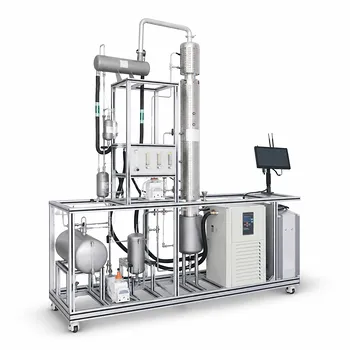
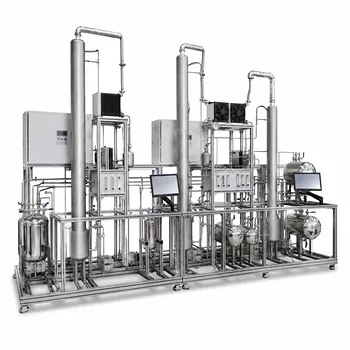
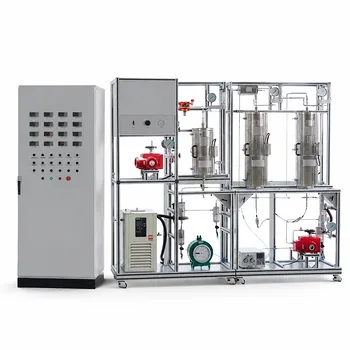
The performance of a fractional distillation pilot plant hinges on a simple boundary: the column’s thermodynamic temperature limits. The bubble point of the heavy‑end bottoms liquid dictates the minimum safe reboiler temperature, while the dew point of the overhead vapor pins the condenser operating temperature. Translating these two calculations into temperature control loop setpoints prevents flooding, incomplete condensation, and thermal instability, ensuring the energy supplied exactly matches what the separation demands.
Bubble point and dew point define the phase envelope of a hydrocarbon mixture. By calculating the exact temperature at which a liquid first boils ($\sum K_i x_i = 1$) and a vapor first condenses ($\sum y_i / K_i = 1$), operators set the reboiler at the bubble point and the condenser at the dew point—turning temperature control into a precise thermodynamic target rather than guesswork.
The Thermodynamic Foundation of Temperature Control
Bubble Point: Setting the Reboiler’s Lower Limit
The reboiler must supply enough heat to vaporize the bottom product.
Calculating the bubble point temperature at column base pressure tells you the minimum temperature where boiling begins.
Set the reboiler control loop just above this value to generate vapor without wasting energy or thermally cracking the heavies.
If the setpoint is too low, no vapor forms—the column stalls.
If it is too high, excessive boil‑up can flood trays and degrade heat‑sensitive components.
The bubble point calculation thus becomes the lower bound for the reboiler steam‑valve PID loop.
Dew Point: Defining the Condenser’s Operating Target
Overhead vapor must be completely condensed to recover distillate and supply reflux.
The dew point temperature of that vapor tells you the highest temperature at which condensation can start.
Setting the condenser coolant control loop at or slightly below the dew point guarantees all vapor is condensed, preventing accumulation of non‑condensables or loss of light ends.
A setpoint far below the dew point leads to unnecessary subcooling, wasting coolant and risk‑taking pump cavitation if the liquid is later pumped.
So the dew point becomes the upper bound for the condenser temperature loop, keeping the plant both stable and efficient.
From Calculations to Control Loop Settings
Operators input these thermodynamic temperatures directly as setpoints into the plant’s distributed control system.
The reboiler loop (master) adjusts steam flow to hold the bubble point; the condenser loop adjusts cooling water to hold the dew point.
Maintaining this precise bracket ensures the column operates inside its two‑phase envelope, where separation can happen.
A trial‑and‑error method using DePriester charts and the $\sum K_i x_i = 1$ criterion gives students a hands‑on way to link theory to the pilot plant’s sensor readings.
In modern setups, a digital twin or fast Newton‑Raphson solver delivers the setpoints automatically for non‑ideal systems, still grounded in the same thermodynamic equality.
Extending the Thermal Profile Across the Column
Feed Preheater and the Bubble Point
The column feed should enter as a saturated liquid (at its bubble point) for optimal energy balance and steady tray loading.
Calculating the feed bubble point tells you the exact preheater temperature setpoint—too cold subcools the feed and quenches the flash zone; too hot flashes early, disrupting pressure control.
Thus the bubble point guides another critical temperature loop before the mixture even reaches the column.
The Phase Envelope and Column Temperature Profile
For a multicomponent mixture at constant pressure, the bubble and dew points mark the boundaries of the two‑phase region.
Inside this envelope, temperature varies horizontally—meaning enthalpy changes dramatically with composition but little with temperature, while outside it, temperature lines become nearly vertical and heat duty changes are all sensible.
Knowing this ensures that each tray’s temperature setpoint (from bottom to top) stays within the envelope, so the separation gradient remains stable and predictable.
Understanding the Trade‑offs
Ideal vs. Non‑Ideal Mixtures – Iteration Complexity
For ideal hydrocarbon mixtures, $K_i$ depends only on $T$ and $P$, making bubble/dew point calculation fast and reliable.
For non‑ideal mixtures, activity coefficients and fugacity corrections introduce nested double‑loop iterations; a simple DePriester‑based trial‑and‑error can converge to the wrong temperature.
Using an incorrect ideality assumption feeds a faulty setpoint to the control loop, potentially destabilizing the entire column.
Pressure Deviations and Sensor Accuracy
Bubble and dew point values shift with column pressure; a small error in the pressure transmitter propagates directly to a wrong temperature target.
If the bottom pressure is misread, the reboiler setpoint may call for vapor that never forms.
Thus, robust pressure‑compensated calculations are just as vital as the temperature loops themselves.
Overcooling vs. Incomplete Condensation
Setting the condenser below the dew point ensures safety, but excessive subcooling raises energy cost and can lead to pump cavitation if the liquid is subsequently pumped.
The art is to calculate the exact dew point, then apply a small deadband to handle minor fluctuations without sliding into gross inefficiency.
This balance relies on the bubble point of the condensed liquid—cooling far below it is rarely justified.
Making the Right Choice for Your Pilot Plant
How you use bubble and dew point calculations depends on your primary goal.
- If your primary focus is safe, stable startup: Set the reboiler control loop just above the bubble point of the bottom product and the condenser loop exactly at the overhead vapor’s dew point. This guarantees a robust two‑phase region from the first tray onward.
- If your primary focus is energy efficiency: Fine‑tune the condenser setpoint to minimize subcooling (stay no more than 2–3°C below the dew point) while using the feed bubble point to preheat only to saturation. Excess heat duty beyond the phase‑change requirements wastes steam and cooling water.
- If your primary focus is dealing with non‑ideal mixtures: Implement a Newton‑Raphson solver with $1/T$ as the independent variable and update composition loop‑by‑loop to get accurate setpoints. Don’t rely on simple nomographs when polar components or azeotropes are present.
Mastery of bubble‑point and dew‑point thermodynamics transforms temperature control from reactive adjustment into a predictive, physics‑driven operation that keeps your pilot plant stable, efficient, and ready to scale.
Summary Table:
| Component | Thermodynamic Target | Setpoint Goal | Risk of Incorrect Setting |
|---|---|---|---|
| Reboiler | Bubble Point ($T_{bubble}$) | Just above bubble point | Column stall, thermal cracking, or flooding |
| Condenser | Dew Point ($T_{dew}$) | At or slightly below dew point | Loss of light ends or energy-wasting subcooling |
| Feed Preheater | Bubble Point ($T_{bubble}$) | At bubble point (saturated liquid) | Feed quenching or premature flashing |
Optimize Your Unit Operations Training with LABPARK
Looking to enhance your laboratory or training facility? LABPARK provides state-of-the-art Educational and Vocational Unit Operations Pilot Plants in chemical engineering, bioprocess & biotech, and environmental & water treatment. Designed specifically for universities, research institutes, and enterprises, our systems offer hands-on experience with thermodynamic principles like fractional distillation.
Contact us today to find the perfect pilot plant for your institution!
Related Products
- Multi-Modal Distillation Unit Operations Training Pilot Plant
- Multi-Functional Special Distillation Educational Pilot Plant
- Continuous Sieve-Plate Distillation Pilot Plant for Unit Operations Laboratory Education
- Green Anhydrous Ethanol Purification Extractive Distillation Unit Operations Training Pilot Plant
- Dual-Mode Rectification Pilot Plant for Practical Training Unit Operations
People Also Ask
- How can energy balance equations for condensers & reboilers be validated experimentally? Guide
- What are the primary reflux ratio control strategies? Master Distillation Unit Operations
- How does catalyst water concentration affect distillation pilot plant design? Key separation train choices.
- Why is vacuum operation capability an essential feature for a distillation unit operations pilot plant? Unlock Efficiency
- How can real-time carbon number prediction improve distillation pilot plants? Optimize control.