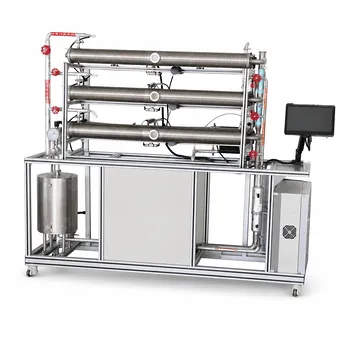
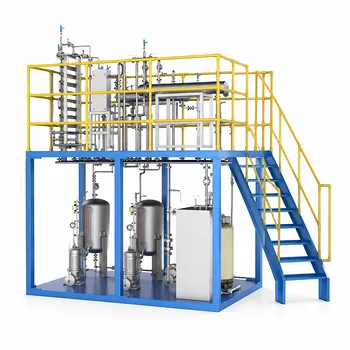
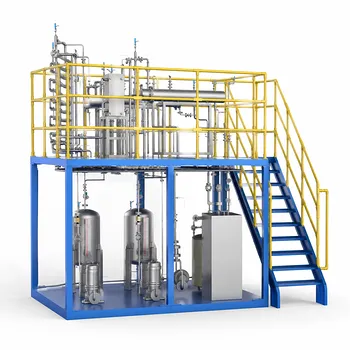
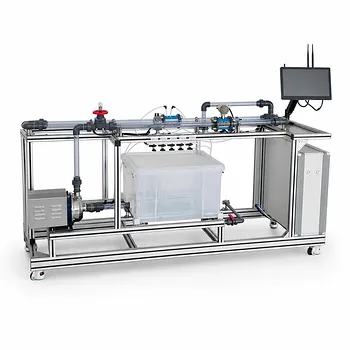
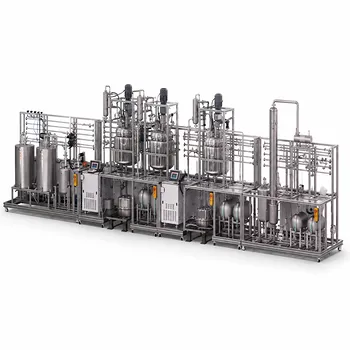
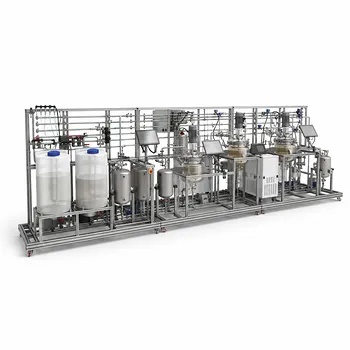
Real mixtures rarely behave as simple equations predict. In a vocational training pilot plant, students can prepare a non-ideal liquid mixture like ethanol-water, then measure the actual volume change on mixing or the temperature rise during blending to directly calculate excess properties—the thermodynamic deviation from an ideal solution. Similarly, by measuring the pressure, volume, and temperature of a gas mixture and comparing it to the ideal gas law, they compute residual properties, which isolate the deviation from the ideal gas state. These hands-on measurements turn abstract thermodynamic definitions into tangible, numeric deviations that reveal the real-world consequences of molecular interactions.
The power of the pilot plant lies not in taking a single measurement, but in showing how thermodynamic deviations—expressed as excess and residual properties—directly control the operability and design of separation units, reactors, and energy systems. When students can link a calculated activity coefficient to a required change in reflux ratio, the concept moves from a textbook equation to an industrial decision.
The Gap Between Theory and Reality
Memorizing a definition is not the same as understanding its operational impact. The gap between an ideal model and a real fluid often determines whether a column floods or whether a extraction step is economically feasible.
What Excess and Residual Properties Actually Tell Us
Excess properties quantify how far a real liquid mixture has strayed from ideal solution behaviour. They are defined as (M^E = M - M^{id}), capturing the heat, volume, or free energy effects caused by intermolecular forces that simple models ignore. Residual properties carry out the same role for gases: (M^R = M - M^{ig}), comparing a real fluid to an ideal gas at the same temperature and pressure.
Why a Textbook Example Isn’t Enough
A spreadsheet can generate a smooth curve of excess enthalpy versus composition. What it cannot convey is the messy reality of incomplete mixing, sensor lag, or unexpected temperature fluctuations that occur in a real plant. The deep need of vocational training is to replace a theoretical abstraction with a physical experience that demands interpretation, troubleshooting, and engineering judgment.
How Pilot Plants Make the Abstract Tangible
A well-instrumented unit operations pilot plant transforms a chemical mixture into a data-rich experimental system. The emphasis must be on the sequence: prepare, measure, compare, conclude.
Preparing Real Mixtures and Measuring Real Deviations
The simplest entry point is the excess volume. Students gravimetrically prepare a series of ethanol-water mixtures in a jacketed, temperature-controlled vessel. An overflow capillary or a precise level sensor detects the final volume. Because the ideal solution assumes additive volumes, the deviation—often a contraction for this system—is the excess volume. Simultaneously, a thermocouple records the temperature change on mixing, giving a direct path to the excess enthalpy. These raw physical measurements bypass any black-box simulation, making molecular assembly a visible phenomenon.
From Raw Data to Insight: Calculating Activity Coefficients
Measuring an excess property is only the starting point. The real educational leap occurs when students use those numbers to derive activity coefficients. For example, knowing excess Gibbs free energy allows the calculation of activity coefficients via the Gibbs-Duhem equation. These coefficients then predict the formation of an azeotrope in a distillation. In a pilot-scale distillation column, students can verify this prediction by observing that the vapour and liquid compositions converge at a specific ethanol fraction, despite endless boiling. They learn that the excess property they measured earlier is the root cause of this operational ceiling.
Demonstrating Residual Properties with Gas-Phase Systems
The concept of residual properties often feels distant from liquid-dominated pilot plants, but it becomes concrete with a simple gas handling setup. A closed volume filled with a pure gas or gas mixture—equipped with a pressure transmitter and thermocouple—can be operated at elevated pressures. Students record the pressure-volume-temperature relationship and immediately see the deviation from the ideal gas law (PV = nRT). The compressibility factor (Z) deviates from unity, and from that deviation they can calculate residual enthalpy or entropy. This closes the loop: the same sensor suite used for reaction kinetics now serves thermodynamic fundamentals.
Bridging the Theory-Operation Divide
The ultimate goal is to connect a coefficient in a model to a knob on the control panel. Excess and residual properties are not abstract bookkeeping; they are the hidden variables that determine separability and energy cost.
How Non-Ideal Behavior Disrupts Unit Operations
In a countercurrent liquid-liquid extraction unit, the distribution of a solute between two phases depends heavily on non-ideal mixing. If the activity coefficients in the raffinate phase are much higher than in the extract phase, the simple partition coefficient no longer predicts performance. Students running a pilot extraction with an acetic acid–water–organic solvent system can measure concentration profiles, back-calculate the effective activity coefficients, and observe how solubility limits directly reduce stage efficiency. The excess property data explain why a 3‑stage column might be needed where an ideal model predicts 2.
Using Pilot Plant Data to Optimize Process Parameters
Once the non-ideality is quantified, the operator can act. When an excess Gibbs energy model indicates a strong azeotrope, the training exercise shifts: students must adjust the reflux ratio, change the feed tray location, or consider an entrainer for azeotropic distillation. In a pilot plant equipped with a distributed control system, they can test these changes online and compare separation purity. The measured excess properties become the justification for energy-intensive operational decisions, turning a thermodynamic property into a cost factor.
Understanding the Trade-offs
Pilot plant demonstrations are not a panacea. Without careful instructional framing, the experiments can confuse as much as they enlighten.
Measurement noise can obscure small excess effects. In dilute solutions, the volume change on mixing may be smaller than the resolution of the level sensor, leading to misinterpretation. Instructors must select systems with pronounced non-idealities—ethanol-water, acetone-chloroform, or strongly associating mixtures—to ensure the signal dominates the noise.
Complexity can overwhelm fundamentals. Modern pilot plants are packed with automated data acquisition that can feel like a magic black box. If students simply push a button and get an activity coefficient on a screen, the cognitive link between the physical mixing event and the computed excess property is lost. The best approach pairs manual sample preparation with raw sensor data before moving to automated analysis.
Residual property experiments require careful safety boundaries. High-pressure gas systems carry inherent risks. The pedagogical value must be weighed against the need for rigorous safety protocols, which can limit the volume of hands-on time. A compromise is to use a gas expansion apparatus or a simple pressurized vessel in a fume hood, scaling down from a full pilot plant while still collecting real P-V-T data.
Making the Right Choice for Your Training Goal
A single pilot plant cannot serve all learning objectives equally. The configuration and experimental design should be driven by the core competency you aim to build.
- If your primary focus is building intuitive thermodynamic understanding: Start with simple, visual excess volume and heat-of-mixing experiments in a batch vessel. Keep the data reduction manual and transparent.
- If your primary focus is process design and operability: Integrate the activity coefficient calculation directly into a running distillation or extraction unit, and require students to adjust operating parameters based on their own thermodynamic analysis.
- If your primary focus is gas-phase process simulation: Dedicate a small pressure-rated setup to demonstrate residual properties via compressibility factor measurement, linking it later to centrifugal compressor performance curves.
- If your primary focus is troubleshooting non-ideal separation: Deliberately introduce a feed composition that creates an azeotrope or an emulsion, and have students diagnose the root cause by measuring excess properties and comparing them with an ideal-stage model.
Real thermodynamic education happens when the liquid level in the collection cylinder refuses to match the ideal calculation, and the student must explain why. A pilot plant turns that moment of cognitive dissonance into a permanent, measurable understanding of excess and residual behaviour.
Summary Table:
| Property Type | Definition & Formula | Pilot Plant Demonstration | Operational Impact |
|---|---|---|---|
| Excess Properties | Liquid mixture deviation: $M^E = M - M^{id}$ | Volume & temperature change during ethanol-water blending. | Affects azeotrope formation, column design, & extraction efficiency. |
| Residual Properties | Gas deviation: $M^R = M - M^{ig}$ | Pressure-Volume-Temperature (P-V-T) of pressurized gases. | Determines compressor performance and gas-phase process optimization. |
Bring Thermodynamics to Life in Your Lab
Bridge the gap between textbook theory and industrial reality with LABPARK. We provide industry-grade Educational and Vocational Unit Operations Pilot Plants in chemical engineering, bioprocess & biotech, and environmental & water treatment for universities, research institutes, and enterprises.
Our pilot plants allow students to measure real physical deviations, calculate activity coefficients, and master process optimization in a safe, controlled environment.
Contact LABPARK today to discover how our pilot plants can enhance your engineering curriculum and research capabilities!
Related Products
- Multi-Reactor Educational Pilot Plant for Reaction Engineering Unit Operations
- Three-Tube Heat Transfer Educational Pilot Plant for Unit Operations Training
- Fixed-Bed Chemical Reaction and Gas Dust Tar Removal Unit Operations Pilot Plant
- Multi Pump Fluid Transport Process Piping Unit Operations Training Pilot Plant
- Natural Product Extraction Unit Operations Training Pilot Plant
People Also Ask
- How do educational unit operations pilot plants address safety and waste management when scaling up?
- How do educational unit operations pilot plants bridge theory and design? Bridge the Engineering Gap
- Why Compare Predicted and Experimental Excess Enthalpy? Key to Accurate Pilot Plant Scale-up
- How to study gasification in pilot plants? Compare exit gas composition & efficiency
- Why Use PTFE & Hastelloy in Chemical Pilot Plants? Prevent Corrosion & Ensure Safety