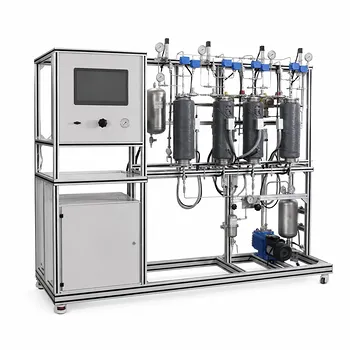
Universities don’t just teach nanotechnology—they can demonstrate it live.
By equipping environmental and water treatment unit operations pilot plants with advanced membrane separation modules (like nanofiltration) and adsorption columns loaded with engineered nanomaterials, institutions create an operational bridge between the atomic-scale promise of nanotechnology and the real-world demands of water purification. Students directly operate these pilot systems, evaluate removal rates for heavy metals, organic pollutants, and microorganisms, and collect the hands-on performance data—fouling rates, pressure drops, regeneration cycles—that no textbook can fully convey.
Pilot-scale nanofiltration and adsorption units transform abstract concepts of high surface area, reactive nanoparticles, and molecular sieving into measurable, teachable outcomes. This hands-on immersion not only cements theoretical understanding but also uncovers the operational constraints—energy demand, membrane longevity, and safe nanoparticle containment—that define whether a lab discovery becomes a deployed solution.
From Theory to Practice: The Essential Role of Pilot Plants
Demonstrating Nanofiltration and Adsorption at Scale
A nanofiltration (NF) pilot plant simulates industrial water treatment at a manageable scale, with membranes possessing pores measured in nanometers. Students manipulate feed pressure, flow rate, and contaminant concentration to observe the removal of salts, endocrine-disrupting compounds, and pathogens. Adsorption columns packed with nanomaterials like graphene oxide or functionalized activated carbon run in parallel, revealing how enormous internal surface areas capture low-concentration toxins. These unit operations turn a theoretical pore-size diagram into a physical pressure gauge and conductivity meter reading.
Bridging the Gap Between Lab-Scale Nanomaterials and Industrial Operation
Lab success with a carbon nanotube filter on a stir plate does not automatically translate to a continuous-flow process handling thousands of liters. Pilot plants force students to confront scaling realities: how nanomaterials perform under sustained operation, whether they agglomerate or leach, and how flow distribution changes when membranes scale up. This context is irreplaceable. They learn that the most elegant nanoparticle synthesis means little if the resulting filter collapses under a realistic cross-flow velocity.
Evaluating Key Performance Metrics: Efficiency, Fouling, and Lifespan
The true value of a nanomaterial-based filter is measured by its sustained performance. Students monitor rejection rates over time, track transmembrane pressure increases that signal fouling, and determine chemical cleaning frequencies. They quantify flux recovery after backwashing or cleaning-in-place, developing an intuitive sense for the operational trade-offs that govern the economic viability of any advanced membrane. This is the data that separates a promising material from a deployable technology.
Designing the Educational Experience with Nanotechnology Modules
Configuring for Nanofiltration and Advanced Adsorption
A well-designed pilot plant integrates a feed tank with spiked contaminants, a high-pressure pump, a spirally wound NF membrane module, and an adsorption column in series or parallel. Students can isolate each unit operation to study its individual contribution. By varying the order—adsorption before membrane, or vice versa—they learn how pretreatment protects expensive NF modules and how post-membrane polishing captures trace recalcitrants. This process engineering insight is exactly what industry demands.
Simulating Real-World Contaminant Removal
Environmental engineering curricula must train students for the complexity of actual water matrices. Pilot plants allow the injection of realistic contaminant cocktails: heavy metals diluted to parts per billion, humic acid as natural organic matter, or microplastics and synthetic dyes. Using nanofiltration to separate divalent ions from monovalent ones, or dosing zero-valent iron nanoparticles to create a reactive barrier, students see how chemical oxidation-reduction reactions and physical sieving complement each other. They can measure removal rates and compare them against traditional media to validate the nanomaterial advantage.
Integrating Safety Protocols for Nanoparticle Handling
Nanoparticles pose occupational health and environmental release risks that require deliberate training. A pilot plant configured with a closed-loop system enables students to practice safe handling: secondary containment for nanoparticle slurries, monitoring airborne particle concentrations, and disposal of spent membranes or adsorbent beds. They learn to operate membrane backwash systems that capture concentrated nanoparticle retentate for safe neutralization, embedding a safety culture that is non-negotiable for professional practice.
Understanding the Trade-offs
The Reality of Membrane Fouling and Regeneration
No nanofiltration membrane stays pristine forever. Students quickly discover that high removal efficiency often correlates with rapid fouling, especially when natural organic matter binds to nanoscale pores. They must balance performance with cleaning frequency, chemical consumption, and the integrity of the membrane surface—a lesson in the persistent gap between idealized nano-surfaces and biological complexity. Regenerating nanomaterial adsorbents similarly tests the economic sense of recovery versus disposal.
Energy Consumption vs. Contaminant Selectivity
Nanofiltration requires lower operating pressure than reverse osmosis but still consumes considerable energy at scale. Students analyze the energy footprint per cubic meter of treated water alongside the achieved removal selectivity. They learn that pursuing 99.9% removal of a low-concentration contaminant can double the energy bill, forcing a cost-benefit analysis that mirrors municipal utility decisions. This practical economics lesson cannot be learned from a journal article.
Nanoparticle Leaching and Environmental Containment
A critical risk is the unintended release of the nanomaterial itself. Pilot plant experiments can be designed to detect trace levels of nanoparticle breakthrough. Students grapple with the question: if a graphene-oxide membrane sheds material over time, is the cure safer than the disease? They develop back-end capture strategies, such as post-filtration with larger-pore prefilters that trap any aggregated particles, and appreciate why regulatory acceptance hinges on proven containment.
Cost and Scalability Hurdles
The simplest nanomaterial-based innovation fails if fabrication costs outweigh the public health benefit. By running pilot plants, students compile real operating costs—membrane replacement cycles, nanoparticle synthesis expenses, chemical cleaning agents, and labor. These data ground discussions on scalability, showing why municipal plants often favor robust, low-cost polymeric membranes over exotic nano-enhanced ones until the economic equation shifts.
Making the Right Choice for Your Educational Goal
Aligning pilot plant design with learning objectives ensures maximum impact. Consider these paths:
- If your primary focus is core science fundamentals: Prioritize a modular system where students can isolate nanofiltration and adsorption to test molecular sieving, size exclusion, and surface chemistry principles directly.
- If your primary focus is research-driven innovation: Configure a flexible plant with interchangeable membrane modules and adsorbent columns so students can rapidly prototype novel nanomaterial coatings and benchmark them against established NF membranes.
- If your primary focus is workforce readiness for industry: Integrate realistic multi-stage treatment trains, full instrumentation (pressure transmitters, flow meters, online TOC analyzers), and mandatory safety/containment protocols that mirror industrial standard operating procedures.
- If your primary focus is safety and regulatory compliance: Design explicit experiments on nanoparticle capture, spent media disposal, and effluent monitoring to embed a comprehensive environmental health and safety mindset.
When a pilot plant becomes a controlled crucible for trial, error, and measurement, it transforms nanotechnology from a theoretical frontier into an operational toolkit—and trains the engineers who will one day bring clean water to scale.
Summary Table:
| Educational Focus | Key Plant Configuration | Core Learning Outcome |
|---|---|---|
| Science Fundamentals | Modular nanofiltration & adsorption | Test size exclusion & surface chemistry |
| Research & Innovation | Interchangeable membrane modules | Prototype coatings & benchmark membranes |
| Workforce Readiness | Multi-stage trains & full instrumentation | Master industrial SOPs & real operations |
| Safety & Compliance | Closed-loop systems & containment | Practice safe nanoparticle handling & capture |
Elevate Your Engineering Curriculum with LABPARK
Translate complex chemical and environmental theories into practical, hands-on skills. LABPARK provides state-of-the-art Educational and Vocational Unit Operations Pilot Plants in chemical engineering, bioprocess & biotech, and environmental & water treatment for universities, research institutes, and enterprises.
Empower your students to master advanced nanotechnology filtration, membrane fouling management, and industrial safety protocols.
Contact LABPARK today to customize a pilot plant solution for your lab!
Related Products
- Electrochemical Water Treatment Educational Unit Operations Pilot Plant
- Ion Exchange Water Purification Educational Pilot Plant for Engineering Unit Operations
- Multi-Functional Membrane Separation Educational Pilot Plant for Unit Operations Lab
- Dual-Mode Rectification Pilot Plant for Practical Training Unit Operations
- Solid Waste Pyrolysis and Refining Educational Pilot Plant for Unit Operations
People Also Ask
- What design features do educational electrochemical pilot plants utilize to manage gas liberation and water loss?
- How can unit operations pilot plants show lead-acid concentration vs state of charge? Real-time monitoring guide.
- How do educational electrochemical pilot plants scale up electrolysis? Master industrial engineering.
- How to Estimate Sulfate in Water Treatment Pilot Plant Deposits: Gravimetric Guide
- How can foaming be managed during steam generation experiments in water treatment unit operations pilot plants? Tips