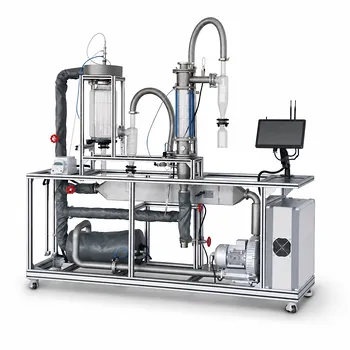
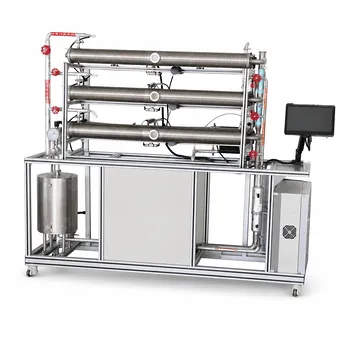
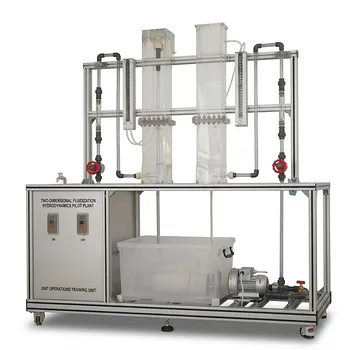
Here’s the truth about teaching process analyzer implementation: unit operations pilot plants transform abstract textbook concepts into a hands-on proving ground. Students learn to define an analyzer’s Technical Requirements by directly specifying what it must measure in a live process stream—concentration, precision, temperature range, corrosion resistance. They then execute a Feasibility Assessment by installing or simulating candidate analyzers on the pilot plant, testing them under controlled process upsets, and collecting real data to confirm whether the technology can meet those requirements before full-scale procurement.
The core value of a pilot plant in this context is risk reduction. It forces students to confront the messy reality of process conditions—dirty, corrosive, multi-phase streams—and translate that into quantitative, verifiable analyzer specifications. Instead of memorizing a checklist, they learn to iterate: define a requirement, test a method, interpret the data, and refine the specification. This cycle builds the clinical skepticism and practical intuition that no lecture can replicate.
Defining Technical Requirements in the Pilot Plant Environment
The pilot plant provides the crucial physical context that turns a generic wish list into a disciplined, process-specific specification. Students stop asking “what can this analyzer do?” and start asking “what must this analyzer do in this exact unit operation to keep the process safe and on-spec?”
Anchoring Specifications to a Real Unit Operation
A pilot plant’s modular design allows you to isolate a single step—like a distillation column, a continuous stirred tank reactor, or a heat exchanger network. Students can be assigned to write an analyzer specification for that specific vessel’s outlet stream. They must note the stream’s physical state (liquid, gas, slurry), its temperature and pressure, and any corrosive or fouling components.
For example, in a catalytic reactor pilot unit, they might need to measure the conversion of a key reactant with ±0.5% precision at 200°C and 15 bar. The pilot plant makes these numbers tangible, because the student can touch the reactor, see the insulation, and read the pressure gauge. The requirement is no longer a guess; it is a direct response to a real operating window.
Separating “Nice-to-Have” from “Must-Have” Parameters
Pilot-scale systems expose students to the resource constraints that drive this prioritization. You have limited sampling ports, limited budgets, and limited space for analyzer hardware. This forces a crucial conversation: do we need a qualitative pass/fail check or a quantitative concentration measurement? Is a response time of 30 seconds acceptable, or will it cause a process upset?
The pilot plant acts as a negotiation table. Students must defend every specification by linking it to a process control objective—preventing a distillation flood, maintaining a stoichiometric feed ratio, avoiding a thermal runaway. This is the exact mindset required in industry, and it’s where many academic exercises fall short.
Incorporating the Hidden Costs of Process Streams
On paper, a stream is just a line on a P&ID. In a pilot plant, it’s a hot, viscous liquid that can clog sample lines or etch an unguarded probe. When students observe a stream’s real behavior, they learn to include requirements for sample conditioning, temperature compensation, and wetted-material compatibility.
They might specify that an optical probe must withstand an acidic, high-temperature stream for 72 hours without signal drift. This detail emerges only from seeing the physical setup, tracing the piping, and understanding the process chemistry happening inside. This direct observation is how you build the habit of writing defensive, complete specifications.
Conducting a Feasibility Assessment with Real-World Constraints
Once the technical requirements are defined, the pilot plant becomes the testbed. The goal is not to simulate every possible plant scenario, but to use the pilot environment to break the analyzer’s assumptions and measure its true performance envelope.
Creating a Proof of Concept Under Process Dynamics
Students can install a candidate analytical technology—a near-infrared probe, a gas chromatograph, a pH sensor—directly on a pilot reactor or separator. They then deliberately perturb the process: they change the feed composition, ramp the temperature, or introduce a known contaminant. This is drastically different from a clean lab. The analyzer sees real mixing effects, real fouling, and real multi-component interference.
The data they collect—correlation plots, drift logs, interference studies—becomes the foundation of the feasibility report. They answer the core question: did the analyzer’s measurement track the reference method within the allowed error band during dynamic operation? If the answer is no, they have a concrete data set to analyze why, rather than just a theoretical objection.
Stress-Testing the Analyzer’s Mechanical and Chemical Compatibility
A bench-top laboratory test rarely exposes an analyzer to the vibration, EMI (electromagnetic interference), and ambient temperature swings present in a pilot plant. This is where hidden failure modes surface. Students might discover that a nearby pump’s variable frequency drive creates noise on the analyzer’s analog output, or that a poor grounding scheme causes a ground loop.
They learn to log not just the analytical signal, but also auxiliary parameters: ambient temperature, vibration levels, power quality. This trains them to write feasibility reports that include installation prerequisites—something often forgotten until the analyzer fails at a real plant. The pilot plant makes these “integration risks” visible and manageable.
Teaching Iterative Specimen Development
Feasibility assessment is rarely a single test. A student’s initial spec might be unachievable with the chosen technology, or the pilot plant might reveal a previously unknown interference. This is a critical learning moment. They must either modify the technical requirement (e.g., accept a lower precision) or propose a different analytical technique.
The pilot plant provides the rapid turnaround needed for this iteration. Within a few lab sessions, a student group can test, fail, adjust, and retest. This compression of the learning cycle is the pilot plant’s greatest pedagogical power. It imprints the principle that technical requirements and feasibility are a conversation, not a one-time handoff.
Understanding the Trade-offs and Limitations
An honest education must include what a pilot plant cannot teach. Ignoring these gaps leads to overconfidence and costly mistakes during technology transfer.
The Deception of Cleanliness and Short Run Times
A pilot plant can run for hours or days, but commercial processes run for months. This limits the ability to assess long-term drift, membrane fouling, or electrode poisoning in a truly representative way. Students must learn to design accelerated aging tests, using higher contaminant concentrations or temperature cycles, while understanding the extrapolation risks.
Similarly, pilot plants are often easier to clean and maintain. A student might conclude an analyzer is maintenance-free because it survives a 4-hour batch, while in reality a 30-day continuous run would show a different story. The instructor must explicitly draw this line, making the student ask: “How would this data look if we ran the unit for 1000 hours?”
Scale-Down Effects on Flow and Representivity
Sampling a fast-flowing, 12-inch pipe is not the same as sampling a small-bore pilot line. Mixing characteristics, Reynolds numbers, and thermal gradients can differ. Students must be taught to evaluate whether their feasibility data is sensitive to these scale effects.
For example, an optical flow cell in a pilot plant might show a clear signal, but at full scale, bubble formation or striation could cause severe baseline noise. The pilot plant is a valid proving ground only if students consciously account for these fluid dynamic differences and note them as assumptions in their feasibility report.
The Danger of Treating the Pilot Plant as a Simulated Plant
A pilot plant is a physical, not a virtual, environment. It has limited flexibility. You cannot always create the exact extreme fault conditions that a real plant might see because it could be unsafe or destructive. Students might be tempted to avoid certain upsets altogether.
The lesson is to define the feasibility envelope honestly: “We tested the analyzer up to 80°C; performance above that temperature is an assumption requiring further review.” This disciplined, boundary-setting communication is a core professional skill, and the pilot plant’s inherent limitations force it to the surface.
Making the Right Choice for Your Educational Goal
Your approach to using a unit operations pilot plant should align with the specific skill you want to build. The following recommendations tie learning outcomes to concrete activities.
-
If your primary focus is sharpening specification-writing skills: Use the pilot plant as a context-rich assignment. Give each team a different unit operation, a process stream sample, and a control objective, then require a complete technical requirement document with quantified must-haves and nice-to-haves justified by process data.
-
If your primary focus is developing troubleshooting and critical thinking: Plan a “hidden defect” exercise. Pre-install an analyzer with a subtle grounding issue or a mismatched sampling condition, and ask students to diagnose the root cause from feasibility test data, fostering the forensic mindset essential for plant support.
-
If your primary focus is teaching the full lifecycle of an analyzer project: Structure the course around a single pilot-scale chemical process (e.g., reactive distillation). Have students define requirements, conduct feasibility tests, analyze the data, and present a go/no-go recommendation with a clear risk register, mirroring a real-stage gate review.
-
If your primary focus is bridging laboratory analysis and process control: Integrate a chemometrics lab with the pilot plant. Students build a calibration model on clean samples in the lab, then test it on process streams drawn directly from the pilot plant, quantitating prediction error and diagnosing the causes of model breakdown.
The pilot plant is not a perfect replica of a production facility, but it is the single most effective tool for teaching that an analyzer’s value is determined not by its datasheet, but by its performance when the process gets dirty, hot, and unpredictable. Use it to make that lesson unforgettable.
Summary Table:
| Step | Focus Area | Pilot Plant Value |
|---|---|---|
| Technical Requirements | Defining stream physical & chemical properties | Anchors specifications to a real operating window |
| Feasibility Assessment | Stress-testing analyzers under dynamic conditions | Reveals integration risks like vibration & fouling |
Bring industrial reality to your students with LABPARK. We provide advanced Educational and Vocational Unit Operations Pilot Plants in chemical engineering, bioprocess & biotech, and environmental & water treatment tailored for universities, research institutes, and enterprises. Help your students master process analyzer implementation through hands-on learning—contact LABPARK today to discuss your lab needs!
Related Products
- Multi-Functional Drying Educational Unit Operations Pilot Plant
- General Purpose Cosmetics Production Unit Operations Training Pilot Plant
- Dual-Mode Rectification Pilot Plant for Practical Training Unit Operations
- Multi-Reactor Educational Pilot Plant for Reaction Engineering Unit Operations
- Multimodal Absorption and Desorption Pilot Plant for Unit Operations Training
People Also Ask
- How to study gasification in pilot plants? Compare exit gas composition & efficiency
- Why is the chemical plant startup schedule crucial? De-risk scale-up with pilot plants.
- How do deviations in estimating latent heat impact pilot plant thermal systems? Avoid hardware mis-sizing.
- Why Use PTFE & Hastelloy in Chemical Pilot Plants? Prevent Corrosion & Ensure Safety
- When to transition from PID to adaptive control in pilot plants? Key process indicators.