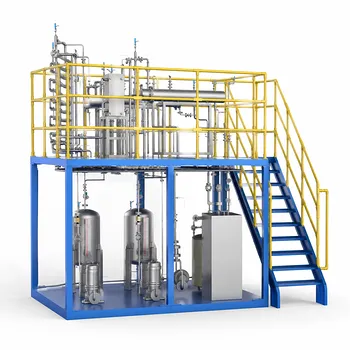
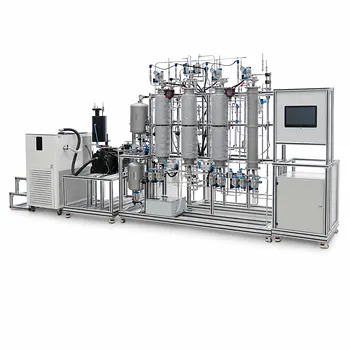
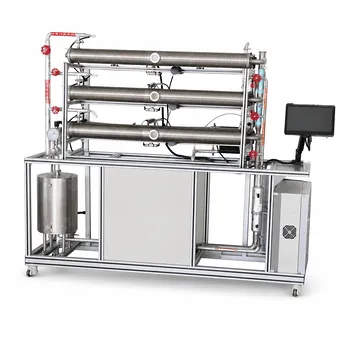
When you’re facing an empty dataset and a pilot plant to design, you don’t need to wait for perfect lab measurements.
You can estimate the latent heat of vaporization using a tiered approach: start with Trouton’s rule for a rapid ballpark figure, move to Chen’s equation when critical properties are available for higher precision, and apply Watson’s correlation to adjust known values across temperatures. These correlations give you the numbers required to size reboilers, condensers, and evaporators even when experimental vaporization data is absent.
Purely theoretical estimates are a launchpad, not a final answer. The real power of a pilot plant is that it takes those initial estimates and validates them against measured temperature, pressure, and condensation rates—closing the gap between paper calculations and safe, efficient operation.
The Hidden Challenge: Sizing Equipment Without Data
In a pilot plant for thermal separation, every component’s sizing hinges on the energy balance.
The latent heat of vaporization is the linchpin of that balance, dictating heat transfer areas and utility demands.
When experimental data is scarce, you’re forced to rely on correlations—each with its own strengths and blind spots.
Getting the estimate wrong can cascade into undersized reboilers that starve the column or oversized condensers that inflate capital costs.
The goal is to pick the right method for your current stage, then use the pilot plant itself to sharpen the numbers.
A Tiered Estimation Framework
Trouton’s Rule: The One-Variable Shortcut
This is the quickest method, needing only the normal boiling point (Tb).
For non‑polar liquids, the latent heat at the boiling point is roughly ΔĤv (kJ/mol) ≈ 0.088 × Tb (K).
For water and low‑molecular‑weight alcohols, a higher coefficient (0.109 × Tb) accounts for strong hydrogen bonding.
It’s a rudimentary tool—ideal for feasibility screening or when no other physical property data exists.
Expect errors of 20–30% for polar or associating compounds, so use it only when speed trumps accuracy.
Chen’s Equation: Adding Critical Properties for Precision
When you can obtain the critical temperature (Tc) and critical pressure (Pc), Chen’s equation delivers a more robust estimate.
It builds on the boiling point but introduces reduced-temperature terms, capturing the curvature of the vapor-pressure curve near the critical point.
This method is the go‑to for detailed equipment sizing in early engineering.
The catch: critical constants themselves may need estimation if the substance isn’t well characterized, introducing a second layer of uncertainty.
Watson’s Correlation: Scaling a Known Point
Often you’ll have a single measured latent heat at one temperature—say, from a literature value at the normal boiling point.
Watson’s correlation scales that value to any other temperature using the reduced-temperature ratio raised to the exponent 0.38.
It’s invaluable when your pilot plant operates far from the boiling point—think vacuum evaporation or high‑pressure distillation.
The exponent is an empirical average; for highly polar fluids, it can drift, so treat the result as a well‑informed approximation.
Beyond the Basics: Corresponding‑States Refinements
If even higher fidelity is required, corresponding‑states methods like the Haggenmacher equation can further refine the estimate.
These approaches account for vapor‑phase non‑ideality through the compressibility factor, making them especially useful when the vapor behaves far from ideal gas conditions.
They remain an extension of the same framework—starting from Tb, Tc, and Pc—and add incremental accuracy when you’re willing to do more math.
Understanding the Trade‑offs: Accuracy vs. Speed
Trouton’s rule is instant but blind to molecular complexity.
Chen’s equation demands more input and still relies on the quality of your critical constants—if those are estimated, the chain of uncertainty lengthens.
Watson’s exponent is a one‑size‑fits‑many solution that may not fit your specific fluid.
All these methods assume you’re dealing with a pure component; mixtures add another layer of non‑ideality that correlations struggle to capture.
For a pilot plant, the real risk is that a seemingly small percentage error in latent heat can translate into a significant mis‑sizing of heat exchangers.
An undersized condenser can limit throughput, while an oversized reboiler wastes energy and drive up operating costs.
Why the Pilot Plant Becomes the Ultimate Validator
A unit‑operations pilot plant isn’t just a smaller version of the final process—it’s a measurement platform.
You can log actual evaporation and condensation rates, inlet and outlet temperatures, and pressure drops at the exact conditions your process demands.
With this empirical data, you back‑calculate the true latent heat and compare it to your estimates.
That comparison does two things: it validates your sizing decisions for scale‑up, and it tunes the correlation parameters (like the Watson exponent) for your specific fluid system.
This close‑the‑loop approach bridges theoretical thermodynamics—Antoine equations, compressibility factors, corresponding‑states assumptions—with the real‑world behavior inside your equipment.
The result isn’t just a more accurate number; it’s a safer, more energy‑efficient plant design.
Actionable Guidelines for Your Thermal Separation Project
- If your primary focus is rapid concept screening: Use Trouton’s rule to put rough numbers behind energy duties and kickstart feasibility discussions.
- If your primary focus is detailed equipment sizing before data exists: Combine Chen’s equation with Watson’s correlation, sourcing critical properties from reliable databases, and apply a healthy safety factor to your heat exchanger areas.
- If your primary focus is scale‑up and operational reliability: Treat the pilot plant as the definitive source. Plan dedicated test runs to measure condensation and evaporation rates, then recalibrate your estimation models with the field data.
Estimate to start, measure to finish—because in pilot plants, the most valuable latent heat data is the data you collect yourself.
Summary Table:
| Method | Data Required | Best Use Case | Limitations |
|---|---|---|---|
| Trouton's Rule | Normal boiling point ($T_b$) | Rapid concept screening & quick calculations | High error (20-30%) for polar or associating fluids |
| Chen's Equation | Boiling point ($T_b$), Critical temp ($T_c$), Critical pressure ($P_c$) | Detailed equipment sizing in early engineering stages | Requires critical constants, which may also need estimation |
| Watson's Correlation | One known latent heat value at a reference temperature | Scaling known values to different operating temperatures | Empirical exponent (0.38) can drift for highly polar fluids |
Validate Your Chemical Process Designs with LABPARK
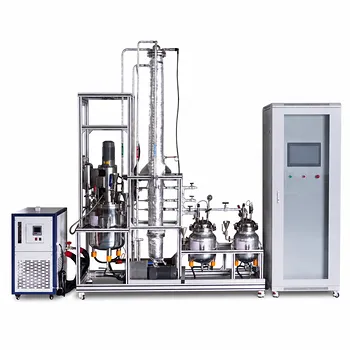
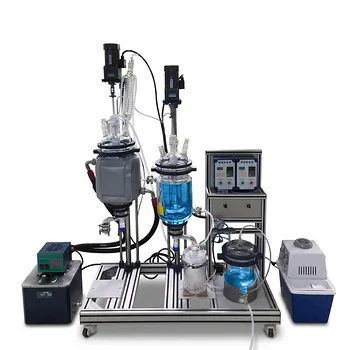
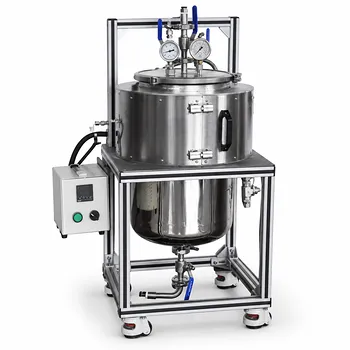
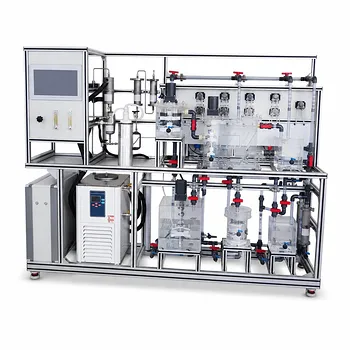
Accurate thermodynamic estimations are just the starting point. LABPARK provides state-of-the-art Educational and Vocational Unit Operations Pilot Plants in chemical engineering, bioprocess & biotech, and environmental & water treatment. Designed specifically for universities, research institutes, and enterprises, our pilot plants allow you to generate real-world empirical data, validate theoretical calculations, and ensure safe scale-up.
Ready to elevate your research or training facility? Contact LABPARK today to discuss your custom pilot plant needs!
Related Products
- Carbon Material Thermal Pretreatment Multiphase Separation Educational Pilot Plant
- Potassium Salt Thermal Dissolution and Crystallization Separation Educational Unit Operations Pilot Plant
- Hot Filtration Educational Unit Operations Pilot Plant Laboratory System
- Thermal Desorption Exhaust Gas and Tail Water Treatment Educational Pilot Plant
- Gas-Solid Heterogeneous Separation Demonstration Educational Unit Operations Pilot Plant
People Also Ask
- How is trace chromium in wastewater pre-concentrated and determined? A Guide
- What role does IMAC play in antibody purification & how is it taught in pilot plants?
- How is IMAC used for Fab fragment purification in bioprocess pilot plants? Scale-up & optimization guide.
- What fabrication parameters optimize polymer-modified glassy carbon electrodes? Prevent charge transfer limits.
- How to map active metals in catalyst pores? Optimize Unit Operations & Kinetics