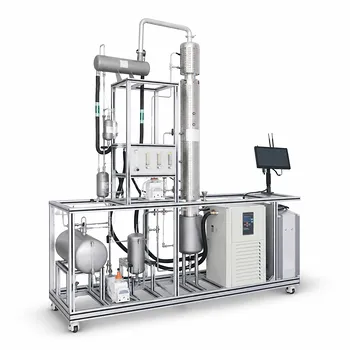
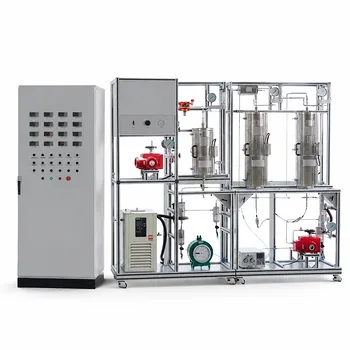
The boiling points of nitrogen and oxygen are famously low, but you don't need a cryogenic plant to teach their separation. The core industrial principle—exploiting boiling point differences through multi-stage vapor-liquid equilibrium—can be effectively and safely demonstrated using fractional distillation unit operations pilot plants that run on safer binary mixtures like ethanol and water. By operating these systems under vacuum or atmospheric pressure, students and researchers can study the exact same thermodynamic and hydraulic phenomena that govern air separation, without the complexity and hazard of extreme cryogenics.
Cryogenic air separation relies on boiling point differences between nitrogen (-195.8°C) and oxygen (-183°C) across many theoretical stages. A well-designed pilot plant using a safer binary mixture replicates this multi-stage equilibrium concept, allowing direct analysis of column hydraulics, plate efficiencies, reflux ratios, and temperature profiles—the very same engineering fundamentals that govern industrial gas purification.
Why Cryogenic Air Separation Principles Matter for Learning
Industrial fractional distillation of liquid air is a classic unit operation built on a straightforward concept: components with lower boiling points concentrate at the top of the column, while those with higher boiling points move downward. Understanding how this works is critical for chemical engineers, but the process is physically demanding and dangerous to replicate directly in an educational setting.
The Industrial Reality: Low Temperatures, High Stakes
Nitrogen’s boiling point of -195.8°C and oxygen’s -183°C create a narrow 12.8°C separation window. To make the process viable, industrial columns operate under pressure to raise boiling points slightly and must use highly insulated, precision-engineered systems. Translating this directly to a teaching lab is impractical due to cost, safety, and the sheer difficulty of maintaining stable cryogenic conditions.
The Educational Gap: How to Teach What You Can’t Touch
The deep need is not to build a small air separation plant, but to give students a genuine, hands-on experience with the underlying transport phenomena and thermodynamics. The challenge is finding a practical proxy that doesn’t sacrifice pedagogical integrity. This is where a thoughtfully configured pilot plant becomes invaluable.
Translating Cryogenic Principles into a Safe Pilot Plant Environment
The primary reference’s core insight solves this problem head-on: use a fractional distillation unit operations pilot plant with a safer binary mixture. The separation is no longer about nitrogen and oxygen, but about two components with a manageable boiling point difference, like ethanol (78.4°C) and water (100°C). The thermodynamics and column behavior remain fundamentally the same.
The Analogy That Doesn’t Break Down
Multi-stage vapor-liquid equilibrium is a universal concept. Whether you are separating argon from oxygen at -186°C or ethanol from water at 80°C, the same principles apply: vapor rises, liquid descends, and each theoretical stage enriches the more volatile component. A pilot plant running ethanol-water lets students directly measure the same variables an engineer would analyze on an air separation unit, but without the need for a cold box.
Critical Operating Parameters You Can Now Manipulate
Running a safer mixture unlocks the ability to vary and observe key engineering parameters that industrial operators wrestle with daily:
- Reflux ratio: Increasing reflux improves purity but raises energy costs—just as in cryogenic columns.
- Column hydraulics: Flooding, weeping, and pressure drop behavior are independent of the mixture’s chemistry.
- Plate or packing efficiency: Students can calculate Murphree efficiencies and see how they relate to the number of theoretical stages, a direct analog to the trays needed for nitrogen purity.
- Temperature profiles: Monitoring temperature at different column heights reveals the composition gradient, a visual, real-time map of separation progress.
Designing a Pilot Plant Demonstration That Mirrors Air Separation
To make the demonstration truly effective and align with the deep need of understanding industrial gas separation, the pilot plant must be configured with specific operating modes. The supplementary references point to modular pilot plant designs that can be adapted, and the primary reference emphasizes the role of vacuum to lower boiling points, mimicking cryogenic conditions without the cold.
Vacuum Operation: The Key to Lowering the Boiling Point
Industrial air separation uses cryogenic temperatures; a well-designed educational pilot plant uses vacuum to achieve a similar effect on a safer mixture. By reducing the pressure, you lower the boiling points of both components, shrinking the energy scale of the experiment. This directly teaches students how pressure influences vapor-liquid equilibrium—a principle essential for designing efficient industrial gas plants that operate at elevated pressures to optimize energy use.
Continuous vs. Batch Operation
Modular pilot plants allow instructors to demonstrate both batch and continuous distillation. For air separation principles, a continuous operation with a stable feed and controlled reflux is the closer analog. By adjusting the feed location and rate—as suggested in the supplementary descriptions—students can observe the steady-state concentration gradient and learn how feed quality impacts separation, a lesson directly applicable to the large-scale, continuous process of an air separation unit (ASU).
Understanding the Trade-offs and Limitations
While this approach is highly effective, an objective technical advisor must clarify its boundaries. The demonstration is a faithful model of the thermodynamic concept, but it is not a perfect replica of industrial air separation.
What You Lose: Cryogenics Engineering
A pilot plant using ethanol-water does not teach the insulation design, brazed aluminum heat exchanger fabrication, or turbine-driven refrigeration cycles critical to a real ASU. The safety culture around oxygen compressors and the dangers of hydrocarbon buildup are also absent. This demonstration is focused on the core separation principle, not the entire cryogenic plant design.
What You Gain: Accessible Mastery of Fundamentals
The trade-off is overwhelmingly positive for educational goals. Students gain deep, intuitive mastery of vapor-liquid equilibrium, reflux control, and column efficiency—skills that are transferable to any distillation process, including air separation. The absence of extreme cold actually removes a barrier to learning, allowing them to focus on the physics without the protective gear and special materials.
How to Apply This to Your Training or Research Goal
Your specific objective will determine how you emphasize the demonstration. Here are actionable takeaways based on common goals in chemical engineering education and vocational training:
- If your primary focus is core thermodynamic understanding: Use an ethanol-water mixture under vacuum. Prioritize measuring the temperature profile and calculating the number of theoretical stages required to reach a target purity, linking this directly to the narrow boiling point difference in air.
- If your primary focus is operational skills for plant engineers: Configure the pilot plant for continuous operation and let trainees troubleshoot flooding or weeping. Run the column at different reflux ratios to show the trade-off between product purity and energy consumption—a universal lesson for any distillation operator.
- If your primary focus is process scale-up and efficiency: Focus on measuring column pressure drop and calculating HETP (Height Equivalent to a Theoretical Plate) for different packing types. This quantifies efficiency losses during scale-up, a problem engineers face when moving from lab data to an industrial nitrogen plant.
By reframing the challenge—not as a miniature cryogenic plant, but as a perfect thermodynamic simulator—you unlock a powerful, safe, and deeply instructive way to teach the principles behind nitrogen extraction and all industrial distillation.
Summary Table:
| Feature | Industrial Cryogenic Air Separation | Pilot Plant Demonstration Proxy |
|---|---|---|
| Working Mixture | Liquid Air (Nitrogen & Oxygen) | Ethanol and Water (or similar binary mixture) |
| Boiling Point Range | -195.8°C to -183°C (Cryogenic) | 78.4°C to 100°C (Atmospheric or vacuum) |
| Safety & Complexity | High risk, requires vacuum-insulated cold boxes | Safe, accessible, runs at moderate temperatures |
| Core Learning Outcomes | Heat exchanger design, cryogenic safety | Reflux ratio control, column hydraulics, VLE calculations |
Bring Industrial Distillation Principles to Life Safely
At LABPARK, we empower universities, research institutes, and enterprises with high-fidelity, hands-on training solutions. We provide premium Educational and Vocational Unit Operations Pilot Plants in chemical engineering, bioprocess & biotech, and environmental & water treatment. Our systems allow students and researchers to master complex transport phenomena and vapor-liquid equilibrium safely without the hazards of extreme cryogenic temperatures.
Ready to elevate your engineering lab? Contact LABPARK today to find the perfect pilot plant configuration for your curriculum.
Related Products
- Multi-Modal Distillation Unit Operations Training Pilot Plant
- Multi-Functional Special Distillation Educational Pilot Plant
- Continuous Sieve-Plate Distillation Pilot Plant for Unit Operations Laboratory Education
- Green Anhydrous Ethanol Purification Extractive Distillation Unit Operations Training Pilot Plant
- Dual-Mode Rectification Pilot Plant for Practical Training Unit Operations
People Also Ask
- How can energy balance equations for condensers & reboilers be validated experimentally? Guide
- How can real-time carbon number prediction improve distillation pilot plants? Optimize control.
- What are the primary reflux ratio control strategies? Master Distillation Unit Operations
- How does catalyst water concentration affect distillation pilot plant design? Key separation train choices.
- Why is vacuum operation capability an essential feature for a distillation unit operations pilot plant? Unlock Efficiency