Cracking ethane in a pilot plant turns abstract free radical theory into a tangible, data-rich experiment. Students can directly investigate the mechanism and byproduct formation by operating a continuous tubular reactor that mimics an industrial steam cracker, paired with online gas chromatography (GC). By systematically varying temperature, residence time, and the steam-to-hydrocarbon ratio, they track the yields of ethene, hydrogen, methane, and heavier hydrocarbons in real time. These measurements let them infer the dominant propagation and termination steps, validate kinetic models, and close mass balances—converting a textbook network of radical reactions into a teachable, hands-on laboratory exercise.
The real power of a pilot plant is making the invisible visible: product distribution data reveal exactly how temperature shifts the balance between propagation and termination in the free radical chain. What looks like a daunting web of reactions becomes a clear, quantifiable pattern that students can see, measure, and model.
Designing the Experiment: Pilot Plant Setup for Ethane Cracking
Ethane cracking is a high-temperature, gas-phase reaction that demands a reactor built for rapid heating and precise control. The pilot plant must provide the conditions for a free radical chain while capturing the data needed to dissect it.
Selecting a Tubular Reactor to Simulate the Industrial Furnace
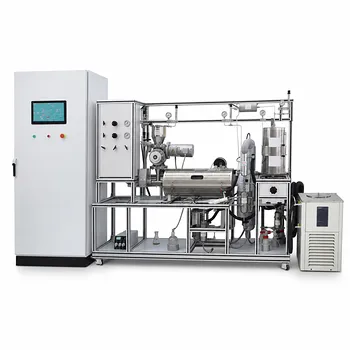
Industrial crackers use long, narrow tubes inside a firebox. A pilot-scale tubular reactor (often a coiled metal tube inside an electric furnace) replicates this with a well-defined plug flow residence time distribution. This selection keeps the fluid dynamics simple, so students can focus on reaction kinetics rather than complex mixing. The tube diameter is small enough to minimize radial temperature gradients, ensuring the entire stream sees the same thermal history.
Online Gas Chromatography: The Essential Analytical Eye
The free radical mechanism cannot be observed directly, but its fingerprints appear in the product spectrum. An online GC with a thermal conductivity detector (TCD) and a flame ionization detector (FID) samples the reactor effluent automatically.
- TCD quantifies hydrogen and lighter permanent gases.
- FID measures hydrocarbons from methane up to butane and benzene. Automated sampling every few minutes lets students build time-resolved concentration curves, linking operating changes to immediate shifts in selectivity.
The Lever of Three Variables: Temperature, Residence Time, and Steam Dilution
The free radical chain is exquisitely sensitive to three levers. First, temperature (typically 750–900 °C) dictates the initiation rate: higher temperatures produce more methyl radicals and accelerate propagation, but also favor coking and secondary reactions. Second, residence time (0.1–0.5 seconds) controls how far the chain propagates before termination; too long leads to over-cracking and heavy byproducts. Third, the steam-to-hydrocarbon ratio reduces the ethane partial pressure, which suppresses bimolecular termination and shifts selectivity toward ethene. The pilot plant’s mass flow controllers and furnace temperature PID loop let students sweep these variables systematically.
From Concentration Profiles to Radical Pathways
With a stream of GC data, the experiment moves from running the plant to interpreting the mechanism. The same data set can be used for kinetic model fitting and for qualitative reasoning about radical behavior.
Tracking Primary Products to Map Initiation and Propagation
The free radical mechanism begins with C–C bond cleavage: C₂H₆ → 2 •CH₃. Methyl radicals then abstract hydrogen from ethane to form methane and an ethyl radical: •CH₃ + C₂H₆ → CH₄ + C₂H₅•. The ethyl radical decomposes to ethene and a hydrogen atom: C₂H₅• → C₂H₄ + H•, and H• continues the chain by attacking ethane. As a result, methane is a direct marker of initiation and early propagation, while ethene and hydrogen are the primary chain-carrying products. Students plot the molar yields of CH₄, C₂H₄, and H₂ as a function of temperature or residence time. A plateau or decrease in ethene at extreme conditions signals secondary reactions (further dehydrogenation to acetylene or coke formation).
Byproduct Fingerprints as a Window into Termination
Recombination of radicals is the termination step. Methyl radicals can combine to give ethane (reversing the initiation), but more telling are larger byproducts. When ethyl and methyl radicals meet, they form propane; two ethyl radicals give butane. Heavier alkenes like propylene arise from chain branching or secondary cracking of larger intermediates. The pilot plant’s GC reveals these species at low but detectable levels. Students can calculate relative termination rates by tracking the sum of these recombination products, linking the radical concentration back to the initiation rate and thus to the activation energy of the process.
Bridging Theory and Data with Kinetic Analysis
The pilot plant does not just provide a snapshot; it supplies concentration–time (or residence time) data that can be plugged directly into reactor design equations. For a plug flow reactor, the design equation is dCᵢ/dτ = rᵢ. By measuring the ethene or methane concentration at several residence times (varying flow rate at fixed temperature), students can apply the integral method: if a first-order model fits the ethane disappearance, a semilog plot of concentration versus time gives a straight line, yielding the rate constant $k$. Repeating this at different temperatures and applying the Arrhenius equation (plotting $\ln k$ vs. $1/T$) yields the apparent activation energy of the global cracking reaction. This exercise connects the molecular free radical picture to the macroscopic engineering parameter $E_a$. Even if the true mechanism is a network, such simplified kinetic treatment teaches the value and limits of lumped models.
Understanding the Trade-offs and Common Pitfalls
A pilot plant is a teaching tool, not a free pass to perfect data. Students must navigate the same compromises that industrial engineers face.
The Sensitivity–Safety Trade-off at High Temperatures
Ethane cracking requires temperatures that can soften metal alloys and create hot spots. A pilot tubular reactor may have thin walls for fast heat transfer, but that creates fragility. Students quickly learn that pushing for higher conversion (above ~70%) risks runaway coking, blocked tubes, and even tube rupture. The educational value lies in managing this trade-off: collecting enough high-temperature data to see the radical mechanism’s shift without destroying the equipment. Adding steam helps mitigate coking but also cools the stream, requiring careful energy balance.
Interpreting Byproduct Data Without Overfitting
The GC will detect dozens of trace species. It is tempting to assume every peak corresponds to a new reaction path. In reality, many compounds are secondary products of recombination or thermal decomposition of larger molecules. The challenge is to identify which byproducts are mechanistically diagnostic. Methane, ethane, ethene, hydrogen, and propane are robust indicators; heavier aromatics like benzene are often the result of complex condensation reactions, not direct radical termination. Students need to frame their analysis around the core propagation–termination cycle and treat the heaviest species as integrated markers of coking tendency.
The Hidden Energy Cost: Why Separation Matters
Free radical cracking is only half the story. The reactor effluent is a mixture of unreacted ethane, ethene, hydrogen, methane, and heavier byproducts. Separating ethene from ethane requires cryogenic distillation with up to 150 trays and temperatures below 273 K—an enormous energy sink. Educational pilot plant setups often include a small distillation column downstream. Running that column with the actual cracking effluent confronts students with the reality: the free radical mechanism dictates not just what you make, but also how hard it is to purify. A high per-pass conversion might look good on paper but can flood the downstream separation with methane and hydrogen, raising energy demand. The pilot plant makes this interdependency tangible.
Making the Most of Your Pilot Plant Experiment
A well-designed ethane cracking session moves beyond “crank up the heat and see what happens.” Structure your investigation around clear analytical goals.
- If your primary focus is verifying the free radical mechanism: Start with a single temperature and residence time, and identify the fingerprint products (CH₄, C₂H₄, H₂, C₃H₈). Use the ratio of methane to ethene as a monitor of initiation vs. propagation; then vary temperature to watch how the methane yield increases, confirming that C–C bond cleavage drives the early steps.
- If your primary focus is deriving kinetic parameters: Run a set of experiments at fixed temperature but varied flow rates (residence times). Apply the integral method to the ethane decay data to extract a pseudo-first-order $k$, then collect $k$ values at four or five temperatures to calculate the activation energy. Compare your value with literature data to discuss the influence of heat and mass transfer limitations at pilot scale.
- If your primary focus is understanding industrial feasibility: Couple the reactor with the downstream distillation unit. Measure not only reactor yield but also the energy required to separate products to polymer-grade ethene. Evaluate the impact of steam ratio on separation load, and map the entire process economics at pilot scale.
Every data point your pilot plant generates tells a story about the radical chain—your job as a student is to listen with kinetics, thermodynamics, and a healthy respect for the explosive potential of hot ethane.
Summary Table:
| Parameter | Impact on Mechanism | Key Analytical Marker |
|---|---|---|
| Temperature (750–900 °C) | Drives initiation and propagation rates | Methane ($CH_4$) yield |
| Residence Time (0.1–0.5s) | Dictates extent of propagation vs. termination | Ethene ($C_2H_4$) & Hydrogen ($H_2$) |
| Steam Dilution | Lowers partial pressure, reducing termination | Byproducts (Propane, Butane, Coke) |
Bring Industrial-Scale Learning to Your Laboratory with LABPARK
Bridge the gap between textbook theory and hands-on engineering reality. LABPARK provides state-of-the-art Educational and Vocational Unit Operations Pilot Plants in chemical engineering, bioprocess & biotech, and environmental & water treatment.
Tailored for universities, research institutes, and enterprises, our pilot plants empower students to analyze complex reaction kinetics, operate continuous reactors safely, and master advanced analytical instrumentation.
Ready to elevate your engineering curriculum? Contact LABPARK today to explore our pilot plant solutions.
Related Products
- Methane Cracking Educational Unit Operations Pilot Plant
- Ethyl Acetate Synthesis Unit Operations Pilot Plant for Practical Training
- Bio-fermentation Ethanol Production Practical Training Unit Operations Pilot Plant
- Green Anhydrous Ethanol Refining Practical Training Pilot Plant
- Green Anhydrous Ethanol Purification Extractive Distillation Unit Operations Training Pilot Plant
People Also Ask
- How do ethane vs naphtha cracking influence teaching pilot plant analytical configurations? Key Design Guide
- How can flow-NMR be integrated with pilot plant reactors to monitor kinetics? A Complete Guide
- How do cracking temperature and residence time affect olefin yield? Pilot Plant Guide
- How are utility consumption rates integrated into chemical pilot plant economic evaluations?
- How should OSBL investments be estimated? Key Steps to Avoid Budget Overruns in Pilot Plant Projects