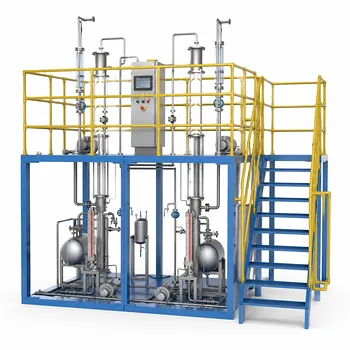
Knowledge Bioprocess and Biotechnology Education How can NIR & Mid-IR monitor fermentation in pilot plants? Optimize your bioprocess unit operations.
Author avatar

Tech Team · LABPARK

Updated 1 month ago

How can NIR & Mid-IR monitor fermentation in pilot plants? Optimize your bioprocess unit operations.


Real-time spectroscopic monitoring turns a bioprocess pilot plant from a black box into a transparent, data-rich system. Near-infrared (NIR) spectroscopy is primarily used to measure biomass, cell density, and physical properties like viscosity in situ. Mid-infrared (Mid-IR) spectroscopy is highly effective for tracking the concentration of key nutrients and metabolites, such as glucose and ethanol, directly within the fermentation broth. This integration allows for immediate process control decisions without the delays of offline sampling.

The core advantage of in-situ spectroscopy is the ability to build a continuous, quantitative picture of your fermentation's health. It shifts the focus from reactive, end-of-batch analysis to proactive, real-time control. Successfully applying these techniques, however, depends less on the sensor and more on overcoming specific operational challenges through robust calibration.

Moving Beyond Measurement: Building a Window into the Bioreactor

The surface application is simple: replace grab samples with a probe. The deep value comes from generating a high-density data stream that reveals process kinetics in real time. This transforms how you develop and control a process.

Illuminating Biomass and Physical State with NIR

NIR spectroscopy is uniquely suited for non-invasive physical measurements because its signals are based on overtones and combination bands from X-H bonds (C-H, O-H, N-H). These bands are 10 to 100 times weaker than fundamental Mid-IR vibrations.

This low absorptivity is its superpower. It allows NIR light to penetrate several millimeters into a dense E. coli or yeast culture.

Using a fiber-optic probe, you can analyze light scattering and absorption to correlate directly with cell density. This provides a real-time growth curve without taking a single sample. You can also track physical changes like viscosity increases in aerobic fermentations producing biopolymers.

Decoding Chemical Complexity with NIR and Mid-IR

Monitoring chemical concentrations is where both techniques excel, often in complementary ways. The goal is to simultaneously track substrate consumption (like glucose) and product or by-product formation (like ethanol or organic acids).

Mid-IR spectroscopy is robust for this task. It measures fundamental vibrational modes, producing sharp, highly specific peaks for molecules like ethanol or acetate. A critical advantage in a pilot plant is that well-designed Mid-IR sensors are often insensitive to normal fluctuations in agitation speed, airflow, and backpressure.

NIR spectroscopy can perform highly selective measurements, even for nearly identical molecules. By using optimized chemometric models like Partial Least Squares (PLS) regression with Fourier filtering, you can distinguish between glutamine and asparagine in a complex bioreactor matrix. This allows for precise, real-time control of critical nutrient feeds with mean prediction errors as low as 2-5%.

Overcoming the Environmental Hurdles

An in-situ measurement idea is aspirational. A rugged, reliable signal is operational reality. A pilot plant is a chaotic environment that fights your sensor. Your calibration strategy is what wins the battle.

Taming Agitation and Aeration

Vigorous stirring and sparged air create bubbles and density fluctuations that degrade spectral quality, especially for NIR probes. The light path is disrupted, and your prediction becomes noise.

This is often the single biggest factor in sensor failure. The primary mitigation strategy is to maintain constant agitation and aeration rates during measurement cycles. More advanced approaches involve using signal optimization algorithms to reject bad scans or synchronizing data collection with specific bubble patterns.

Compensating for Thermal Variance

Temperature changes the strength and position of molecular bonds, causing spectral shifts. A model calibrated at 30°C will give a wrong concentration prediction at 32°C.

The solution lies in the calibration model itself. Rather than trying to keep temperature perfectly isothermal (which is often impractical), you use non-linear multivariate calibration methods. Training a model like an artificial neural network with data collected across a realistic temperature range allows it to inherently compensate for these fluctuations.

Understanding the Trade-offs

The blind spot in many PAT strategies is mistaking sensor cost for analytical fitness. The choice between NIR and Mid-IR is not about which is "better" but about which set of constraints you can live with.

  • NIR: The Flexibility King. Its primary advantage is sample interface. Because NIR light penetrates millimeters, you can use non-contact diffuse reflectance probes with a simple sapphire window. There is no need for precise optical pathlengths. The trade-off is that the spectra are broad and overlapping, demanding more effort to build a complex, robust chemometric model.
  • Mid-IR: The Specificity Expert. Its advantage is sharp, fundamental spectral fingerprints that are easier to interpret. The trade-off is sample handling. The high signal intensity is easily saturated, so Attenuated Total Reflectance (ATR) crystals are required. These demand precise, stable contact with the fluid, making them susceptible to fouling from cells and requiring more maintenance in a long-duration fermentation.

Making the Right Choice for Your Goal

Your application dictates the sensor. A robust pilot plant PAT strategy often combines the strengths of both techniques where budget allows.

  • If your primary focus is monitoring growth kinetics and physical properties: Start with an NIR probe. Its ability to non-invasively measure cell density and viscosity without a precise pathlength makes it the practical, workhorse choice.
  • If your primary focus is critical control of a single nutrient or product with high precision: Evaluate a Mid-IR ATR probe first. Its chemical specificity and tolerance to background process noise offer a more direct calibration path for a target analyte.
  • If your primary focus is comprehensive reaction mapping for a multi-stage process like biodiesel production: NIR is the ideal solution. A single NIR probe can be calibrated to simultaneously track triglycerides, diglycerides, free glycerol, and moisture at different stages to identify the reaction endpoint and optimize separation.

The decision is ultimately about which analytical constraint you can best manage with your resources, and that choice transforms a simple sensor into a true process control tool.

Summary Table:

Feature NIR Spectroscopy Mid-IR Spectroscopy
Primary Target Biomass, cell density, viscosity Nutrients (glucose), metabolites (ethanol)
Key Strengths Deep light penetration, non-contact probing High chemical specificity, sharp spectral peaks
Main Challenges Overlapping spectra, bubble interference Sensor fouling, requires precise pathlength (ATR)
Best Application Growth kinetics & physical properties High-precision chemical & nutrient tracking

Scale Up Your Bioprocesses with LABPARK Pilot Plants

Integrating advanced real-time monitoring like spectroscopy requires a robust, scalable system. LABPARK provides premium Educational and Vocational Unit Operations Pilot Plants in chemical engineering, bioprocess & biotech, and environmental & water treatment.

We help universities, research institutes, and enterprises bridge the gap between laboratory research and industrial-scale production with custom-engineered pilot systems designed for hands-on learning and advanced process development.

Ready to elevate your research or training facility? Contact LABPARK today to discuss your project requirements and get a tailored solution!

Related Products

People Also Ask

Related Products

Bio-fermentation Ethanol Production Practical Training Unit Operations Pilot Plant

Bio-fermentation Ethanol Production Practical Training Unit Operations Pilot Plant

Bio-fermentation ethanol production pilot plant for hands-on training in unit operations: fermentation, solid-liquid filtration, membrane separation, and distillation. Bridges theory with industrial practice using industrial-grade components, customizable for university labs. Hybrid automated and manual control for comprehensive learning.

Multimodal Absorption and Desorption Pilot Plant for Unit Operations Training

Multimodal Absorption and Desorption Pilot Plant for Unit Operations Training

Multimodal absorption and desorption pilot plant for higher education labs. Bridges theory and industrial practice with transparent packed columns, three operational modes (real-material, simulated, semi-physical), and SCADA control. Students explore mass transfer, column hydraulics, and process control. Customizable.

Natural Product Extraction Unit Operations Training Pilot Plant

Natural Product Extraction Unit Operations Training Pilot Plant

Integrated natural product extraction pilot plant for chemical engineering training bridges theory and industrial practice with modular extraction and evaporation/concentration units, hybrid touchscreen and manual control, realistic process simulation, and self-contained softened water and vacuum utilities.

Multi Pump Fluid Transport Process Piping Unit Operations Training Pilot Plant

Multi Pump Fluid Transport Process Piping Unit Operations Training Pilot Plant

Industrial-scale multi-pump pilot plant for unit operations training in fluid transport and process piping, featuring real-material and semi-physical simulation modes, comprehensive pump and flowmeter calibration, and safety-enhanced two-tier platform, bridging academic theory and industrial practice for chemical engineering education.

Dual-Mode Rectification Pilot Plant for Practical Training Unit Operations

Dual-Mode Rectification Pilot Plant for Practical Training Unit Operations

Industrial-scale dual-mode rectification pilot plant for chemical engineering practical training. Features real-material and simulated-material operation modes, sieve-plate column with sight glasses for visual observation of hydrodynamics, and customizable SCADA control for safe, hands-on learning of unit operations and mass transfer.

Multi-Functional Membrane Separation Educational Pilot Plant for Unit Operations Lab

Multi-Functional Membrane Separation Educational Pilot Plant for Unit Operations Lab

The Multi-functional Membrane Separation Educational Unit Operations Pilot Plant is an integrated bench-scale laboratory system designed for teaching undergraduate engineering education. It features Ultrafiltration, Nanofiltration, and Reverse Osmosis modules in a compact, mobile unit for practical hands-on learning.

Dual Mode Heat Transfer Pilot Plant for Unit Operations Training

Dual Mode Heat Transfer Pilot Plant for Unit Operations Training

Engineering-scale dual-mode heat transfer pilot plant for hands-on unit operations training in chemical engineering. Features real and simulated modes, multiple heat exchanger types, comprehensive coefficient determination, and advanced process control with data acquisition for engineering students and researchers.

Multi-Modal Distillation Unit Operations Training Pilot Plant

Multi-Modal Distillation Unit Operations Training Pilot Plant

Multi-modal distillation pilot plant for practical unit operations training in chemical engineering education. Features real, analog, and semi-physical simulation modes, industrial construction, customizable for university labs. Hands-on fractionation columns, SCADA control, safety systems. Includes sight glasses, sampling ports, closed-loop recycling.

Multi-Reactor Educational Pilot Plant for Reaction Engineering Unit Operations

Multi-Reactor Educational Pilot Plant for Reaction Engineering Unit Operations

Integrated bench-scale educational pilot plant for chemical engineering teaching featuring fixed bed fluidized bed and stirred tank reactors with web-based digital twin controls and safety interlocks for hands-on unit operations and reaction engineering comparative studies in one compact system.

Educational Unit Operations Pilot Plant for Intraparticle Diffusion Effective Factor Measurement

Educational Unit Operations Pilot Plant for Intraparticle Diffusion Effective Factor Measurement

Designed for chemical engineering university labs, this pilot plant allows hands-on determination of catalyst particle intraparticle diffusion effective factors and gas-solid reaction kinetics using a fixed-bed tubular reactor with industrial touchscreen control, bridging theory and practical reactor design.

Multi-Functional Drying Educational Unit Operations Pilot Plant

Multi-Functional Drying Educational Unit Operations Pilot Plant

Versatile multi-functional drying educational unit operations pilot plant integrating tunnel, fluidized bed, and spray drying. Enables hands-on study of drying curves, psychrometry, and gas-solid separation for chemical engineering curriculum in higher education labs.

General Purpose Cosmetics Production Unit Operations Training Pilot Plant

General Purpose Cosmetics Production Unit Operations Training Pilot Plant

Integrated pilot-scale cosmetics production training plant for chemical engineering education featuring utility supply emulsification blending and filtration modules with dual touchscreen manual control customizable mobile design ideal for practical hands-on unit operations and advanced process control learning.

Fixed-Bed Chemical Reaction and Gas Dust Tar Removal Unit Operations Pilot Plant

Fixed-Bed Chemical Reaction and Gas Dust Tar Removal Unit Operations Pilot Plant

Integrated educational pilot plant for studying catalytic gas-solid reactions and downstream gas purification. Features dual fixed-bed reactor, three-stage heating, and touchscreen control for hands-on engineering training. Ideal for chemical and environmental engineering curricula.

Carbon Dioxide Hydrogen Methanol Synthesis Educational Unit Operations Pilot Plant

Carbon Dioxide Hydrogen Methanol Synthesis Educational Unit Operations Pilot Plant

Hands-on educational pilot plant for methanol synthesis from carbon dioxide and hydrogen. Enables practical study of high-pressure catalysis, unit operations, and process control. Features real-time data acquisition, safety systems, and customizable experiment modules for undergraduate and graduate chemical engineering laboratories.

Methanol Synthesis and Catalyst Performance Evaluation Educational Unit Operations Pilot Plant

Methanol Synthesis and Catalyst Performance Evaluation Educational Unit Operations Pilot Plant

Bench-scale methanol synthesis and catalyst evaluation educational pilot plant for chemical engineering labs to study catalytic kinetics, high-pressure operations, process control, and unit operations under realistic conditions with industrial safety features, precision gas delivery, data acquisition, and intelligent monitoring.

Ethyl Acetate Synthesis Unit Operations Pilot Plant for Practical Training

Ethyl Acetate Synthesis Unit Operations Pilot Plant for Practical Training

Modular and customizable pilot plant for ethyl acetate synthesis practical training. Integrates esterification reaction, liquid-liquid extraction, neutralization, and sieve-plate distillation unit operations. Bridging theory and real-world industrial processes. Designed for university chemical engineering labs

Solid Waste Pyrolysis and Refining Educational Pilot Plant for Unit Operations

Solid Waste Pyrolysis and Refining Educational Pilot Plant for Unit Operations

This pilot plant for solid waste pyrolysis and refining integrates pyrolysis, separation, distillation, and catalytic hydrogenation into one educational unit. It provides visual process observation, smart data logging, and industrial safety for hands-on learning of engineering unit operations.

Dual-Mode Gas Absorption and Desorption Unit Operations Training Pilot Plant

Dual-Mode Gas Absorption and Desorption Unit Operations Training Pilot Plant

Industrial-scale pilot plant for gas absorption and desorption training in chemical engineering. Features dual-mode operation with real and simulated materials, transparent columns for flow visualization, and customizable design. Supports independent or combined loops for hands-on unit operations experiments.

100L Continuous Loop Hydrogenation Educational Unit Operations Pilot Plant

100L Continuous Loop Hydrogenation Educational Unit Operations Pilot Plant

This 100L continuous loop hydrogenation pilot plant is designed for chemical engineering education, featuring 316 stainless steel construction, advanced gas-liquid mass transfer components, explosion-proof safety systems, and a 15.6-inch touchscreen with 5G connectivity, cloud data logging, bridging theory and industry.

Multi Functional Catalytic Reaction and Reactor Evaluation Educational Unit Operations Pilot Plant

Multi Functional Catalytic Reaction and Reactor Evaluation Educational Unit Operations Pilot Plant

Bench-scale educational pilot plant for catalytic reaction and reactor evaluation, integrating fixed bed, fluidized bed, and stirred tank reactors. Students compare reactor designs, evaluate catalysts, and study reaction kinetics and hydrodynamics. Perfect for unit operations labs in chemical engineering curricula.


Leave Your Message