Knowledge Environmental and Water Treatment Education How to Evaluate Pressurized Oxidation of Alkaline Sulfides in Pilot Plants? Key Insights
Author avatar

Tech Team · LABPARK

Updated 2 months ago

How to Evaluate Pressurized Oxidation of Alkaline Sulfides in Pilot Plants? Key Insights


Your pilot plant must replicate industrial conditions by co-injecting steam and air into the liquid at 25–30 psig and ~280°F, then precisely measure the oxidation products, oxygen mass transfer, and temperature profiles over time. This directly reveals how reaction rate and conversion are influenced by pressure—turning a slow, low-concentration process into a measurable, scalable dataset.

The central insight: low-concentration alkaline sulfide streams demand high pressure and heat to push oxidation to completion and to make oxygen dissolve fast enough. A pilot plant succeeds only when it gives you reliable kinetic, mass transfer, and thermal data, not just one of them.

Why Pressurized Oxidation Matters for Dilute Sulfides

Overcoming the Poor Economics of Recovery

When hydrogen sulfide levels dip below the threshold for cost-effective sulfur recovery, thermal oxidation is the fallback. The goal shifts from product recovery to safe, complete conversion into sulfite, sulfate, and thiosulfate species that can be discharged or further treated.

The Indispensable Role of Pressure and Temperature

Low sulfide concentrations mean sluggish intrinsic kinetics. Elevating pressure to 25–30 psig and temperature to roughly 280°F dramatically accelerates the reaction and increases oxygen solubility. Without this push, oxidation would be too slow to measure or model accurately.

The Essential Design of a Pilot Plant

Co‑Injection of Steam and Air: Why Both Matter

Steam delivers the required heat while keeping the reacting mass in the liquid phase. Air (or enriched oxygen) provides the oxidant. Co‑injecting them ensures that thermal energy and oxygen are introduced uniformly, preventing hot spots or oxygen starvation that would obscure true kinetic behavior.

Reactor Configuration and Materials

A continuous stirred‑tank reactor (CSTR) or a bubble column reactor works best. The CSTR offers uniform composition ideal for intrinsic kinetics; a bubble column simplifies gas‑liquid contacting and mass transfer studies. All wetted parts must resist hot alkaline sulfide corrosion—typically nickel alloys or fluoropolymer‑lined steel.

Instrumentation and Analytical Demands

You must capture three data streams in real time: liquid composition, dissolved oxygen, and temperature. Online analyzers (ion chromatography or sulfide‑specific probes) for reaction rates, a dissolved‑oxygen sensor placed after the gas injection point, and multiple thermocouples for a dynamic heat profile. Off‑line titrations validate the online signals.

What You Must Measure to Evaluate the Process

Tracking Oxidation Reaction Rates

Sample the liquid at controlled intervals and quench immediately. Measure residual sulfide, thiosulfate, sulfite, and sulfate concentrations. Plot their time evolution to extract rate constants and selectivity patterns. The rate law emerges only when pressure, temperature, and mixing are held constant and known.

Quantifying Oxygen Mass Transfer Under Pressure

The volumetric mass transfer coefficient (kLa) is the bottleneck. Vary the air flow rate, pressure, and impeller speed (if stirred) while measuring steady‑state dissolved oxygen. The kLa at operating pressure determines if the reaction is kinetic‑ or mass‑transfer‑limited—critical for scale‑up.

Maintaining and Profiling Temperature Control

The oxidation is highly exothermic. Track temperature at the injection point, throughout the reactor, and at the product stream. A consistent profile proves that the steam injection rate balances heat loss and reaction heat. Deviations point to channeling, poor mixing, or runaway risks.

Understanding the Trade‑offs and Common Pitfalls

The Cost of High Pressure Operation

25–30 psig may seem modest, but it multiplies the required wall thickness, gasket integrity, and safety relief sizing. Small‑diameter vessels help contain costs while still yielding valid kinetic data. Never sacrifice proper pressure control just to simplify the skid—oxygen solubility changes non‑linearly with pressure, wrecking data fidelity.

Managing Exothermic Reactions and Safety

Steam injection must precisely offset heat loss. Too little steam chills the reaction and stalls oxidation; too much overheats and can create dangerous pressure surges if the decomposition of intermediates like thiosulfate accelerates. A dedicated quench line and relief valve are non‑negotiable.

Sampling and Analytical Challenges at Low Concentrations

At ppm‑level sulfides, analytical error can be larger than the reaction conversion. Use sulfide‑selective ion electrodes with careful temperature compensation, or derivatization methods. Validate every run with a spike recovery to ensure your rate data are not artefacts of measurement noise.

Turning Pilot Data into a Scalable Solution

Choose your pilot strategy based on the decision you need to make.

  • If your primary focus is kinetic model development: Run the reactor as a well‑mixed, pressurized CSTR in a differential mode (low conversion). Isolate the intrinsic rate law by varying concentration, temperature, and oxygen partial pressure one factor at a time.
  • If your primary focus is oxygen mass transfer optimization: Use a bubble column with steady‑state dissolved oxygen measurements at multiple pressures. Derive kLa correlations, then verify them against actual sulfide conversion to ensure you haven’t over‑aerated.
  • If your primary focus is safe, compliant discharge: Run extended continuous tests at target effluent concentrations. Monitor thiosulfate and sulfate distribution to prove that intermediate oxidation products don’t build up, and document the thermal profile to satisfy safety reviews.

A well‑instrumented pilot plant under moderate pressure and high temperature gives you the actionable insight that low‑concentration streams otherwise hide.

Summary Table:

Parameter Operating Range Purpose in Pilot Evaluation
Pressure 25–30 psig Boosts oxygen solubility & reaction rates
Temperature ~280°F (~138°C) Accelerates slow intrinsic kinetics
Wetted Parts Nickel alloys / Fluoropolymers Resists hot alkaline sulfide corrosion
Co-injection Steam & Air Matches heat load and provides oxidant

Scale Up Your Chemical & Environmental Processes with LABPARK

Are you looking to bridge the gap between lab-scale chemistry and industrial performance? LABPARK offers specialized Educational and Vocational Unit Operations Pilot Plants in chemical engineering, bioprocess & biotech, and environmental & water treatment for universities, research institutes, and enterprises.

Whether you need to study pressurized oxidation kinetics or optimize mass transfer, our highly-instrumented skids deliver the reliable, scalable data you need.

Ready to upgrade your lab's capabilities? Contact us today to request a quote or custom design!

Related Products

People Also Ask

Related Products

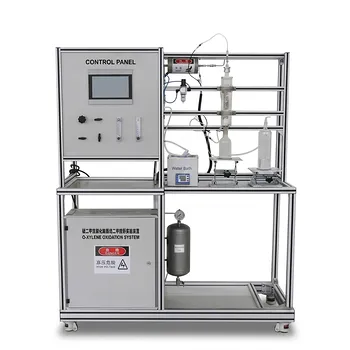
O-Xylene Oxidation to Phthalic Anhydride Educational Unit Operations Pilot Plant

O-Xylene Oxidation to Phthalic Anhydride Educational Unit Operations Pilot Plant

Explore our bench-scale educational pilot plant for o-xylene oxidation to phthalic anhydride, featuring a fixed-bed tubular reactor with visual observation, precise temperature control, and safety systems, ideal for chemical engineering hands-on training and industrial simulation, designed for university unit operations.

Constant Pressure Filtration Educational Unit Operations Pilot Plant

Constant Pressure Filtration Educational Unit Operations Pilot Plant

Hands-on educational pilot plant for constant pressure filtration. Classic plate and frame filter press allows students to study kinetics, determine specific cake resistance, perform cake washing and evaluate washing rates. Ideal for chemical engineering curriculum. Mobile, customizable, safety-compliant design.

Pressure Swing Adsorption Educational Unit Operations Pilot Plant

Pressure Swing Adsorption Educational Unit Operations Pilot Plant

Integrated bench-scale pressure swing adsorption pilot plant for hands-on teaching of gas-solid separation, mass transfer, and process optimization using nitrogen-oxygen model, featuring dual-column design, industrial touchscreen control, digital assessment suite, and customizable hardware and software configurations for educational laboratories.

Methanol Synthesis and Catalyst Performance Evaluation Educational Unit Operations Pilot Plant

Methanol Synthesis and Catalyst Performance Evaluation Educational Unit Operations Pilot Plant

Bench-scale methanol synthesis and catalyst evaluation educational pilot plant for chemical engineering labs to study catalytic kinetics, high-pressure operations, process control, and unit operations under realistic conditions with industrial safety features, precision gas delivery, data acquisition, and intelligent monitoring.

Methane Cracking Educational Unit Operations Pilot Plant

Methane Cracking Educational Unit Operations Pilot Plant

This bench-scale methane cracking educational pilot plant provides hands-on catalytic conversion training with a 1000°C furnace, seven mass flow controllers, and real-time automation for safe, curriculum-aligned experiments. Designed for university teaching of unit operations and reaction engineering.

Multi-Functional Special Distillation Educational Pilot Plant

Multi-Functional Special Distillation Educational Pilot Plant

Versatile multi-functional special distillation pilot plant for chemical engineering education. Supports continuous, vacuum, azeotropic, reactive, extractive distillation. Transparent glass columns enable real-time visual observation of hydrodynamics and separation processes.

Fixed-Bed Chemical Reaction and Gas Dust Tar Removal Unit Operations Pilot Plant

Fixed-Bed Chemical Reaction and Gas Dust Tar Removal Unit Operations Pilot Plant

Integrated educational pilot plant for studying catalytic gas-solid reactions and downstream gas purification. Features dual fixed-bed reactor, three-stage heating, and touchscreen control for hands-on engineering training. Ideal for chemical and environmental engineering curricula.

Continuous Batch Extractive Distillation Educational Pilot Plant

Continuous Batch Extractive Distillation Educational Pilot Plant

Versatile pilot plant for continuous, batch, and extractive distillation training. High-borosilicate glass column for visualizing hydraulics, 15.6-inch touchscreen with data logging, precise reflux ratio control 1-99, and durable corrosion-resistant frame. Ideal for chemical engineering education and process research.

Multi Pump Fluid Transport Process Piping Unit Operations Training Pilot Plant

Multi Pump Fluid Transport Process Piping Unit Operations Training Pilot Plant

Industrial-scale multi-pump pilot plant for unit operations training in fluid transport and process piping, featuring real-material and semi-physical simulation modes, comprehensive pump and flowmeter calibration, and safety-enhanced two-tier platform, bridging academic theory and industrial practice for chemical engineering education.

100L Continuous Loop Hydrogenation Educational Unit Operations Pilot Plant

100L Continuous Loop Hydrogenation Educational Unit Operations Pilot Plant

This 100L continuous loop hydrogenation pilot plant is designed for chemical engineering education, featuring 316 stainless steel construction, advanced gas-liquid mass transfer components, explosion-proof safety systems, and a 15.6-inch touchscreen with 5G connectivity, cloud data logging, bridging theory and industry.

Chemical Pipeline Assembly and Fluid Transport Practical Training Unit Operations Pilot Plant

Chemical Pipeline Assembly and Fluid Transport Practical Training Unit Operations Pilot Plant

Integrated skid-mounted engineering training pilot plant for university labs offers hands-on experience in chemical pipeline assembly, fluid transport, centrifugal pump operation, and pressure testing. Customizable system bridges academic theory and industrial practice with digital pre-lab resources and comprehensive tools.

Educational Unit Operations Pilot Plant for Intraparticle Diffusion Effective Factor Measurement

Educational Unit Operations Pilot Plant for Intraparticle Diffusion Effective Factor Measurement

Designed for chemical engineering university labs, this pilot plant allows hands-on determination of catalyst particle intraparticle diffusion effective factors and gas-solid reaction kinetics using a fixed-bed tubular reactor with industrial touchscreen control, bridging theory and practical reactor design.

Supercritical High-Gravity Flash Evaporation Educational Unit Operations Pilot Plant

Supercritical High-Gravity Flash Evaporation Educational Unit Operations Pilot Plant

Bench-scale integrated teaching system for advanced separation and mass transfer, combining supercritical high-gravity flash evaporation with heating, chemical reaction, and material collection, featuring modular design, Stainless Steel 316L construction, transparent visualization, touchscreen control, and safety systems for chemical engineering education.

Thermal Desorption Exhaust Gas and Tail Water Treatment Educational Pilot Plant

Thermal Desorption Exhaust Gas and Tail Water Treatment Educational Pilot Plant

Bench-scale educational pilot plant for treating thermal desorption exhaust gas and tail water integrates condensation, Fenton oxidation, precipitation, filtration, and carbon adsorption. Ideal for chemical engineering and environmental labs, teaching unit operations, process control, and real-time data analysis.

Fluidized Bed Gas Solid Catalytic Reaction Educational Pilot Plant

Fluidized Bed Gas Solid Catalytic Reaction Educational Pilot Plant

Our educational fluidized bed gas-solid catalytic reaction pilot plant is ideal for chemical engineering labs. Students study fluidization dynamics, catalyst evaluation, and process control hands-on. Features include a customizable reactor, touchscreen HMI, and safety interlocks for safe, curriculum-aligned experiments.

Centrifugal Pump Performance and Orifice Flowmeter Calibration Educational Pilot Plant

Centrifugal Pump Performance and Orifice Flowmeter Calibration Educational Pilot Plant

This versatile educational pilot plant enables engineering students to conduct centrifugal pump performance tests, orifice flowmeter calibration, and fluid mechanics experiments using a transparent flow loop, industrial HMI, and 3D virtual simulation for a comprehensive hands-on learning experience.

Natural Product Extraction Unit Operations Training Pilot Plant

Natural Product Extraction Unit Operations Training Pilot Plant

Integrated natural product extraction pilot plant for chemical engineering training bridges theory and industrial practice with modular extraction and evaporation/concentration units, hybrid touchscreen and manual control, realistic process simulation, and self-contained softened water and vacuum utilities.

Steam Methane Reforming Hydrogen Production and Purification Educational Pilot Plant

Steam Methane Reforming Hydrogen Production and Purification Educational Pilot Plant

This bench-scale educational pilot plant combines steam methane reforming with hydrogen purification, offering safe, hands-on unit operations training for university engineering laboratories. Its customizable design and high-precision monitoring enable real-time study of catalysis, phase separation, and process dynamics.

Multi-Reactor Educational Pilot Plant for Reaction Engineering Unit Operations

Multi-Reactor Educational Pilot Plant for Reaction Engineering Unit Operations

Integrated bench-scale educational pilot plant for chemical engineering teaching featuring fixed bed fluidized bed and stirred tank reactors with web-based digital twin controls and safety interlocks for hands-on unit operations and reaction engineering comparative studies in one compact system.

Solid Waste Pyrolysis and Refining Educational Pilot Plant for Unit Operations

Solid Waste Pyrolysis and Refining Educational Pilot Plant for Unit Operations

This pilot plant for solid waste pyrolysis and refining integrates pyrolysis, separation, distillation, and catalytic hydrogenation into one educational unit. It provides visual process observation, smart data logging, and industrial safety for hands-on learning of engineering unit operations.


Leave Your Message