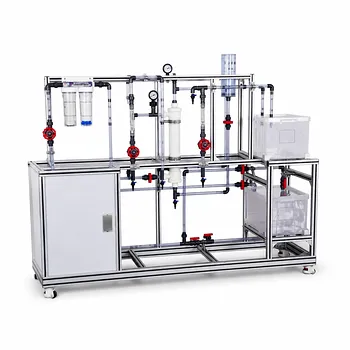
The direct answer to integrating pervaporation into an esterification pilot plant is a closed circulation loop. You connect a pervaporation membrane module to the reactor, pump the reacting liquid across a hydrophilic composite membrane (such as PVA/PES), and continuously vacuum the permeate side. This selectively removes water in situ, relentlessly pushing the reaction past its thermodynamic equilibrium limit. A classic example sees butyric acid conversion jump from 71.61% to 92.94% simply by adding this membrane loop.
By continuously stripping the byproduct water through a hydrophilic membrane, you transform a batch equilibrium-limited esterification into a near-complete conversion process. The core of the integration lies in the circulation loop, the membrane’s selectivity for water, and careful optimization of the membrane surface-area-to-volume ratio to avoid co-removing valuable alcohol reactants.
Understanding the Equilibrium Bottleneck
Why Esterification Reaches a Limit
An esterification reaction between an acid and an alcohol produces ester and water. Since both reactants and products are present in the same liquid phase, the reaction naturally settles at a thermodynamic equilibrium where forward and backward rates equal. Without intervention, you are stuck with a significant leftover of unreacted starting materials.
The Water Problem
Water is the byproduct that pulls the equilibrium back. According to Le Chatelier’s principle, removing water forces the reaction to produce more ester to re-establish the balance. Simply boiling the water away often fails because of azeotropes or similar boiling points, especially in small-scale pilot units.
How Pervaporation Selectively Removes Water
Hydrophilic Membrane Chemistry
Pervaporation uses a dense, hydrophilic composite membrane (frequently a PVA active layer on a PES support). Water molecules dissolve into the membrane and diffuse through it based on a chemical affinity gradient, not on relative volatility. The membrane acts as a selective gate, allowing water to pass while largely rejecting the ester and organic reactants.
Driving Force and Vacuum Operation
A vacuum pump or sweep gas on the permeate side creates a partial pressure difference, driving water vapor from the liquid feed to the other side. The permeated vapor is then condensed and removed. This continuous, low-temperature separation keeps the reaction mixture water-lean without applying high heat that could degrade heat-sensitive esters.
Integration into Pilot Plants: The Loop Setup
Continuous Circulation and In-Situ Separation
The integration is achieved by a continuous circulation loop. A pump draws the reacting mixture from the esterification reactor, passes it through the membrane module, and returns the retentate (water-depleted stream) back to the reactor. The water is extracted in real time, never allowing the reaction to reach equilibrium.
Membrane Module Placement
The module can be placed in a side-stream loop. This setup is especially flexible for pilot plants used in education and research, as it allows you to bypass the membrane without stopping the reaction. You can run the same experiment with and without the pervaporation loop to directly measure the conversion enhancement.
Optimizing the Surface-Area-to-Volume Ratio
The Critical Parameter for Performance
The ratio of membrane surface area to reaction volume dictates success. If the area is too small, the water removal rate lags behind the reaction’s water production rate, and the equilibrium shift is weak. If the ratio is too large, the process becomes overly aggressive: not only water but also the reacting alcohol begins to permeate, lowering yield and wasting material.
Avoiding Alcohol Loss
For reactions like the esterification of tartaric acid with ethanol to produce diethyltartrate, ethanol is small and polar enough to partially permeate the hydrophilic membrane. An overly large membrane area will pull significant amounts of ethanol through it, hurting the overall mass balance. Therefore, the membrane area must be tuned using kinetic data to maximize water removal while keeping alcohol loss within an acceptable limit.
Understanding the Trade-offs
Alcohol Co-Permeation
The same hydrophilicity that lets water through will gate-crash some alcohol molecules. This is the fundamental selectivity trade-off. A highly water-selective membrane generally offers lower flux; a high-flux membrane may let more alcohol slip through. In pilot-scale research, quantifying this loss teaches the difference between theoretical perfection and practical separation.
Membrane Stability and Fouling
At pilot scale, membranes face long-term exposure to hot organic acids and alcohols. While PVA/PES composites are designed for reasonable chemical resistance, swelling or fouling by reaction intermediates can degrade performance over time. Regular cleaning cycles and material compatibility tests are part of the integration’s learning curve.
Energy Consumption
Pervaporation consumes vacuum energy to pull water through the membrane. For a pilot plant, this is manageable, but scaling up requires a careful energy balance. The energy saved by avoiding azeotropic distillation or complex downstream purification must be weighed against the membrane+ vacuum operation costs.
Practical Benefits for Research and Education
Demonstration of Process Intensification
An integrated membrane-reactor pilot plant is a perfect platform to showcase process intensification — combining reaction and separation into one step. Students see directly how a thermodynamically limited conversion can be broken, connecting textbook principles like Le Chatelier’s principle to a tangible industrial technique.
Handling Azeotropic Mixtures
Many esterifications produce water-alcohol azeotropes that limit simple distillation. Pervaporation bypasses this entirely by using chemical affinity rather than volatility. The pilot plant becomes a tool to study how membrane technology can solve azeotrope problems without adding entrainers or expensive pressure-swing schemes.
Making the Right Choice for Your Pilot Plant Goal
How you integrate pervaporation should match your specific objective.
- If your primary focus is maximizing single-pass conversion: Optimize the membrane area for the fastest water removal possible while monitoring alcohol permeation. Aim for that 92%+ conversion benchmark seen in butyric acid esterification.
- If your primary focus is studying membrane selectivity and material stability: Use a modular system where you can swap membrane coupons, run long-duration tests, and analyze permeate composition to map the trade-off between flux, selectivity, and fouling.
- If your primary focus is an educational demonstration of equilibrium shift: A simple side-stream loop with a modest membrane area is sufficient. The real-time disappearance of the water layer or a clear jump in GC conversion after starting the pervaporation loop makes the concept unforgettable.
This integration transforms a classic dead-end batch reaction into a dynamic, forward-driven synthesis, giving you a powerful tool to teach, research, and scale advanced chemical production.
Summary Table:
| Component / Parameter | Role in Integration | Key Considerations |
|---|---|---|
| Circulation Loop | Connects reactor to membrane module | Ensures continuous, in-situ water extraction |
| Hydrophilic Membrane | Selectively permeates water (e.g., PVA/PES) | High selectivity prevents reactant alcohol loss |
| Vacuum System | Creates partial pressure driving force | Requires condensation of permeate vapor |
| Area-to-Volume Ratio | Determines water removal rate | Must be balanced to avoid alcohol co-permeation |
Bring Process Intensification to Your Lab with LABPARK
Are you looking to demonstrate advanced separation techniques like pervaporation in your curriculum or research? LABPARK designs and delivers premium Educational and Vocational Unit Operations Pilot Plants tailored for universities, research institutes, and enterprises.
Whether your focus is chemical engineering, bioprocess & biotech, or environmental & water treatment, our modular pilot units provide the flexibility and precision needed for hands-on learning and cutting-edge process development.
Maximize your research potential—contact LABPARK today to discuss your pilot plant requirements!
Related Products
- Ultrafiltration Membrane Separation Educational Pilot Plant
- Ethyl Acetate Synthesis Unit Operations Pilot Plant for Practical Training
- Multifunctional Membrane Separation Educational Pilot Plant with Ultrafiltration, Nanofiltration, Reverse Osmosis
- Multi Functional Membrane Crystallization Educational Unit Operations Pilot Plant
- Hollow Fiber Ultrafiltration Membrane Separation Educational Pilot Plant
People Also Ask
- How do PEI, PVDF, and PSU membranes compare in pilot plants? Find the best fit.
- Pervaporation vs. Vapor Permeation: Handling Suspended Solids in Membrane Pilot Plants
- Why Use a Membrane Separation Pilot Plant vs. Lab Testing? Avoid Costly Scale-Up Failures
- Isotropic vs. Anisotropic Membranes: How to Choose the Best Pilot Plant Modules
- How do membrane pilot plants demonstrate synthetic vs biological membrane advantages?