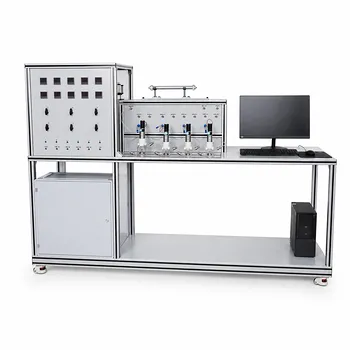
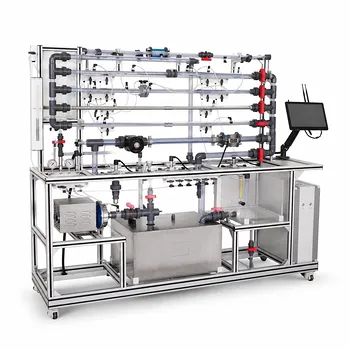
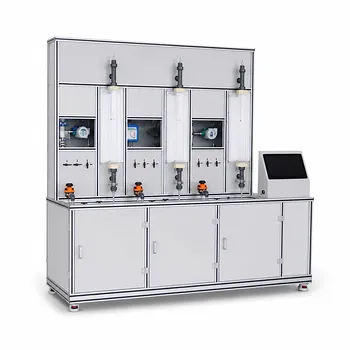
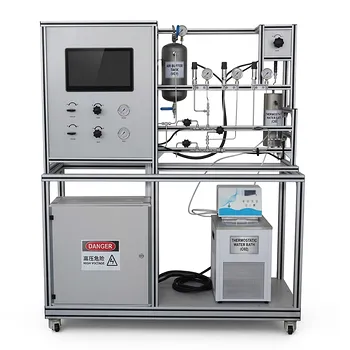
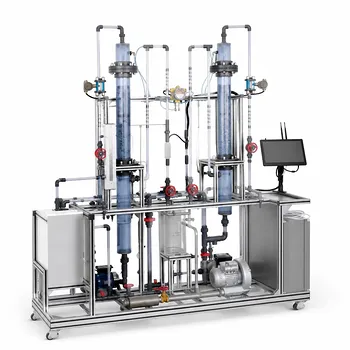
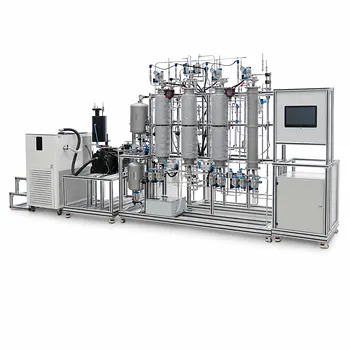
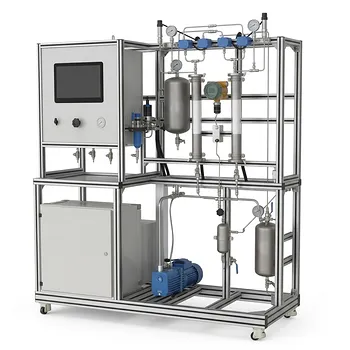
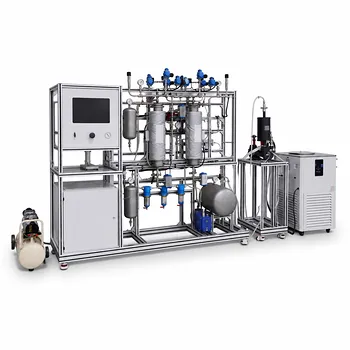
A gas-liquid pilot plant transforms an abstract textbook concept into a hands-on diagnostic exercise: students systematically vary stirrer speed or gas flow rate and observe the reaction rate’s response. If the rate climbs with agitation, mass transfer is the bottleneck; if it stays flat while temperature swings change it dramatically, chemical kinetics dominate. This real-time feedback trains engineers to decouple physical transport from intrinsic chemistry—a skill that underpins reactor design and scale‑up.
The core insight: By running the same reaction at different hydrodynamic conditions, you turn the pilot plant into a sensor for the rate‑limiting step. Pair that experiment with a few temperature‑variation runs, and you have a robust, repeatable protocol that reveals whether you need more interfacial area or more catalyst.
The Experimental Strategy
The Two‑Variable Diagnostic Protocol
The method is elegantly simple: isolate one variable at a time.
First, keep temperature, concentration, and catalyst loading constant, then vary the agitator speed (or liquid velocity in a column). A clear rise in conversion rate signals mass‑transfer control—more turbulence delivers fresh gas to the liquid.
If the rate eventually plateaus and stops responding to further agitation, you’ve entered the kinetics‑controlled regime where the chemical reaction itself is the slowest step.
Second, fix the agitation at a point on the plateau and raise the temperature. A steep increase in rate (exponential with 1/(T)) confirms kinetic control.
Together, these two sweeps give students an unmistakable mental model of how hydrodynamic and thermal knobs pull different levers inside the reactor.
Why the Pilot Plant Is the Ideal Teaching Tool
Laboratory‑scale pilot plants—packed columns, stirred tanks, falling‑film reactors—let students directly manipulate the interfacial area and mass transfer coefficient ((k_L a)).
Unlike a simple flask, these units have calibrated flow meters, variable‑speed stirrers, and precisely known geometric areas. That turns guesswork into measurement.
When students plot rate versus stirrer speed, they create a practical regime map. The slope and flattening tell them exactly where the system transitions from external‑transport limitation to intrinsic kinetics, often within a single three‑hour lab session.
Reading the Hatta Number in Real Time
For advanced courses, a falling‑film reactor provides a constant, known interfacial area.
Students can measure the disappearance of a reactant under two different film thicknesses and immediately calculate the Hatta number ((Ha)). This dimensionless group—the ratio of the maximum reaction rate in the liquid film to the maximum mass‑transfer rate—classifies the regime with a single number.
- (Ha > 3): The reaction is so fast it’s over within the film; the overall rate is mass‑transfer limited.
- (Ha < 0.3): The reaction happens mainly in the bulk liquid; the system is kinetics‑controlled.
- (Ha \approx 1): Both processes matter, and reactor choice becomes critical.
Seeing this number shift as they change liquid flow rate or temperature gives students an intuitive grasp that sticks far longer than any slide deck.
The Quantitative Toolkit: From Rate Data to Dimensionless Insight
Decoupling (k_L a) and (k_1)
In a stirred‑tank pilot plant, students can measure the overall volumetric mass‑transfer coefficient ((k_L a)) by absorbing a non‑reactive gas (e.g., oxygen in water) under identical hydrodynamic conditions.
Then, with the reactive system, they measure the apparent rate constant ((k_{obs})). From the relationship
[ \frac{1}{k_{obs}} = \frac{1}{k_L a} + \frac{1}{k_1} ]
…they see the limiting contribution directly. When (k_L a \gg k_1), agitation won’t matter; when the opposite is true, doubling the stirrer speed can nearly double the rate.
Using Packed Columns to Control Interfacial Area
In a packed‑column pilot plant, the specific wetted area is a known function of liquid and gas flow rates.
By running experiments at different packing sizes (and thus different areas), students hold all else constant and test whether rate is proportional to (a). A direct proportionality confirms mass‑transfer control. No dependence points back to kinetics.
The Falling‑Film Advantage
A falling‑film reactor is the gold standard for this teaching exercise.
Because the gas‑liquid interface is a flat, measurable rectangle, students can separate the physical mass‑transfer coefficient (k_L) from the interfacial area (a). They then calculate (Ha = \sqrt{k_1 D_A}/k_L) and see how diffusion, reaction, and hydrodynamics intertwine. This clarity exposes the boundary‑layer reaction dynamics that other reactor types blur.
Common Pitfalls in Lab‑Scale Diagnostics
The Low‑Reynolds‑Number Trap
One silent danger in small pilot plants is operation at low Reynolds numbers.
Here, the liquid‑film transport coefficient can be surprisingly insensitive to stirrer speed. A student might increase rpm from 200 to 600, see no rate change, and falsely conclude kinetics are controlling—when in reality the flow is still laminar and the mass‑transfer resistance hasn’t been challenged.
Fix: Pre‑measure the gas‑liquid mass‑transfer coefficient at each rpm with a non‑reactive tracer to confirm a real change in (k_L a) before interpreting reaction data.
Incomplete Phase Dispersion
In a stirred reactor, if the impeller speed is too low to fully suspend any solid catalyst or to disperse the gas, the effective interfacial area may hardly change with rpm.
This mimics the response of a kinetics‑controlled system, even when mass transfer truly limits the rate. Always visually verify that the gas is well dispersed and, when solids are present, that they are fully suspended.
Overlooking Temperature as a Cross‑Check
Students sometimes stop at the agitation test and label the system “mass‑transfer limited” as soon as they see a rate increase with rpm.
But a reaction can be co‑limited or still influenced by kinetics. The definitive step is the temperature ramp: if the rate’s sensitivity matches an expected activation energy (~40 kJ/mol or more), kinetics play a significant role. Teaching this dual‑check habit builds bulletproof diagnostic discipline.
Making the Right Choice for Your Lab Exercise
After students have diagnosed the regime, the pilot plant opens the door to reactor‑selection reasoning.
The insights from the Hatta number directly inform industrial choices: a very fast reaction ((Ha>3)) demands a reactor with enormous interfacial area (spray tower, packed column), while a slow reaction ((Ha<0.3)) needs liquid holdup (bubble column). Running the reaction in both a stirred tank and a falling‑film unit on the same day makes this connection unforgettable.
For instructors and students, the actionable advice is:
- If your primary focus is teaching the diagnostic method: Start with a simple stirred‑tank reactor, run the two‑variable sweep (rpm then temperature), and have the students plot the regime map manually.
- If your primary focus is illustrating dimensionless analysis: Use a falling‑film pilot plant to measure (k_L) and (Ha) directly, then discuss how reactor choice follows from that single number.
- If your primary focus is avoiding scale‑up mistakes: Show a case where low‑Re data fooled engineers into thinking a reaction was kinetics‑limited, then reveal the truth with a high‑velocity packed‑column test.
- If your primary focus is process intensification: Let students change the gas flow rate and observe how a series‑parallel reaction’s selectivity shifts when the first step becomes diffusion‑controlled, demonstrating how mass‑transfer limitations can be a tool rather than just a bottleneck.
A pilot plant, used as a diagnostic instrument, equips students with a mental framework they’ll carry into every reactor they ever design—because knowing what limits the rate is the first step to making it better.
Summary Table:
| Diagnostic Parameter | Mass-Transfer Controlled | Kinetics-Controlled |
|---|---|---|
| Agitation / Stirrer Speed | Reaction rate increases with speed | Reaction rate plateaus and remains flat |
| Temperature Ramping | Weak/minor rate dependence | Exponential rate increase (Arrhenius type) |
| Hatta Number ($Ha$) | $Ha > 3$ (reaction occurs in liquid film) | $Ha < 0.3$ (reaction occurs in bulk liquid) |
| Interfacial Area Variation | Reaction rate is proportional to area | Reaction rate is independent of area |
Bring Hands-On Reactor Design to Your Lab
Equip your students and researchers with the tools to master complex transport phenomena and reaction kinetics. LABPARK provides state-of-the-art Educational and Vocational Unit Operations Pilot Plants in chemical engineering, bioprocess & biotech, and environmental & water treatment. Tailored for universities, research institutes, and enterprises, our systems translate abstract theory into practical engineering competence.
Contact LABPARK today to explore our pilot plant solutions and request a custom quote.
Related Products
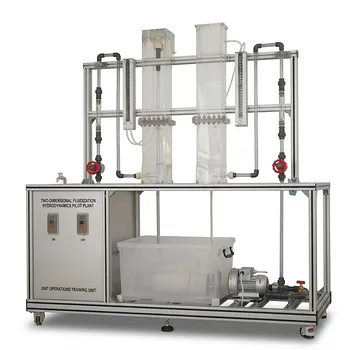
- Two-Dimensional Fluidization Hydrodynamics Educational Pilot Plant for Unit Operations Training
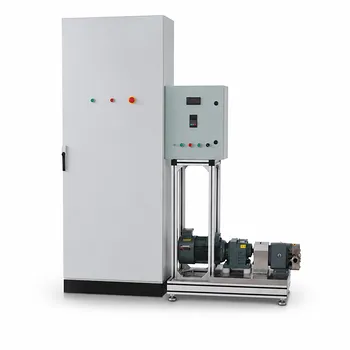
- Quantitative Dosing and Liquid Flow Control Educational Unit Operations Pilot Plant
- Educational Unit Operations Pilot Plant for Intraparticle Diffusion Effective Factor Measurement
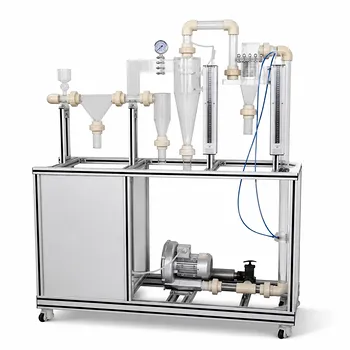
- Gas-Solid Heterogeneous Separation Demonstration Educational Unit Operations Pilot Plant
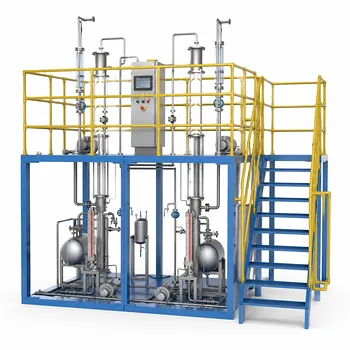
- Dual-Mode Gas Absorption and Desorption Unit Operations Training Pilot Plant
People Also Ask
- What pressure drop characteristics should students & researchers monitor in a fluidization pilot plant?
- How does active time pulsing mixing enhance fluid homogenization? Configuration Guide for Educational Pilot Plants
- How can acoustic chemometrics prevent reactor clogging in educational fluidized bed pilot plants?
- What is the operational significance of solids feed rate on emulsion phase dynamics in fluidized bed pilot plants?
- How can inline NIR & microwave sensors study fluidized bed drying dynamics? A Real-Time Guide