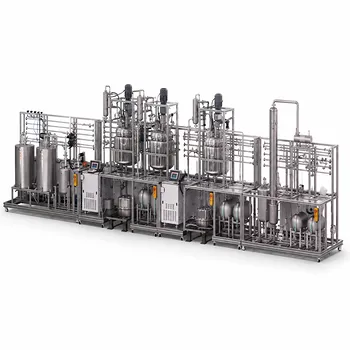
The most dangerous spark in your pilot plant is the one you cannot see coming.
Mitigating electrostatic hazards when transferring non-conductive fluids, powders, or gases requires a systematic, defense-in-depth strategy. The core foundation is establishing equipotential bonding and grounding for all metallic components—piping, flanges, vessels, and agitators—to prevent charge accumulation. This is supplemented by operational controls like inert gas purging, velocity limits, and material selection to stop a flammable atmosphere and an ignition source from ever coexisting.
While grounding forms the bedrock of electrostatic safety, a true mitigation strategy recognizes that it is a passive, single-layer defense. A static-safe pilot plant is an integrated system where the choice of solvent, pipe material, flow velocity, and atmosphere are as critical as the ground wire in preventing an arc from becoming a catastrophic fire or explosion.
The Invisible Firestarter: How Static Charge Accumulates
The threat begins at the molecular level, hidden from view during routine operations. Understanding this genesis is the first step toward effective control.
Charge Separation by Friction
Every time a liquid, powder, or gas flows through a pipe or is agitated in a vessel, frictional contact separates electrical charges. This process creates a static charge where electrons are stripped from one surface and accumulate on another, much like rubbing a balloon on fabric.
The Accumulation Problem in Non-Conductive Fluids
In conductive materials like water, these separated charges can quickly flow back together and neutralize. The real danger lies with non-conductive fluids, such as hexane, heptane, and toluene. These materials allow charge to build up to dangerous levels because the electricity cannot easily dissipate.
The Critical Threshold of 100 pS/m
Pilot plants processing slurries or pure solvents with a conductivity below 100 picoSiemens per meter (pS/m) are at high risk. In this zone, a liquid can store enough electrical potential energy to release a sudden, incendive spark directly into a flammable atmosphere, igniting fugitive vapors or gases.
Engineering a Static-Safe Pilot Plant
Controlling this invisible threat requires a layered approach, blending foundational hardware fixes with precise operational procedures.
The Foundation: Bonding and Grounding
Ensuring all conductive equipment shares the same electrical potential and has a path to earth is non-negotiable. This starts with the piping itself and extends to every connected component.
- Equipotential Bonding: Individual pipe flanges must be connected with bonding straps. This ensures that if one section becomes charged, the potential difference—which causes the spark—cannot form between sections.
- Material Integrity: Conductive equipment materials are essential. A stainless steel process line is a natural conductor that can be grounded effectively. Replacing or avoiding non-conductive materials like Teflon-lined pipes or glass vessels in high-risk areas removes an insulating barrier that allows charge to accumulate.
Controlling the Environment: Inerting and Vapor Management
A spark is only a problem if it finds a flammable atmosphere. Controlling the environment inside the equipment is a powerful complementary defense.
- Inert Gas Blanketing: Operating the system under a nitrogen atmosphere displaces oxygen, making the atmosphere inside tanks and pipes incapable of supporting combustion, even if a discharge occurs.
- Minimizing Fugitive Vapors: Following standards like NFPA 77 and API RP 2003, plant design must prioritize containing flammable vapors. A well-sealed system prevents a stray static spark outside the piping from igniting a localized vapor cloud.
Taming the Flow: Velocity and Relaxation Time
The physics of flow itself is a key control point. The goal is to generate charge at a rate slower than it can dissipate.
- Linear Velocity Control: Frictional charge generation increases with flow speed. Maintaining a low linear velocity through the recirculation loop is critical. The speed must be calibrated to prevent charge buildup while still being high enough to keep solids suspended and prevent settling.
- Appropriate Hold Times: After a fluid is pumped or agitated, it needs time for the static charge to "relax" and bleed away to ground. Designing a receiving vessel with sufficient hold time, matched to the relaxation time of the specific solvent, is a crucial passive safety measure.
Changing the Rules: Material and Solvent Conductivity
Sometimes, the most effective solution is to alter the hazardous medium itself, making it less capable of holding a charge.
- Solvent Substitution: Where your process chemistry allows, replacing a non-conductive solvent with one of higher conductivity is a direct elimination of the hazard.
- Antistatic Additives: For processes that cannot change their primary solvent, using antistatic additives can significantly increase a fluid's conductivity, safely moving it above the 100 pS/m danger zone and promoting charge dissipation.
Understanding the Trade-offs and Common Pitfalls
No single solution is without its limitations. A technically sound plan accounts for these weaknesses.
The Limits of Grounding Alone
A ground wire is your primary safety net, but it is not a cure-all. Grounding a non-conductive, flammable liquid flowing through a Teflon pipe does nothing to dissipate the charge within the fluid itself. The liquid remains charged until it enters a grounded metal vessel. This is why a combination of conductive materials and grounding is mandatory, not optional.
The Secondary Consequences of Material Substitution
Swapping glass or Teflon for conductive stainless steel solves a static problem but may introduce others. Stainless steel is not universally corrosion-resistant; in acidic environments, it can be attacked. The answer is not to abandon the safety solution, but to anticipate it—potentially integrating techniques like cathodic protection (using sacrificial anodes or impressed current) to manage corrosion in your newly-grounded, all-metal system. Operator training on these identical safety limits and protocols is the final, essential layer that ensures all systems function as designed.
Making the Right Choice for Your Pilot Plant
Your mitigation strategy must align with the specific materials and hazards you are handling. Here is how to tailor your approach:
- If your primary focus is a closed-loop recirculation of non-conductive slurry: Combine a stainless steel system with strict bonding, grounding, low linear velocities, and a nitrogen inerting blanket.
- If your primary focus is transferring a flammable, nonconductive liquid between vessels: Start with equipotential bonding of source and destination vessels, ensure all transfer piping is conductive and grounded, and verify hold times match the solvent's relaxation time.
- If your primary focus is mitigating risks in an environment with fugitive vapors: Focus first on vapor containment and area ventilation per NFPA 497, then pair it with rigorous grounding of all nearby equipment to prevent an ignition source.
A safe pilot plant is not defined by a single safety device; it is a cohesive system where every material choice, operating parameter, and emergency protocol works together to make the generation of a catastrophic spark functionally impossible.
Summary Table:
| Mitigation Strategy | Core Action | Key Benefit |
|---|---|---|
| Bonding & Grounding | Connect all metallic components (pipes, flanges, vessels) to earth | Prevents charge accumulation and potential differences |
| Velocity Control | Maintain low linear flow velocities | Reduces the rate of frictional charge generation |
| Inert Gas Blanketing | Displace oxygen inside vessels using nitrogen | Eliminates the flammable atmosphere needed for combustion |
| Conductivity Enhancement | Use antistatic additives to keep conductivity >100 pS/m | Promotes safe, rapid charge dissipation to ground |
Build a Safe & Reliable Pilot Plant with LABPARK
Process safety starts with the right equipment design. LABPARK provides premium Educational and Vocational Unit Operations Pilot Plants in chemical engineering, bioprocess & biotech, and environmental & water treatment. Tailored for universities, research institutes, and enterprises, our pilot plants are engineered with rigorous safety and control standards to mitigate electrostatic and operational hazards.
Ready to elevate your research or training facility? Contact LABPARK today to discuss your project requirements with our technical specialists!
Related Products
- Fixed Bed Gas Solid Catalytic Reaction Educational Pilot Plant
- Multi Pump Fluid Transport Process Piping Unit Operations Training Pilot Plant
- Carbon Dioxide Hydrogen Methanol Synthesis Educational Unit Operations Pilot Plant
- Ethyl Acetate Synthesis Unit Operations Pilot Plant for Practical Training
- Natural Product Extraction Unit Operations Training Pilot Plant
People Also Ask
- How do reactor pilot plants safely study gas-solid reactions? Master kinetics with thermal & flow control.
- How does the Mears criterion evaluate transport resistance? Key Guide to Intrinsic Kinetics
- Why is a multibed configuration necessary for exothermic reactions? Optimize your pilot plant trajectory.
- Fluidized vs. Fixed Bed Reactors: Comparing Heat & Complexity in Pilot Plants
- How is the friction factor determined for fixed-bed pilot plants? Select the best pressure drop correlation.